
Supermicro SYS-1019D-FRN8TP SuperServer
Computer Hardware > Server > Barebone-Servers
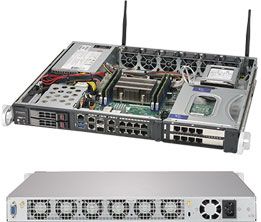
Supermicro SYS-1019D-FRN8TP SuperServer
| Lieske Part No. | 2517396 |
|---|---|
| Mfg Part No | SYS-1019D-FRN8TP |
| EAN-Code | |
| Manufacturer | Supermicro |
| Here only | 1.937,98 EUR
2.306,20 EUR incl. VAT
|
Further information for Supermicro SYS-1019D-FRN8TP SuperServer
| General | |
| Processor | Intel Xeon D-2146NT |
| Cores | 8 |
| Threads | 16 |
| Clock frequency | 2.3 GHz |
| Thermal Power Consumption | 80 W |
| Memory | up to 512 GB ECC LRDIMM or up to 256 GB reg. ECC RDIMM |
| Memory standard | DDR4-2133 MHz |
| DIMM slots | 4 |
| PCI-E slots | 1 x PCI-E 3.0 x16, 1 x Mini PCI-E x1 |
| M.2 slots | 1 x M-Key, 1 x B-Key |
| M.2 M-key capacity | 2242/2280 |
| M.2 B-key capacity | 22424 |
| Network connections | 1 x 1GbE, 2 x 10GBase-T, 2 x 10G SFP+, 1 x IPMI LAN |
| USB | USB 3.0 |
| VGA | 1 (front) |
| Current supply | 400W Redundant Platinum Level |
| Technology | Intel Quick Assist Technology |
| Form factor | Mini-ITX |
Applications
The server is suitable for applications requiring high network bandwidth and simultaneous storage integration in a compact housing. Typical use cases include network edge servers, virtualisation platforms, security solutions, small data centres, or as a basis for NAS and SAN systems. The combination of integrated network connections and M.2 slots makes it particularly suitable for users requiring fast data processing and transfer.
Functions and Equipment in Detail
The SYS-1019D-FRN8TP supports up to 512 GB ECC LRDIMM or up to 256 GB registered ECC RDIMM modules in the DDR4-2133 MHz standard, distributed across four DIMM slots. This memory configuration ensures high bandwidth and reliability for critical applications. The integrated Intel Quick Assist Technology (QAT) supports accelerated encryption and compression functions, which is particularly beneficial for applications with high data traffic.
Technology Explained Simply
The platform features a PCI-Express 3.0 x16 slot and a Mini PCI-E x1 slot, which can be used for installing additional network or storage adapters. For storage media, two M.2 slots are available: an M-Key slot for storage solutions with a maximum capacity of 2242/2280, and a B-Key slot for SSDs or WAN modules with a maximum capacity of 22424. The integrated network infrastructure includes two 10GBase-T ports, two 10G SFP+ ports, and a dedicated IPMI-LAN port for remote maintenance and monitoring. Additionally, a 1-Gbit-Ethernet port is available. Power supply is provided by two redundant 400-watt power supplies of Platinum class, ensuring high efficiency and reliability.
Compatibility and Accessories
The server is designed for use with standard 2.5-inch hard drives, supporting up to four such drives. The M.2 slots enable integration of SSDs or special network modules. The network connections are designed for use in modern high-speed networks, with the 10G ports operable via copper cables (Base-T) or optical SFP+ modules. The IPMI functionality enables remote maintenance over a separate network, independent of main network traffic.
Mounting and Installation
The Mini-ITX format housing has a width of 437 mm, a height of 43 mm, and a depth of 429 mm. The compact design allows flexible mounting in standard 19-inch racks or compact installation solutions. Installation requires mounting the processor unit, memory, storage media, and network components. The power supply is already integrated into the housing and configured redundantly.
Advantages in Operation
The server offers high performance density in a small footprint. The redundant power supply increases availability, while the integrated IPMI function simplifies remote maintenance and monitoring. Support for ECC memory enhances data security, and QAT technology accelerates cryptographic and compression processes. The combination of integrated network connections and storage options reduces the need for additional hardware and lowers system complexity.

This is an offer of:
79279 Vörstetten
https://industry-electronics.com
Tel. 07666/88499-0
Fax. 07666/88499-111
Diesen Artikel finden Sie unter:
industry-electronics.com/artikel/2517396

Lieske Elektronik e.K.
Reutener Str. 1079279 Vörstetten
https://industry-electronics.com
Tel. 07666/88499-0
Fax. 07666/88499-111
Diesen Artikel finden Sie unter:
industry-electronics.com/artikel/2517396