
Supermicro SYS-1019D-16C-FRN5TP SuperServer
Computer Hardware > Server > Barebone-Servers
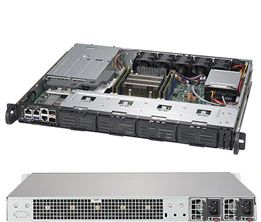
Supermicro SYS-1019D-16C-FRN5TP SuperServer
| Lieske Part No. | 2517389 |
|---|---|
| Mfg Part No | SYS-1019D-16C-FRN5TP |
| EAN-Code | |
| Manufacturer | Supermicro |
| Here only | 3.624,80 EUR
4.313,51 EUR incl. VAT
|
Further information for Supermicro SYS-1019D-16C-FRN5TP SuperServer
| General | |
| Processor | Intel® Xeon® D-2183IT |
| Cores | 16 |
| Threads | 32 |
| Clock frequency | 2,2 GHz |
| Thermal power | 100 W |
| Memory | up to 512 GB ECC LRDIMM |
| Memory bus | DDR4-2400 MHz |
| DIMM slots | 4 |
| PCI-E slots | 4 x8 PCI-E 3.0 |
| M.2 slots | 2 M-Keys 2242/80/110, 1 B-Key 3042, 1 E-Key 2230 |
| M.2 interface | PCI-E 3.0 x4/SATA |
| 2.5-inch drives | 2 |
| E1.S modules | 2 |
| E1.S operating temperature | 40 °C |
| Network | 2x 10GbE (shared with IPMI) |
| USB ports | 2x USB 3.0 |
| VGA connector | 1 |
| COM port | 1 via RJ45 or Micro USB |
| Power adaptor | 400W redundant |
| Power supply efficiency | Platinum Level |
| Form factor | 1U rackmount |
Applications
The server is suitable for environments requiring a compact form factor with high performance density. The 1U form factor enclosure design enables dense mounting in standard 19-inch racks. Due to integrated network functions, including multiple 10-Gigabit Ethernet ports, it is particularly suitable for network and storage infrastructures. Support for E1.S modules (at an ambient temperature of up to 40 °C) extends its application possibilities in scenarios with high I/O requirements.
Features and Equipment in Detail
The server features four DIMM slots supporting up to 512 GB ECC LRDIMM or up to 256 GB registered ECC RDIMM modules with DDR4-2400 MHz. This memory configuration enables high bandwidth and reliability for demanding workloads. Integrated graphics are provided via a VGA port, supplemented by two USB 3.0 ports and a serial COM port available via RJ45 or Micro USB. Network connectivity is provided via two 10GbE ports (shared with IPMI), two 10G SFP+ ports, and a separate Ethernet management port.
Technology Explained Simply
The processor architecture with 16 cores and 32 threads enables parallel processing of multiple tasks, which is particularly beneficial for virtualised environments or database applications. DDR4-2400 MHz memory support ensures sufficient bandwidth for modern applications. The four PCI-E 3.0 x8 slots offer sufficient connectivity options for additional network or storage controllers, with the option to use AIOM (Adapter-in-One Modules). The M.2 slots (two M-Keys 2242/80/110, one B-Key 3042, one E-Key 2230) support various storage formats, with M.2 placement shared with a 2.5-inch drive. E1.S modules allow flexible, modular storage expansion, but only at an ambient temperature of 40 °C.
Compatibility and Accessories
The server is equipped with two redundant 400-Watt power supplies at Platinum level, ensuring high energy efficiency and reliability. Network connectivity via 10GbE and SFP+ enables integration into high-speed networks. Support for AIOM modules enhances flexibility in selecting network adapters. The M.2 and 2.5-inch drive bays offer options for storage expansion with SSDs or HDDs, with placement partially overlapping with the M.2 slots.
Mounting and Installation
The server is designed as a 1U rackmount system and fits into standard 19-inch racks. Dimensions are a height of 1.7 inches (43 mm), width of 17.2 inches (437 mm), and depth of 15 inches (381 mm). Mounting is done via integrated rack rails ensuring secure fixation. Installation requires mounting into a rack and connecting network cables and power supply. Integrated management and diagnostic functions (IPMI) facilitate remote maintenance.
Operational Advantages
The server offers high performance density in a compact format, optimising usage in racks with limited space. Redundant power supply and energy efficiency at Platinum level reduce operating costs and increase availability. The flexible memory and network architecture allows adaptation to different requirements. Support for E1.S modules (at 40 °C ambient temperature) extends application possibilities in specific use cases.

This is an offer of:
79279 Vörstetten
https://industry-electronics.com
Tel. 07666/88499-0
Fax. 07666/88499-111
Diesen Artikel finden Sie unter:
industry-electronics.com/artikel/2517389

Lieske Elektronik e.K.
Reutener Str. 1079279 Vörstetten
https://industry-electronics.com
Tel. 07666/88499-0
Fax. 07666/88499-111
Diesen Artikel finden Sie unter:
industry-electronics.com/artikel/2517389