
Supermicro SYS-1018GR-T SuperServer black
Computer Hardware > Server > Barebone-Servers
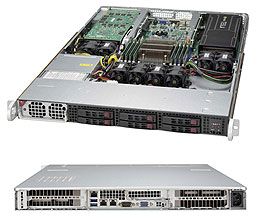
Supermicro SYS-1018GR-T SuperServer black
| Lieske Part No. | 2517379 |
|---|---|
| Mfg Part No | SYS-1018GR-T |
| EAN-Code | 0672042169689 |
| Manufacturer | Supermicro |
| Here only | 1.327,12 EUR
1.579,27 EUR incl. VAT
|
Further information for Supermicro SYS-1018GR-T SuperServer black
| General | |
| Processor socket | LGA 2011 |
| Supported processors | Intel® Xeon® E5-2600v4 / v3, E5-1600v4 / v3 |
| Memory card slots | 8 DIMM slots |
| Memory type | ECC 3DS LRDIMM |
| Memory frequency | 2400 MHz |
| PCIe slots | 2 x 16, 1 x 8 (low-profile) |
| Network controller | Intel® i350 Dual-Port GbE |
| IPMI | 2.0 with KVM and dedicated LAN |
| Drive bays | 6 Hot-Swap 2.5 inch |
| Current supply | 1400 W |
| Efficiency | Platinum Level (94%+) |
| Cooling | 8x Counter-rotating Fans |
| Housing format | 1U |
Applications
The server is designed for professional IT environments where high availability, scalability, and energy efficiency are required. It is typically used in data centres, corporate IT infrastructures, or small to medium-sized server rooms. The combination of compact design, high memory capacity, and expandable PCIe slots makes it particularly suitable for applications such as cloud computing, databases, web servers, and high-performance computing.
Functions and Equipment in Detail
The SYS-1018GR-T offers eight DIMM slots, which can be populated with up to 1 TB ECC 3DS LRDIMM RAM. The supported memory frequency is up to DDR4- 2400 MHz, enabling fast data transfer between CPU and memory. The use of ECC memory ensures higher data integrity, as memory errors can be detected and corrected — a key advantage for critical applications. Integrated IPMI 2.0 technology enables remote management via KVM (Keyboard, Video, Mouse) and a dedicated network connection, allowing system administration even when the server is powered off.
Technology Explained Simply
The server features two PCIe 3.0 x16 slots, suitable for graphics cards such as NVIDIA GPUs or Xeon Phi coprocessors. This expands the application possibilities in areas such as machine learning, scientific computing, or graphics-intensive applications. An additional PCIe 3.0 x8 slot in low-profile design offers further expansion options. The power supply has a capacity of 1400 watts and meets the Platinum level of the 80 PLUS certification (minimum 94% efficiency), ensuring high energy efficiency and low operating costs. The Digital Switching Control technology and PMBus 1.2 standard enable precise control of the power supply and optimised load distribution.
Compatibility and Accessories
The server is equipped with six hot-swap 2.5-inch drive bays, allowing easy replacement of hard drives or SSDs without shutting down the system. This increases availability and simplifies maintenance tasks. The integrated Intel® i350 Dual-Port GbE network controller technology provides two Gigabit Ethernet ports, suitable for redundant network connections or operation in high-bandwidth networks. Combined with IPMI 2.0, it enables secure remote management and monitoring of the system.
Mounting and Installation
The server is designed as a 1U housing, with a height of 1.7 inches (43 mm), a width of 17.2 inches (437 mm), and a depth of 28.5 inches (724 mm). These dimensions comply with the standard for rack installations. Mounting is typically done in a 19-inch rack, with designated mounting points and fastening elements ensuring secure installation. The eight counter-rotating fans ensure optimal cooling and support intelligent speed control to adjust airflow according to load conditions.
Advantages in Operation
Operation of the server is characterised by high energy efficiency, low maintenance requirements, and high availability. The hot-swap drives and remote management functions via IPMI 2.0 reduce downtime. Support for modern processors and memory standards enables future-proof equipment that can adapt to growing requirements. The integrated network control and high memory capacity make the server a powerful foundation for various IT infrastructures.

This is an offer of:
79279 Vörstetten
https://industry-electronics.com
Tel. 07666/88499-0
Fax. 07666/88499-111
Diesen Artikel finden Sie unter:
industry-electronics.com/artikel/2517379

Lieske Elektronik e.K.
Reutener Str. 1079279 Vörstetten
https://industry-electronics.com
Tel. 07666/88499-0
Fax. 07666/88499-111
Diesen Artikel finden Sie unter:
industry-electronics.com/artikel/2517379