
Supermicro SSG-6048R-E1CR36L SuperStorage Server
Computer Hardware > Server > Barebone-Servers
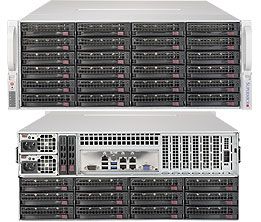
Supermicro SSG-6048R-E1CR36L SuperStorage Server
| Lieske Part No. | 2517891 |
|---|---|
| Mfg Part No | SSG-6048R-E1CR36L |
| EAN-Code | 0672042174966 |
| Manufacturer | Supermicro |
| Here only | 3.363,09 EUR
4.002,08 EUR incl. VAT
|
Further information for Supermicro SSG-6048R-E1CR36L SuperStorage Server
| General | |
| Socket | LGA 2011 |
| Supported processors | Intel Xeon E5-2600v4, E5-2600v3 |
| QPI | 9,6 GT/s |
| Main memory | up to 2 TB |
| Memory type | ECC 3DS LRDIMM |
| Memory bus | DDR4- 2400 MHz |
| DIMM slots | 16 |
| PCIe slots | 1x x16, 6x x8 |
| LAN | Dual 10GBase-T |
| LAN chipset | Intel X54036x |
| Hard drive bays | 32x 3.5 inch hot-swap (24 front, 12 rear) |
| NVMe bays | 4x Hybrid (SAS3/SATA3/NVMe) |
| 2.5-inch drive tray | 2x Hot-Swap (rear), 4x internal |
| SAS controller | LSI 3008 |
| SAS Mode | IT mode |
| Remote administration | IPMI 2.0, KVM over LAN, Media over LAN |
| Cooling | 7x 80 mm mid fans |
| Current supply | 1280 W redundant |
| Efficiency class | Platinum Level (94 %) |
| Form factor | 4U Rackmount |
Applications
This server is particularly suitable for storage solutions, database applications, virtualisation environments, and backup and archiving systems. The high number of hard drive bays and support for SAS3/SATA3 as well as NVMe technology make it an appropriate platform for storage clusters and high-availability environments. Integrated remote management via IPMI 2.0 enables central monitoring and control even from a distance.
Functions and Features in Detail
The SSG-6048R-E1CR36L offers up to 2 TB ECC 3DS LRDIMM memory with support for DDR4- 2400 MHz. The 16 DIMM slots allow flexible scaling of memory capacity. The platform features 32 hot-swap 3.5-inch drive bays (24 front, 12 rear), where drives can be connected via SAS3 or SATA3. Additionally, 4 hybrid bays for NVMe SSDs are available, supporting a combination of SAS3, SATA3, and NVMe technology. For additional storage options, 2 hot-swap 2.5-inch bays (rear) and 4 internal 2.5-inch drive bays are provided.
Technology Explained Simply
The memory architecture is based on DDR4 technology with a maximum clock rate of 2400 MHz, ensuring high bandwidth for system memory. ECC technology (Error-Correcting Code) ensures high data integrity by detecting and correcting errors in memory. The 3DS-LRDIMM modules (Load-Reduced DIMM) enable higher memory density and improve stability at high memory capacities. SAS3 technology (Serial Attached SCSI) offers high data transfer rates and is optimised for use in professional storage solutions. The integrated LSI 3008 SAS controller technology operates in IT mode, enabling direct drive control by the CPU and reducing latency.
Compatibility and Accessories
The server is equipped with a dual 10GBase-T LAN module based on Intel X54036x, ensuring high network bandwidth for data transfer. The PCIe slots include 1x PCIe 3.0 x16 and 6x PCIe 3.0 x8, with the first two slots occupied by the controller and the JBOD expansion port. Remote management is performed via IPMI 2.0 with support for KVM over LAN and Media over LAN, enabling remote maintenance and monitoring. The integrated cooling consists of 7x 80-mm mid-fans, ensuring even airflow within the enclosure.
Mounting and Installation
The server is designed in 4U rackmount format, with dimensions of 178 mm (height), 437 mm (width), and 699 mm (depth). Mounting is done in standard 19-inch racks. The hot-swap drive bays allow easy replacement of drives without system disassembly. The redundant power supply with 1280 W power output and Platinum efficiency class (94 %) ensures reliable power delivery and minimises energy consumption.
Operational Advantages
The combination of high memory capacity, fast network connection, and redundant power supplies makes the server a robust solution for critical applications. Remote management via IPMI 2.0 enables efficient system monitoring and maintenance. Support for NVMe SSDs in hybrid bays provides additional performance resources for applications requiring fast access times. The high number of drive bays and configuration flexibility allow custom adaptation to specific requirements.

This is an offer of:
79279 Vörstetten
https://industry-electronics.com
Tel. 07666/88499-0
Fax. 07666/88499-111
Diesen Artikel finden Sie unter:
industry-electronics.com/artikel/2517891

Lieske Elektronik e.K.
Reutener Str. 1079279 Vörstetten
https://industry-electronics.com
Tel. 07666/88499-0
Fax. 07666/88499-111
Diesen Artikel finden Sie unter:
industry-electronics.com/artikel/2517891