
Supermicro SSG-2028R-DE2CR24L SuperStorage Server 2028R-DE2CR24L
Computer Hardware > Server > Barebone-Servers
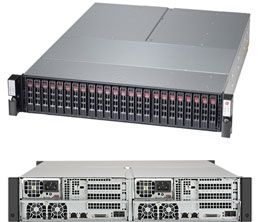
Supermicro SSG-2028R-DE2CR24L SuperStorage Server 2028R-DE2CR24L
| Lieske Part No. | 2517523 |
|---|---|
| Mfg Part No | SSG-2028R-DE2CR24L |
| EAN-Code | 0672042187270 |
| Manufacturer | Supermicro |
| Here only | 4.695,61 EUR
5.587,78 EUR incl. VAT
|
Further information for Supermicro SSG-2028R-DE2CR24L SuperStorage Server 2028R-DE2CR24L
| General | |
| Form factor | 2U Rackmount |
| CPU socket | LGA 2011 |
| Supported processors | Intel Xeon E5-2600v4/ v3 |
| QPI speed | 9,6 GT/s |
| Type of memory | ECC 3DS LRDIMM |
| Max. storage capacity per node | 1 TB |
| Memory frequency | DDR4-2400 MHz |
| DIMM slots per node | 8 |
| PCI-E slots per node | 3 x8 Low-Profile |
| Network connections per node | Dual 10GBase-T LAN |
| Network controller | Intel X540 |
| Node-to-node connection | PCI-E 3.0 x8 and IPMI |
| Private Ethernet connection | 100 Mb |
| Drive bays | 24 2.5" Hot-Swap |
| SAS technology | SAS3 |
| SAS controller | Broadcom 3008 |
| Remote management | IPMI 2.0 |
| Cooling system | 8x 4cm PWM counter rotating cooling fans |
| Current supply | Redundant |
| Efficiency class | Titanium Level (96%) |
| Weight total | 67 lbs (30.4 kg) |
| KVM over LAN | |
| Media over LAN | |
Applications
This server is particularly suitable for storage solutions (storage systems), virtualisation environments, and high-performance computing applications, where multiple independent systems are to be operated in a compact rack format. The ability to replace individual Nodes without affecting the entire system makes it a robust solution for critical applications. The integrated SAS3 technology with 24 shared 2.5-inch hot-swap drive bays enables a flexible and scalable storage architecture.
Features and Specifications in Detail
Each Node provides eight DIMM slots for ECC 3DS LRDIMM modules with a maximum capacity of 1 TB per Node. The supported memory frequency is up to DDR4-2400 MHz, ensuring sufficient bandwidth for demanding workloads. The memory modules are designed for use in server environments with high reliability. For expansion, three PCI-E 3.0 x8 low-profile slots are available per Node, suitable for network cards, storage controllers, or other peripheral devices.
Technology Explained Simply
The two Nodes are interconnected via a dedicated link supporting both PCI-E 3.0 x8 and IPMI (Intelligent Platform Management Interface). This connection enables a robust failover mechanism, allowing operation to switch to the second Node in case of failure, without interrupting the application. Network connectivity is provided via Dual 10GBase-T LAN with Intel X540 network controllers per Node, ensuring high network bandwidth and redundant connections. Additionally, a private 100 Mbit/s Ethernet connection between the Nodes is available for internal communication and management purposes.
Compatibility and Accessories
The storage platform is based on SAS3 with support for SES2 (SCSI Enclosure Services 2), enabling management of drive enclosures and their status via the management interface. The drives are controlled by a Broadcom 3008 controller, designed for high I/O performance and reliability in server environments. Remote management is performed via IPMI 2.0, providing features such as KVM over LAN (Keyboard, Video, Mouse over network) and Media over LAN (access to media over network). These features enable remote maintenance and monitoring of the server without physical access.
Mounting and Installation
The server is designed as a 2U rack-mount unit with dimensions of 437 mm (width), 89 mm (height), and 641 mm (depth). Mounting is done in standard 19-inch racks. Cooling is provided by eight 4 cm PWM-controlled fans arranged in a counter-rotating configuration, ensuring efficient airflow and uniform cooling of components. Power supply is provided by redundant power supplies with Titanium-level efficiency (96 %), offering high energy efficiency and reliability.
Operational Advantages
The modular architecture with two independent Nodes enables high availability and maintainability. Individual Nodes can be replaced during maintenance or in case of failure without affecting the other Node. Integrated remote management via IPMI 2.0, along with redundant network and power supply, enhances operational safety. Support for ECC memory and SAS3 technology ensures high data integrity and performance in storage and network workloads.

This is an offer of:
79279 Vörstetten
https://industry-electronics.com
Tel. 07666/88499-0
Fax. 07666/88499-111
Diesen Artikel finden Sie unter:
industry-electronics.com/artikel/2517523

Lieske Elektronik e.K.
Reutener Str. 1079279 Vörstetten
https://industry-electronics.com
Tel. 07666/88499-0
Fax. 07666/88499-111
Diesen Artikel finden Sie unter:
industry-electronics.com/artikel/2517523