
Supermicro CSE-825TQC-R1K03LPB server enclosure 2HE
19 Inch-Technology > Server Chassis > Chassis 2U
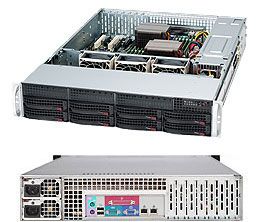
Supermicro CSE-825TQC-R1K03LPB server enclosure 2HE
| Lieske Part No. | 1150348 |
|---|---|
| Mfg Part No | CSE-825TQC-R1K03LPB |
| EAN-Code | 0672042269303 |
| Manufacturer | Supermicro |
| Here only | 863,67 EUR
1.027,77 EUR incl. VAT
|
Further information for Supermicro CSE-825TQC-R1K03LPB server enclosure 2HE
| General | |
| Construction type | 2U |
| Hard drive bays | 8x Hot-swap 3,5 inch + 2x Fixed 3,5 inch |
| Hard drive support | SAS3 (12 Gbps), SATA |
| Power supplies | Redundant |
| Power supply efficiency | Titanium Level (96%) |
| PCI expansion slots | 7 Low-profile |
| Cooling | Adjustable Air Shroud |
| Displays | 6 LED indicators |
| Motherboard format | EE-ATX |
Applications
This housing is suitable for server applications requiring high storage density and a robust, maintenance-friendly architecture. Typical use cases include file servers, backup systems, virtualisation platforms, or database servers, where availability and rapid replacement of storage media are important. The Hot-swap functions reduce downtime, as drives can be replaced without rebooting the system.
Functions and Equipment in Detail
The housing features seven Low-profile PCI expansion slots, enabling integration of additional network or storage controller cards. Cooling is supported by an Adjustable Air Shroud with an improved fan design, ensuring efficient air circulation and maintaining stable internal temperatures. On the front panel, there is a Power button, a Power switch, and six LED indicators displaying the system's operational status, such as network activity, system status, or error conditions.
Technology Explained Simply
The integrated redundant power supplies of Titanium class (efficiency 96%) ensure reliable power supply and minimise energy losses. Redundancy means that in the event of a power supply failure, the second unit takes over operation without interruption, increasing system availability. The high efficiency class Titanium is particularly relevant for energy-efficient data centres, as it reduces power consumption and operating costs. The housing dimensions are 89 mm (height), 437 mm (width), and 647 mm (depth), matching the standard for 2U housings. The total weight is 23.6 kg.
Compatibility and Accessories
The housing is designed for EE-ATX motherboards, ensuring broad compatibility with standard server motherboards. The Hot-swap bays are designed for SAS3 and SATA drives, with SATA support also including older hard drive models. The Low-profile PCI slots allow installation of cards with low profile height, typical for rack servers. The use of redundant power supplies requires a corresponding power supply with at least two independent power sources to fully utilise redundancy.
Mounting and Installation
Installation is performed in a 19-inch rack. The housing is inserted into the rack using mounting rails or integrated rack holes and secured with screws. The front panels of the Hot-swap bays are easily accessible, allowing drives to be replaced without tools. Cooling is supported by the airflow of the Air Shroud, with fan positioning ensuring even cooling of components. The LED indicators on the front panel facilitate diagnosis of operational states during installation and in ongoing operation.
Advantages in Operation
The combination of Hot-swap hard drives, redundant power supplies, and efficient cooling ensures high system availability and ease of maintenance. The high storage capacity in a compact form factor makes the housing an efficient solution for storage and server applications. The Titanium power supplies reduce energy consumption and contribute to sustainable operation. The clear display of operational states via LED indicators supports rapid fault diagnosis and maintenance.

This is an offer of:
79279 Vörstetten
https://industry-electronics.com
Tel. 07666/88499-0
Fax. 07666/88499-111
Diesen Artikel finden Sie unter:
industry-electronics.com/artikel/1150348

Lieske Elektronik e.K.
Reutener Str. 1079279 Vörstetten
https://industry-electronics.com
Tel. 07666/88499-0
Fax. 07666/88499-111
Diesen Artikel finden Sie unter:
industry-electronics.com/artikel/1150348