
Supermicro AS-3015MR-H8TNR barebone MicroCloud 3U single socket AM5
Computer Hardware > Server > Barebone-Servers
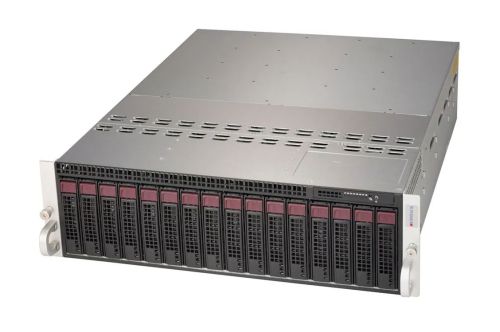
Supermicro AS-3015MR-H8TNR barebone MicroCloud 3U single socket AM5
| Lieske Part No. | 2487315 |
|---|---|
| Mfg Part No | AS-3015MR-H8TNR |
| EAN-Code | 0672042891412 |
| Manufacturer | Supermicro |
| Here only | 5.926,39 EUR
7.052,40 EUR incl. VAT
|
Further information for Supermicro AS-3015MR-H8TNR barebone MicroCloud 3U single socket AM5
| General | |
| CPU socket | 1 (UP) |
| CPU socket type | LGA-1718 |
| DRAM slots | 4 |
| DRAM type | DDR5 |
| HE | 3U |
| Power supplies | 2 |
| Onboard LAN | 25Gbit/s |
| Processor | AMD EPYC(TM) 4004 Series |
| Memory frequency | 5200 MHz |
| Memory maximum value | 192 GB |
| Type of memory | ECC/non ECC UDIMM |
| Current supply | 2200 W |
| Power supply efficiency | 80+ Titanium Level |
| Form factor | 3U Rackmount |
| PCIe slots | 8 x PCIe 5.0 x8 (in x16 slot) + 8 x Micro-LP |
| Front drives | 2x NVMe U.2 / SAS / SATA3 per node |
| Number of nodes | 16 in 3HE |
| Onboard graphics | |
Applications
This server is suitable for applications in cloud infrastructure, virtualization, data processing, and high-availability environments. The configuration with 16 nodes in 3HE enables dense deployment of computing resources in limited rack space. The integrated I/O control via the AMD Knoll Controller Hub supports flexible network configuration and enables the use of PCIe 5.0 slots for expanded peripheral devices.
Features and Equipment in Detail
The system provides four DIMM slots for DDR5 memory, supporting a maximum capacity of up to 192GB ECC or non-ECC UDIMM memory. The memory frequency is 5200MHz, ensuring high bandwidth for data-intensive applications. The memory architecture is optimized for single-processor operation, enabling efficient use of memory resources. Additionally, there are eight PCIe 5.0 x8 slots (in x16 slots) and eight Micro-LP slots (MicroLP upgradable), allowing flexible expansion with network or storage controller cards.
Technology Explained Simply
The integrated I/O control via the AMD Knoll Controller Hub enables centralized management of input/output operations, enhancing system stability and performance. Support for PCIe 5.0 provides a data transfer rate of up to 32 GT/s per lane, ensuring fast data access and low latency. The DDR5 memory architecture enables higher bandwidth and energy efficiency compared to previous generations. The redundant power supply with 80+ Titanium Level certification ensures an efficiency rating of over 94%, reducing operating costs and increasing system availability.
Compatibility and Accessories
The server is designed for use with AMD EPYC(TM) 4004 Series processors and supports installation of up to two front-mounted NVMe U.2, SAS, or SATA3 drives per node. Optional kits allow customization of memory and drive configurations to meet specific requirements. The integrated network interface provides a 25Gbit/s onboard LAN connection, suitable for fast data transfers in modern network infrastructures. The Micro-LP slots are designed for future expansions and can be upgraded with compatible modules.
Mounting and Installation
The system is designed in 3U rackmount format, with a height of 132 mm, width of 438 mm, and depth of 589 mm. Mounting is performed in standard 19-inch racks, with predefined placement of nodes and components enabling easy installation and maintenance. The redundant power supply and modular design facilitate integration into existing infrastructures.
Operational Advantages
The Supermicro AS-3015MR-H8TNR offers high system availability through redundant power supply and modular expandability. The use of DDR5 memory and PCIe 5.0 slots ensures high performance for demanding applications. The 25Gbit/s onboard LAN connection supports fast network connections, while the AMD Knoll control enables efficient I/O management. The dense node arrangement in 3HE maximizes computing power per rack space, improving infrastructure efficiency.

This is an offer of:
79279 Vörstetten
https://industry-electronics.com
Tel. 07666/88499-0
Fax. 07666/88499-111
Diesen Artikel finden Sie unter:
industry-electronics.com/artikel/2487315

Lieske Elektronik e.K.
Reutener Str. 1079279 Vörstetten
https://industry-electronics.com
Tel. 07666/88499-0
Fax. 07666/88499-111
Diesen Artikel finden Sie unter:
industry-electronics.com/artikel/2487315