
Supermicro AS-3015A-I A+ Server
Computer Hardware > Server > Barebone-Servers
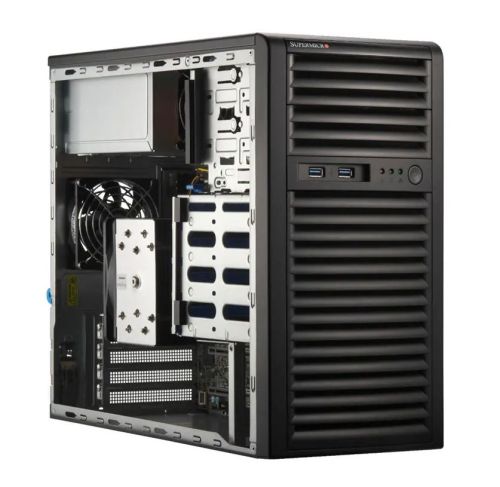
Supermicro AS-3015A-I A+ Server
| Lieske Part No. | 2517650 |
|---|---|
| Mfg Part No | AS-3015A-I |
| EAN-Code | |
| Manufacturer | Supermicro |
| Here only | 792,62 EUR
943,22 EUR incl. VAT
|
Further information for Supermicro AS-3015A-I A+ Server
| General | |
| Processor | AMD EPYC(TM) 4004 Series |
| CPU socket | 1 (UP) |
| CPU socket type | onboard |
| Memory card slots | 4 |
| Memory type | DDR5 |
| Memory mode | Dual Channel |
| Maximum storage capacity | 192 GB |
| Memory support | ECC / Non-ECC |
| Graphics | onboard |
| Form factor | Mid-Tower |
| Network | 2x 1 Gbit/s LAN |
| LAN chipset | Intel® I210-AT |
| PCIe slots | 2x Gen5 x16 (16/NA or 8/8) |
| M.2 slots | 2x PCIe 5.0 x4 |
| Power adaptor | 668W Platinum Level |
Applications
The server is suitable for applications requiring high computing performance and reliability, such as virtualisation, databases, network and storage solutions, as well as serving as a basis for security and monitoring systems. The mid-tower form factor enables flexible installation in standard 19-inch racks or as a standalone system in smaller server rooms. The integrated network connectivity with two 1 Gbit/s LAN ports (Intel® I210-AT) provides sufficient bandwidth for typical corporate networks.
Features and Equipment in Detail
The system features two high-throughput PCIe Gen5 x16 slots, which can be operated in either a 16/NA or 8/8 configuration, enabling flexible use for graphics cards, network cards, or storage expansions. Additionally, two PCIe 5.0 x4 M.2 slots are available, suitable for fast SSDs and enhancing system performance through rapid data access. The platform is designed for operation with a single processor (1UP), with the CPU socket directly integrated onto the motherboard.
Technology Explained Simply
The use of DDR5 memory with dual-channel technology ensures higher bandwidth and more efficient memory access, which is particularly beneficial for parallel workloads. The PCIe Gen5 interfaces offer data transfer rates double that of the previous generation, which is crucial for fast I/O operations and the use of high-performance SSDs. The integrated graphics function is sufficient to operate the system without requiring an additional graphics card. Network connectivity via two 1 Gbit/s LAN ports enables a stable and redundant network connection suitable for critical applications.
Compatibility and Accessories
The server is equipped with a 668W Platinum Level power supply, offering a high efficiency class and thus ensuring energy efficiency. The memory slots support DDR5 modules available in both ECC and Non-ECC variants. The PCIe slots allow installation of expansion cards tailored to the specific application requirements. The M.2 slots are designed for SSDs with PCIe 5.0 x4 interface, enabling high data transfer rates.
Mounting and Installation
The mid-tower form factor allows for easy mounting in standard 19-inch racks or as a freestanding unit. Installation involves inserting the processor, memory modules, and optional expansion cards into the respective slots. The integrated graphics function allows operation without an additional graphics card. Network connectivity is already integrated, eliminating the need for additional network cards. Power supply is provided by the integrated 668W Platinum Level power supply.
Operational Advantages
The combination of AMD EPYC(TM) processor, DDR5 memory, and PCIe Gen5 interfaces delivers high computing performance and fast data access. The integrated graphics function reduces the need for an additional graphics card, simplifying system complexity. The energy efficiency of the Platinum Level power supply contributes to reduced operating costs. The two 1 Gbit/s LAN ports enable a stable network connection suitable for critical applications. The platform is flexible and can be operated with various memory and expansion configurations according to requirements.

This is an offer of:
79279 Vörstetten
https://industry-electronics.com
Tel. 07666/88499-0
Fax. 07666/88499-111
Diesen Artikel finden Sie unter:
industry-electronics.com/artikel/2517650

Lieske Elektronik e.K.
Reutener Str. 1079279 Vörstetten
https://industry-electronics.com
Tel. 07666/88499-0
Fax. 07666/88499-111
Diesen Artikel finden Sie unter:
industry-electronics.com/artikel/2517650