
Supermicro AS-2124GQ-NART-LCC Server A+
Computer Hardware > Server > Barebone-Servers
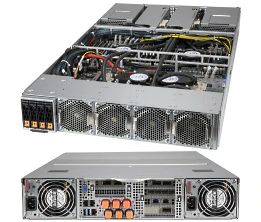
Supermicro AS-2124GQ-NART-LCC Server A+
| Lieske Part No. | 2517618 |
|---|---|
| Mfg Part No | AS-2124GQ-NART-LCC |
| EAN-Code | |
| Manufacturer | Supermicro |
| Here only | 3.846,39 EUR
4.577,20 EUR incl. VAT
|
Further information for Supermicro AS-2124GQ-NART-LCC Server A+
| General | |
| Form factor | 2U Rackmountable |
| Processor type | Dual AMD EPYC™ 7003/7002 Series |
| GPU platform | NVIDIA® HGX™ A100 4-GPU |
| GPU memory options | 40 GB (HBM2) or 80 GB (HBM2e) |
| Memory capacity | 8 TB |
| Memory type | Registered ECC DDR4 |
| Memory clock rate | 3200 MHz |
| Memory card slots | 32 DIMMs |
| PCI-E slots | 4 x16 (LP), 1 x8 (LP) Gen4 |
| Drive bay | 4 hot-swap 2.5 inch |
| Drive types | SAS/SATA/NVMe Hybrid |
| Current supply | 2x 2200 W Titanium Level |
| Power supply option | 2x 3000 W Titanium Level (future) |
| Power supply redundancy | Smart Power Redundancy |
| BMC Functions | IPMI 2.0 + KVM |
| Dedicated LAN port | 10G LAN |
Applications
The server is designed for compute-intensive tasks in the high-performance computing sector, particularly for AI development, machine learning, and scientific simulations. The combination of powerful GPUs and a robust processor concept makes it a suitable platform for data centres, research institutions, and enterprises requiring high computational power and scalability. The liquid cooling ensures stable operating temperature, increasing reliability under continuous load.
Features and Equipment in Detail
The system supports two AMD EPYC™ 7003/7002 Series processors, with the 7003 Series processors being compatible from BIOS version 2.0 onwards. Memory capacity is up to 8 TB Registered ECC DDR4 SDRAM, distributed across 32 DIMM slots, with a clock rate specified as 3200 MHz. This ensures high bandwidth and reliability for demanding applications. The platform features four PCI-E Gen4 x16 (LP) and one PCI-E Gen4 x8 (LP) slot, enabling integration of additional expansion cards. For storage, four hot-swap 2.5-inch drive bays are provided, supporting SAS, SATA, and NVMe technologies.
Technology Explained Simply
The NVIDIA® HGX™ A100 4-GPU platform delivers high computational performance for parallel tasks, with GPUs available either with 40 GB (HBM2) or 80 GB (HBM2e) memory. The liquid cooling ensures that the GPUs remain thermally stable even under heavy loads, increasing lifespan and reliability. The direct PCI-E Gen4 connection and NVLink™ technology enable fast data transfer between GPUs, which is crucial for AI training processes. The integrated BMC with IPMI 2.0 and KVM allows remote maintenance, even when the system is powered off, improving operational safety in data centres.
Compatibility and Accessories
The server is designed for use with NVIDIA® HGX™ A100 4-GPU modules, which support either 40 GB or 80 GB memory. Processor compatibility includes AMD EPYC™ 7003 and 7002 Series, with the 7003 Series supported from BIOS version 2.0. Memory options are limited to Registered ECC DDR4 SDRAM with a clock rate of 3200 MHz. Power supply is provided by two 2200 W Titanium Level Power Supplies with Smart Power Redundancy, with an option for two 3000 W Titanium Level Redundant Power Supplies expected to be available soon.
Mounting and Installation
The system is designed as a 2U rack-mount unit and fits into standard 19-inch racks. Dimensions are a height of 3.5 inches (89 mm), width of 17.2 inches (437 mm), and depth of 32.4 inches (823 mm). Mounting is done via standard rack rails, with installation of processors, memory modules, and drives to be carried out according to technical specifications. The liquid cooling requires integration into a cooling circuit, which must be considered during installation.
Operational Advantages
The server offers high computational performance in a compact form factor, increasing efficiency in data centres. The liquid cooling reduces heat generation and enables continuous load without performance degradation. The integrated remote maintenance function via IPMI 2.0 and KVM simplifies system monitoring and maintenance, especially in distributed infrastructures. Support for hot-swap drives allows for quick replacement without system downtime.

This is an offer of:
79279 Vörstetten
https://industry-electronics.com
Tel. 07666/88499-0
Fax. 07666/88499-111
Diesen Artikel finden Sie unter:
industry-electronics.com/artikel/2517618

Lieske Elektronik e.K.
Reutener Str. 1079279 Vörstetten
https://industry-electronics.com
Tel. 07666/88499-0
Fax. 07666/88499-111
Diesen Artikel finden Sie unter:
industry-electronics.com/artikel/2517618