
Supermicro AS-2124GQ-NART+ Server A+
Computer Hardware > Server > Barebone-Servers
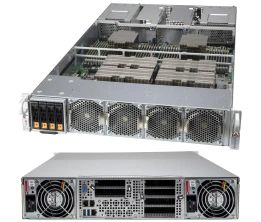
Supermicro AS-2124GQ-NART+ Server A+
| Lieske Part No. | 2517617 |
|---|---|
| Mfg Part No | AS-2124GQ-NART |
| EAN-Code | |
| Manufacturer | Supermicro |
| Here only | 5.984,82 EUR
7.121,94 EUR incl. VAT
|
Further information for Supermicro AS-2124GQ-NART+ Server A+
| General | |
| Form factor | 2U Rackmount |
| Processor | Dual AMD EPYC 7003/7002 Series |
| Memory | 8 TB Registered ECC DDR4 SDRAM |
| Memory frequency | 3200 MHz |
| GPU module | NVIDIA HGX A100 4-GPU |
| GPU memory | 40 GB (HBM2) or 80 GB (HBM2e) |
| GPU interconnect | NVIDIA NVLink v3.0 |
| GPU bandwidth | 600 GB/s |
| PCI-E expansion slots | 4 x16 (LP), 1 x8 (LP) Gen4 |
| BMC Functions | IPMI 2.0 + KVM |
| Dedicated LAN port | 10 Gbit/s |
Applications
The server is designed for use cases in data centers and high-performance computing (HPC) environments, particularly for enterprises relying on GPU-based computational power. The support for NVIDIA HGX A100 4-GPU modules with 40 GB (HBM2) or 80 GB (HBM2e) memory makes it a platform for demanding workloads such as Deep Learning, scientific simulations, or large-scale data analytics. The direct PCI-E Gen4 platform with NVLink connection ensures efficient utilization of GPU resources.
Features and Equipment in Detail
The system features two AMD EPYC 7003/7002 Series processors, where support for 7003 Series processors requires a BIOS update to version 2.0 or newer. The memory capacity is up to 8 TB Registered ECC DDR4 SDRAM in 32 DIMM slots, with a clock speed specified as 3200 MHz. This configuration ensures high memory bandwidth and reliability for critical applications. The platform offers four PCI-E Gen4 x16 (LP) and one PCI-E Gen4 x8 (LP) expansion slots, which can be used for additional cards such as network cards or storage controllers.
Technology Explained Simply
The use of NVIDIA NVLink v3.0 enables extremely fast data transfer between GPUs, which is crucial for applications requiring large data exchanges between graphics processors. The integrated BMC (Baseboard Management Controller) supports IPMI 2.0 as well as KVM (Keyboard, Video, Mouse) functions via a dedicated 10 Gbit/s LAN port, enabling remote maintenance and monitoring of the server. The redundant Titanium Level (96%+) power supply modules with a power rating of 3000 W ensure high efficiency and reliability, with redundancy guaranteeing continuous power supply even if one power supply fails.
Compatibility and Accessories
The system is designed for use with NVIDIA HGX A100 4-GPU modules offering either 40 GB (HBM2) or 80 GB (HBM2e) memory. Support for AMD EPYC 7003/7002 Series processors allows for flexible platform selection. The four 2.5-inch hot-swap drive bays support SAS, SATA, and NVMe drives, enabling flexible storage configuration. The platform is designed for use in standard 19-inch racks.
Mounting and Installation
The server is in 2U rack format, with dimensions height 3.5 inches (89 mm), width 17.2 inches (437 mm), depth 32.7 inches (830.3 mm). Mounting is done in standard rack systems using rails. The hot-swap drive bays allow for easy replacement of storage media without disassembling the system. The integrated BMC control supports remote maintenance via IPMI 2.0, making installation and maintenance possible even from a distance.
Operational Advantages
The combination of NVIDIA NVLink, PCI-E Gen4, and GPUDirect RDMA ensures minimal latency and maximum bandwidth between GPUs and the network. The redundant Titanium power supplies with high efficiency reduce energy consumption and increase operational reliability. The ECC DDR4 memory with high capacity and reliability supports critical applications. Remote maintenance functions via IPMI 2.0 and KVM simplify system monitoring and maintenance in data centers.

This is an offer of:
79279 Vörstetten
https://industry-electronics.com
Tel. 07666/88499-0
Fax. 07666/88499-111
Diesen Artikel finden Sie unter:
industry-electronics.com/artikel/2517617

Lieske Elektronik e.K.
Reutener Str. 1079279 Vörstetten
https://industry-electronics.com
Tel. 07666/88499-0
Fax. 07666/88499-111
Diesen Artikel finden Sie unter:
industry-electronics.com/artikel/2517617