
Supermicro AS-2124BT-HTR Server A+
Computer Hardware > Server > Barebone-Servers
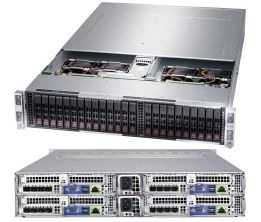
Supermicro AS-2124BT-HTR Server A+
| Lieske Part No. | 2517615 |
|---|---|
| Mfg Part No | AS-2124BT-HTR |
| EAN-Code | |
| Manufacturer | Supermicro |
| Here only | 5.284,43 EUR
6.288,47 EUR incl. VAT
|
Further information for Supermicro AS-2124BT-HTR Server A+
| General | |
| Form factor | 2U Rackmount |
| CPU socket | 2 (DP) |
| CPU socket type | Socket SP3 |
| DRAM slots | 16 |
| DRAM type | DDR4 |
| Max. memory per node | 4TB |
| Type of memory | ECC 3DS LRDIMM |
| Memory bus frequency | DDR4-3200 MHz |
| PCI-E slots | 2 x PCI-E 4.0 x16 (LP) |
| M.2 interface | 1 SATA/PCI-E 3.0 x4 |
| M.2 form factor | 2280, 22110 |
| M.2 Key | M-key |
| Video output | via Aspeed AST2500 BMC2200 |
| IPMI | 2.0 + KVM |
| Software Out of Band License key | SFT-OOB-LIC |
| Hard drive bays | 6 Hot-swap 2.5 Zoll SATA3 |
| Power supplies | 2 redundant |
| Power supply efficiency | Titanium Level (96%) |
| SIOM card support | |
| Dedicated LAN | |
| OOB BIOS management | |
Applications
The server is designed for scenarios requiring high computing power in a compact form factor, such as cloud infrastructures, virtual environments, big data analytics, or as a basis for container orchestration. The four independent nodes allow for efficient resource utilization and maintenance without taking the entire unit offline. The hot-plug functionality of the nodes enables quick replacement and maintenance during operation, which is advantageous for critical applications.
Features and Equipment in Detail
Each node features 16 DIMM slots for DDR4-SDRAM with support up to DDR4-3200MHz. The maximum memory capacity per node is 4TB ECC 3DS LRDIMM, ensuring high memory density and reliability for critical applications. Integrated graphics are provided via the Aspeed AST2500 BMC2200, which also handles video output. This enables simple system monitoring and control, especially in remote operation.
Technology Explained Simply
The platform offers two PCI-E 4.0 x16 (LP) slots per node, suitable for installing expansion cards such as GPUs, network cards, or storage controllers. Additionally, each node supports a SIOM card slot, enabling flexible network integration. The integrated IPMI 2.0 + KVM function with dedicated LAN allows remote maintenance and control of the server, even when the operating system is inactive. A Software Out of Band License key (SFT-OOB-LIC) is included in the delivery scope and enables the use of OOB-BIOS management functions.
Compatibility and Accessories
The server is equipped with an M.2 interface supporting SATA/PCI-E 3.0 x4 standard. Supported M.2 form factors are 2280 and 22110, using the M-Key standard. This allows installation of SSDs or other M.2 modules for additional storage or network functions. The platform is designed for use with redundant power supplies achieving Titanium efficiency class (96 %), ensuring high energy efficiency and reliability in operation.
Mounting and Installation
The server is designed in 2U rack format, with a width of 17.25 inches (438 mm), a height of 3.47 inches (88 mm), and a depth of 28.5 inches (724 mm). Mounting is done in standard 19-inch racks. The four nodes are hot-pluggable, meaning they can be replaced during operation without shutting down the entire server. Installation requires mounting the processors, memory, and drives, with hot-swap drive bays provided for 2.5-inch SATA3 drives.
Advantages in Operation
The combination of four independent nodes in a 2U housing provides high computing density per rack unit. The hot-plug functionality of the nodes and drive bays enables fast maintenance and expansion. The integrated IPMI control with KVM function and dedicated LAN simplifies remote maintenance. The Titanium efficiency of the power supplies reduces energy consumption and operating costs. Support for ECC-3DS-LRDIMM memory ensures high reliability and error correction, which is important for critical applications.

This is an offer of:
79279 Vörstetten
https://industry-electronics.com
Tel. 07666/88499-0
Fax. 07666/88499-111
Diesen Artikel finden Sie unter:
industry-electronics.com/artikel/2517615

Lieske Elektronik e.K.
Reutener Str. 1079279 Vörstetten
https://industry-electronics.com
Tel. 07666/88499-0
Fax. 07666/88499-111
Diesen Artikel finden Sie unter:
industry-electronics.com/artikel/2517615