
Supermicro AS-2114GT-DNR Server 2114GT-DNR
Computer Hardware > Server > Barebone-Servers
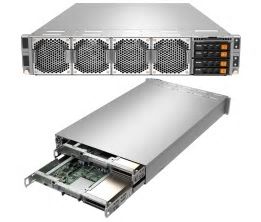
Supermicro AS-2114GT-DNR Server 2114GT-DNR
| Lieske Part No. | 2517601 |
|---|---|
| Mfg Part No | AS-2114GT-DNR |
| EAN-Code | |
| Manufacturer | Supermicro |
| Here only | 4.300,92 EUR
5.118,09 EUR incl. VAT
|
Further information for Supermicro AS-2114GT-DNR Server 2114GT-DNR
| General | |
| Form factor | 2U Rackmount |
| CPU socket | Socket SP3 |
| CPU count | 1 (UP) |
| Processor family | AMD EPYC(TM) 7003/7002 Series |
| DRAM type | DDR4 |
| DRAM slots | 8 |
| Maximum storage capacity | 2TB |
| Memory bus frequency | 3200 MHz |
| PCI-E Gen 4 slots | up to 6 x16 (4 internal, 2 external) |
| AIOM Slot | 1 x PCI-E 4.0 x8 |
| M.2 interface | 2 x PCI-E 4.0 x4 |
| M.2 form factor | 2280, 2210 |
| M.2 Key | M-key |
| IPMI version | 2.0 |
| OOB license | SFT-OOB-LIC included |
| Drive bays | 2 x Hot-swap 2.5 inch U.2 NVMe Gen4 |
| Power supplies | 2 x AST2600 BMC2600W |
| Power supply redundancy | 1+1 |
| Power supply efficiency | Titanium Level (96%) |
Applications
This server is suitable for environments requiring high hardware density in limited rack space. The configuration with two independent nodes in 2U format reduces space requirements compared to two separate 1U servers. Support for AMD EPYC processors makes it particularly suitable for applications with high computing demands, such as Big Data analytics, virtual machine infrastructures, or high-availability solutions. Integrated IPMI 2.0 functionality with KVM and dedicated LAN enables remote maintenance and monitoring, which is important for remote server management and IT operations.
Functions and Equipment in Detail
Each node features eight DIMM slots for Registered ECC DDR4 memory with a maximum capacity of 2TB. The memory bus frequency is 3200 MHz, providing sufficient bandwidth for demanding applications. The platform supports up to six PCI-E Gen 4 x16 slots, four of which are internal and two external. Additionally, there is a PCI-E 4.0 x8 AIOM slot, which can be used for network adapters or storage controllers. The M.2 slots support two M.2 modules in formats 2280 and 2210 with M-Key connector and PCI-E 4.0 x4 interface, enabling fast SSDs for boot or cache purposes.
Technology Explained Simply
Each of the two nodes is equipped with a CPU socket of type Socket SP3, designed for AMD EPYC processors. The integrated IPMI 2.0 technology (Intelligent Platform Management Interface) enables remote control and monitoring of the server, including KVM functions (Keyboard, Video, Mouse) via a dedicated network. The Software Out of Band License key (SFT-OOB-LIC) is included in the delivery scope and allows the use of OOB-BIOS management functions. Power supply is provided by two redundant (1+1) power supplies from the AST2600 BMC2600W series, which feature Titanium-level efficiency (96 %), ensuring high energy efficiency and low operating costs.
Compatibility and Accessories
The server is equipped with two front-mounted hot-swap 2.5-inch U.2 NVMe Gen4 drive bays, suitable for fast, highly available storage solutions. The integrated IPMI technology enables the use of management tools accessible via the dedicated LAN interface. The platform is designed for use with AMD EPYC processors from the 7003 and 7002 Series, with 7003 Series support available from BIOS version 2.0. The M.2 slots are designed for M-Key modules in formats 2280 and 2210, supporting a wide range of SSD modules.
Installation and Mounting
The server is designed in 2U rack format, with a width of 17.2 inches (437 mm), a height of 3.47 inches (88 mm), and a depth of 29.9 inches (760 mm). Mounting is done in standard 19-inch racks. The two nodes are independently operable, enabling flexible usage and maintenance. The hot-swap drives can be replaced without system crash, increasing availability. The redundant power supply ensures high operational reliability.
Operational Advantages
The combination of two independent nodes in a 2U housing provides high hardware density, reducing rack space requirements. Support for AMD EPYC processors and DDR4 Registered ECC memory ensures high performance and reliability. Integrated IPMI 2.0 functionality with dedicated LAN enables efficient remote maintenance. The Titanium-level power supplies ensure high energy efficiency, reducing operating costs. The hot-swap feature of the drives and redundant power supply increase system availability.

This is an offer of:
79279 Vörstetten
https://industry-electronics.com
Tel. 07666/88499-0
Fax. 07666/88499-111
Diesen Artikel finden Sie unter:
industry-electronics.com/artikel/2517601

Lieske Elektronik e.K.
Reutener Str. 1079279 Vörstetten
https://industry-electronics.com
Tel. 07666/88499-0
Fax. 07666/88499-111
Diesen Artikel finden Sie unter:
industry-electronics.com/artikel/2517601