
Supermicro AS-2024US-TRT server 2024US-TRT
Computer Hardware > Server > Barebone-Servers
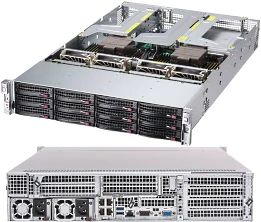
Supermicro AS-2024US-TRT server 2024US-TRT
| Lieske Part No. | 2517513 |
|---|---|
| Mfg Part No | AS-2024US-TRT |
| EAN-Code | |
| Manufacturer | Supermicro |
| Here only | 2.878,80 EUR
3.425,77 EUR incl. VAT
|
Further information for Supermicro AS-2024US-TRT server 2024US-TRT
| General | |
| CPU socket | 2 (DP) |
| CPU socket type | Socket SP3 |
| DRAM slots | 32 |
| DRAM type | DDR4 |
| HE | 2U |
| Power supplies | 2 |
| Onboard LAN | 10Gbit/s |
| Server type | Mainstream Server |
| Processor type | Dual AMD EPYC 7003/7002 Series |
| Memory maximum value | 8 TB |
| Memory type | Registered ECC DDR4 |
| Memory clock frequency | 3200 MHz |
| PCI-E slots | 5 |
| PCI-E version | 4.0 |
| LAN quantity | 2 |
| LAN type | 10GBase-T |
| LAN chipset | Intel® X710-AT2 |
| IPMI version | 2.0 |
| Software OOB License | SFT-OOB-LIC |
| Drive bays | 12 3.5 inch |
| Drive type standard | SATA3 |
| Optional drive types | 8 SATA3 + 4 NVMe or 12 SAS3 |
| Power supply efficiency | Titanium Level (96%+) |
| Onboard graphics | |
| Power supply redundancy | |
Applications
The server is designed for mainstream server applications, including virtualisation, databases, web hosting, and enterprise workloads. The combination of dual EPYC processors, large memory capacity, and expandable storage options makes it particularly suitable for environments requiring high I/O performance and parallel processing. The integrated IPMI 2.0 function with KVM and dedicated LAN enables efficient remote maintenance and monitoring, even when the system is powered off.
Features and Equipment in Detail
The AS-2024US-TRT offers extensive expandability with a total of five PCI-E 4.0 slots: two x16 (full-height, 10.5 inch L), one x16 (full-height, 9.5 inch L), one x16 (low-profile), and one x8 (full-height, 9.5 inch L, in x16). Additionally, there is an internal proprietary x8 low-profile slot (in x16) for special applications. The integrated graphics function enables display of system information without an external graphics card connection.
Technology Explained Simply
Network connectivity is provided via two 10GBase-T LAN ports implemented using an Intel® X710-AT2 chipset. This ensures high bandwidth for network connections and supports modern network protocols. The integrated IPMI 2.0 function with KVM enables remote control of the server, including BIOS access, even when the system is powered off. The Software Out of Band License Key (SFT-OOB-LIC) is included in the delivery scope and allows use of the remote maintenance functions.
Compatibility and Accessories
The server supports various storage configurations: standard configuration includes 12 hot-swap 3.5-inch SATA3 drives. Optionally, 8 SATA3 drives and 4 NVMe drives can be installed using a special tray, or 12 SAS3 drives using an optional SAS kit. The power supply configuration includes two redundant power supplies with Titanium-level efficiency (at least 96%), which can be operated fully redundantly depending on configuration and load.
Mounting and Installation
The server is designed in 2U format, with a width of 17.2 inches (437 mm), a height of 3.5 inches (89 mm), and a depth of 28.46 inches (723 mm). The dimensions comply with the standard for rack mounting in 19-inch server racks. Installation is performed using standard rack mounting rails, with the exact mounting instructions not specified in the text. Configuration of memory and drive modules is done via the designated slots and trays.
Operational Advantages
The combination of dual EPYC processors, large memory capacity, and expandable storage options ensures high performance density. The redundant power supply with Titanium efficiency reduces energy consumption and increases operational reliability. The integrated remote maintenance function via IPMI 2.0 with KVM enables efficient system monitoring and control, even from a distance. Support for NVMe and SAS3 drives expands flexibility in storage architecture.

This is an offer of:
79279 Vörstetten
https://industry-electronics.com
Tel. 07666/88499-0
Fax. 07666/88499-111
Diesen Artikel finden Sie unter:
industry-electronics.com/artikel/2517513

Lieske Elektronik e.K.
Reutener Str. 1079279 Vörstetten
https://industry-electronics.com
Tel. 07666/88499-0
Fax. 07666/88499-111
Diesen Artikel finden Sie unter:
industry-electronics.com/artikel/2517513