
Steinel 086336 presence detector recessed black
Security Technology > Sensors > Motion Detectors
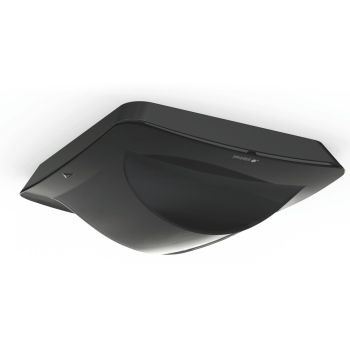
Steinel 086336 presence detector recessed black
| Lieske Part No. | 253266 |
|---|---|
| Mfg Part No | 086336 |
| EAN-Code | 4007841086336 |
| Manufacturer | Steinel |
| Here only | 154,24 EUR
183,55 EUR incl. VAT
|
Further information for Steinel 086336 presence detector recessed black
| General | |
| Transmission range | 25 m |
| Detection type | Radial |
| Technology | High frequency |
| Interfaces | COM1, COM2, DALI-2 APC, DALI-2 IPD, KNX, IP, BT IPD (Slave) |
| Light measurement | not integrated |
| Design | Control PRO II |
| Model | Recessed black |
| Bluetooth technology | |
Applications
The detector is primarily intended for indoor use, particularly in long corridors, halls, office passageways, or similar areas where uniform and sufficiently wide-ranging motion detection is required. The radial detection ensures that movements are also detected from side angles, increasing the reliability of presence detection. The adjustability of the range in both directions allows for precise coverage of individual corridor sections, avoiding unnecessary overlaps or gaps in coverage.
Functions and Equipment in Detail
The Hallway COM1 features integrated Bluetooth technology, enabling wireless communication with external devices. This function is particularly used to connect external light sensors, as the black sensors do not perform their own light measurement. Therefore, light measurement must be carried out by a separate device connected to the system via Bluetooth or KNX. The device interfaces include COM1, COM2, DALI-2 APC, DALI-2 IPD, KNX, IP, and BT IPD (Slave), enabling flexible integration into existing building management systems or lighting controls. Support for multiple protocols ensures high compatibility with various control architectures.
Technology Explained Simply
The high-frequency technology of the sensor enables precise motion detection by evaluating reflections of electromagnetic waves. This technology is independent of lighting conditions and detects movements even in dark rooms. Radial detection means the sensor is active not only in a straight line but in a circular area around itself, increasing the likelihood of detection. The Bluetooth technology is not used for motion detection but for data transmission to external sensors, particularly for light measurement. Integrated interfaces such as KNX or DALI-2 allow direct communication with other devices in the building, eliminating the need for additional gateways or converters.
Compatibility and Accessories
The detector is designed for integration into systems using the protocols COM1, COM2, DALI-2 APC, DALI-2 IPD, KNX, IP, and BT IPD (Slave). These interfaces allow connection to various control and lighting systems. For light measurement, which is not integrated in the black version, an external light sensor must be connected via Bluetooth or KNX. This could, for example, be a separate sensor that measures ambient lighting and transmits the data to the Hallway COM1 to enable intelligent lighting control.
Installation and Mounting
The Hallway COM1 is designed as a recessed device, meaning it is installed into a pre-prepared wall or ceiling opening. Installation requires appropriate site preparation, including conduit installation and electrical connection options. The exact mounting is carried out according to the manufacturer’s technical specifications, with the sensor’s positioning in the room being crucial for optimal coverage. Range adjustment is performed via the integrated control, with settings adjusted according to the specific application scenario.
Operational Advantages
The combination of radial detection, adjustable range, and multiple interfaces enables flexible and reliable use in various application scenarios. Bluetooth technology extends functionality by allowing external sensors to be integrated without requiring additional cabling. Support for standards such as KNX and DALI-2 ensures seamless integration into existing building automation systems. The black finish offers aesthetic integration into dark or black-designed environments, allowing the device to remain unobtrusive in the room.

This is an offer of:
79279 Vörstetten
https://industry-electronics.com
Tel. 07666/88499-0
Fax. 07666/88499-111
Diesen Artikel finden Sie unter:
industry-electronics.com/artikel/253266

Lieske Elektronik e.K.
Reutener Str. 1079279 Vörstetten
https://industry-electronics.com
Tel. 07666/88499-0
Fax. 07666/88499-111
Diesen Artikel finden Sie unter:
industry-electronics.com/artikel/253266