
Siemens BD2-AK3X/GSTZ00 Distribution Box 125A
Installation > Busbar trunking systems
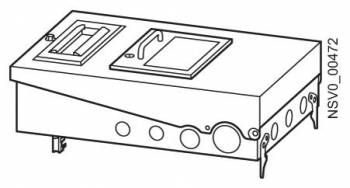
Siemens BD2-AK3X/GSTZ00 Distribution Box 125A
| Lieske Part No. | 729487 |
|---|---|
| Mfg Part No | BVP:203163 |
| EAN-Code | 4019169743051 |
| Manufacturer | Siemens |
| Here only | 705,60 EUR
839,66 EUR incl. VAT
|
Further information for Siemens BD2-AK3X/GSTZ00 Distribution Box 125A
| General | |
| Rated current | 125 A |
| Number of poles | 3 |
| Device type | Outlet box |
| Switch type | Disconnect switch |
| System compatibility | BD2 |
Busbar distribution systems are widely used in electrical installations, as they enable flexible and modular distribution of electrical energy. The BD2-AK3X/GSTZ00 distribution box is an integrated component, directly coupled to the busbars. The use of a switch disconnector ensures that the circuit can be completely interrupted without requiring additional switching devices. This is particularly important in installations where safe disconnection is necessary for maintenance or during faults.
Applications include industrial production facilities, commercial buildings, warehouses, and other facilities requiring modular and expandable power distribution. The distribution box is intended for indoor use and is mounted in distribution enclosures or cabinets. Its design allows for easy integration into existing BD2 systems, ensuring consistent and standardized installation.
Functions and equipment in detail include the integrated 3-pole disconnection function, enabling complete power interruption in all three conductors (L1, L2, L3). The switch disconnector is rated for a nominal voltage of 400 V and supports a nominal current of 125 A. The mechanical design of the switch allows for clear position indication (on/off), facilitating visual control of the operating status. Mounting is done directly onto the busbar system, with electrical connections made via integrated terminal clamps.
Technology explained simply shows that the distribution box functions as a mechanical disconnection device, not only interrupting the power supply but also ensuring safe isolation of the connected consumer. The 3-pole configuration is typical for three-phase systems, where all three phases must be disconnected simultaneously. The nominal current of 125 A is designed for medium to high loads, such as machine drives, heating systems, or larger lighting installations. Use within a busbar distribution system allows flexible adaptation of the installation to changing requirements, as additional distribution boxes can be easily added.
Compatibility and accessories refer to use within the BD2 series from Siemens. The distribution box is specifically designed for integration into busbar distribution systems of the BD2 family. It is compatible with corresponding busbar profiles and mounting elements also belonging to the BD2 series. The use of accessories such as circuit breakers, fuses, or additional distribution boxes is possible, provided they also belong to the BD2 series and match the electrical parameters (voltage, current).
Mounting and installation are performed by direct mounting onto the busbar system. Fixing is done via integrated brackets that are attached to the busbar profiles. Electrical connections are made via designated terminal clamps, ensuring correct assignment of conductors (L1, L2, L3). Installation requires no additional tools beyond a screwdriver or suitable tool for clamp connections. Mounting is typically quick and can be done without additional aids.
Operational advantages lie in the safe disconnection function, enabling precise and visually identifiable power interruption. Integration into a modular busbar distribution system offers flexibility for expansion and adaptation of the installation. The use of a switch disconnector reduces the need for additional switching devices, simplifying installation and making maintenance more efficient. The robust construction ensures reliable performance even under industrial conditions.

This is an offer of:
79279 Vörstetten
https://industry-electronics.com
Tel. 07666/88499-0
Fax. 07666/88499-111
Diesen Artikel finden Sie unter:
industry-electronics.com/artikel/729487

Lieske Elektronik e.K.
Reutener Str. 1079279 Vörstetten
https://industry-electronics.com
Tel. 07666/88499-0
Fax. 07666/88499-111
Diesen Artikel finden Sie unter:
industry-electronics.com/artikel/729487