
Siemens 6GK5980-1DB10-0AA5 terminal block 4-pin
Industrial Material > Automation > Industrial bus systems
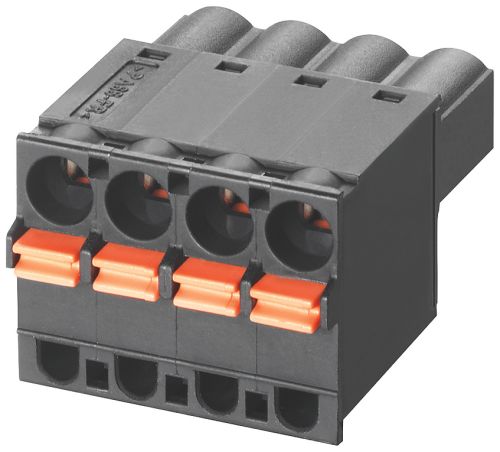
Siemens 6GK5980-1DB10-0AA5 terminal block 4-pin
| Lieske Part No. | 320912 |
|---|---|
| Mfg Part No | 6GK59801DB100AA5 |
| EAN-Code | 4047622172599 |
| Manufacturer | Siemens |
| Here only | 39,09 EUR
46,52 EUR incl. VAT
|
Further information for Siemens 6GK5980-1DB10-0AA5 terminal block 4-pin
| General | |
| Number of poles | 4 |
| Terminal technology | Spring tension |
| Connection technology | Push-In |
| Power supply | DC 24 V |
| Compatibility | SCALANCE X/W/S/M |
Applications
The terminal block is primarily intended for supplying SCALANCE network devices with direct current in industrial automation technology. These devices are used in factories, production facilities and other industrial environments where reliable communication over Ethernet or PROFINET networks is required. The 4-pole configuration provides connection options for two power lines (positive and negative) as well as two additional contacts, which can be used depending on the device type for signals or feedback. Use in DC 24 V systems is typical for industrial controls, as this voltage offers a good balance between safety and performance.
Functions and Equipment in Detail
The terminal block features spring-cage terminal technology, enabling simple and quick installation without tools. The push-in technology allows wires to be inserted directly into the terminal, with the spring automatically securing the connection. This reduces installation time and minimizes wiring errors. The 4-pole configuration is designed for devices requiring separate power supply, with polarity (positive/negative) and additional signal lines clearly defined. The terminals are designed for industrial environments, with mechanical stability and electrical reliability being the main focus.
Technology Explained Simply
The spring-cage terminal technology operates using an elastic spring that compresses automatically when a wire is inserted, securing the connection. This prevents the connection from loosening due to vibrations or mechanical stress. The 4-pole configuration allows for clear assignment of wires: two for power supply (DC 24 V) and two for additional functions, such as status signals or feedback. The use of DC 24 V is widespread in industrial automation, as this voltage provides sufficient power for most control and communication devices while being safer to handle than higher voltages.
Compatibility and Accessories
The terminal block is specifically developed for the SCALANCE series from Siemens, including models SCALANCE X, W, S and M. These devices are part of Siemens’ industrial network and automation solutions and are used in various application areas, such as manufacturing automation, process control or building automation. Compatibility with these devices is ensured by the specific design and connection configuration.
Mounting and Installation
Installation is tool-free, achieved by simply inserting the wires into the push-in terminals. The spring-cage technology ensures the connection remains stable without requiring additional screwing or clamping operations. The terminals are designed for use in industrial devices, with installation into the designated slots of SCALANCE devices. Installation is typically carried out by professionals familiar with electrical and automation technology.
Advantages in Operation
Using the spring-cage terminal block provides fast and secure wiring, reducing installation time and minimizing error sources. The mechanical stability of the connection ensures reliable power supply, even under difficult operating conditions. Compatibility with the SCALANCE series ensures seamless integration into existing automation and network environments. The use of DC 24 V is widespread in industry, simplifying maintenance and component replacement. The 4-pole configuration allows for clear wire assignment, facilitating fault diagnosis and maintenance.

This is an offer of:
79279 Vörstetten
https://industry-electronics.com
Tel. 07666/88499-0
Fax. 07666/88499-111
Diesen Artikel finden Sie unter:
industry-electronics.com/artikel/320912

Lieske Elektronik e.K.
Reutener Str. 1079279 Vörstetten
https://industry-electronics.com
Tel. 07666/88499-0
Fax. 07666/88499-111
Diesen Artikel finden Sie unter:
industry-electronics.com/artikel/320912