
Siemens 6ES72141AG400XB0 CPU 1214C DC/DC/DC
Industrial Material > Automation > PLC Systems
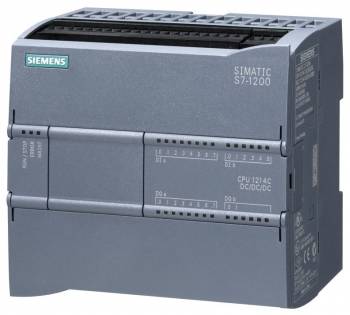
Siemens 6ES72141AG400XB0 CPU 1214C DC/DC/DC
| Lieske Part No. | 867257 |
|---|---|
| Mfg Part No | 6ES72141AG400XB0 |
| EAN-Code | 4047623402787 |
| Manufacturer | Siemens |
| Here only | 648,76 EUR
772,02 EUR incl. VAT
|
Further information for Siemens 6ES72141AG400XB0 CPU 1214C DC/DC/DC
| General | |
| Operating voltage | 20,4-28,8 V DC |
| Digital inputs | 14 DI 24 V DC |
| Digital outputs | 10 DO 24 V DC |
| Analogue inputs | 2 AI 0-10 V DC |
| Program/data memory | 150 KB |
| Communication interface | Ethernet integrated |
| Control type | DC/DC/DC Compact CPU |
| Design software | STEP 7 Basic in TIA Portal |
Applications
The CPU 1214C is suitable for a wide range of applications, including the control of simple packaging machines, heating systems, or as a subordinated system in larger installations. Due to its compact design and modular construction, space in the enclosure is saved, which is particularly advantageous in limited installation environments. The integrated I/Os reduce the need for additional modules for basic tasks.
Functions and Equipment in Detail
The CPU features an integrated Ethernet connection, enabling the connection of HMI devices. Communication capabilities include integrated functions such as PROFINET and Modbus, allowing flexible networking with other devices and systems. Additionally, signal and communication modules can be used to extend functionality, for example, IO-Link or AS-i modules. Programming is done using the STEP 7 Basic software in the TIA Portal, which provides unified data management, a consistent user interface, and seamless communication services for all system components. This reduces programming effort and accelerates commissioning.
Technology Explained Simply
The CPU 1214C is configured as a DC/DC/DC setup, meaning that both the input power supply and the inputs and outputs operate at 24 V DC. The integrated 14 DI and 10 DO allow direct connection to digital sensors and actuators. The 2 AI with a measurement range of 0 to 10 V DC are suitable for capturing analog signals, such as from temperature or pressure sensors. The internal memory is 150 KB for program and data storage, which can be expanded via a Memory Card. Power supply is via a DC voltage of 20.4 to 28.8 V, allowing flexible adaptation to various power sources.
Compatibility and Accessories
The CPU is compatible with various accessories, including Memory Cards such as the 6ES7954-8LT04-0AA0 (32 GB) or 6ES7954-8LL04-0AA0 (256 MB), which extend the memory. Spare parts such as terminal blocks (e.g., 6ES7292-1BC30-0XA0) or front covers (6ES7291-1AB30-0XA0) are available to ensure mechanical integration. Additionally, communication modules such as the 6ES7274-1XH30-0XA0 simulator module or the 6ES7290-3AA30-0XA0 Single Port VE=4 can be used to extend network functions. The CPU can also be combined with Plug-In couplers such as the 3RQ4118-2AM00 (DC 24 V, spring clamp connection) or the 3RQ4038-2AB00 (AC/DC 24 V, spring clamp connection) to expand connection options.
Mounting and Installation
The CPU is installed in an enclosure and connected to the supply voltage and signal lines via the integrated terminals. Mounting typically occurs in a standard control cabinet, with mechanical fastening achieved through designated mounting points. The connection terminals are designed for screw or spring clamp connections, with various terminal blocks available to adapt the connection type to the specific installation. Programming in the TIA Portal is performed using PC software, with the CPU connected to the programming computer via the Ethernet connection.
Advantages in Operation
The CPU 1214C offers high flexibility through modular expandability and integrated communication functions. Programming in the TIA Portal enables efficient system design with minimal effort. The integrated I/Os reduce the number of required modules and save space in the enclosure. Support for standards such as PROFINET and Modbus simplifies integration into existing networks. Expandability via Memory Cards allows adaptation to increasing memory requirements during operation.

This is an offer of:
79279 Vörstetten
https://industry-electronics.com
Tel. 07666/88499-0
Fax. 07666/88499-111
Diesen Artikel finden Sie unter:
industry-electronics.com/artikel/867257

Lieske Elektronik e.K.
Reutener Str. 1079279 Vörstetten
https://industry-electronics.com
Tel. 07666/88499-0
Fax. 07666/88499-111
Diesen Artikel finden Sie unter:
industry-electronics.com/artikel/867257