
Siemens 6ES7155-8AR00-0AN0 IM 155-8 PN with end cap
Industrial Material > Automation > PLC Systems
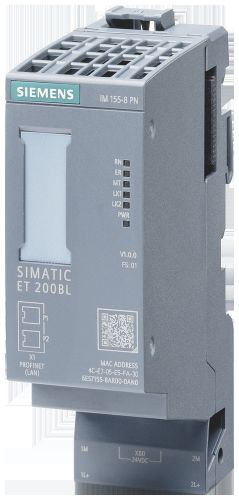
Siemens 6ES7155-8AR00-0AN0 IM 155-8 PN with end cap
| Lieske Part No. | 890559 |
|---|---|
| Mfg Part No | 6ES71558AR000AN0 |
| EAN-Code | 4034106036492 |
| Manufacturer | Siemens |
| Here only | 199,18 EUR
237,02 EUR incl. VAT
|
Further information for Siemens 6ES7155-8AR00-0AN0 IM 155-8 PN with end cap
| General | |
| Manufacturer | Siemens |
| Interface | PROFINET |
| Number of RJ45 ports | 2 |
| Maximum number of I/O modules | 16 |
| PROFINET safety class | 1 |
| Cycle time | 1 ms |
| Operation temperature | -30 to 60 °C |
| Applicable height | up to 5000 m |
| Potential groups | supported |
| EMC | Improved |
| Accessories | end cap, labelling plates (reference and colour coding) |
| Short-circuit protection | |
| Diagnostic function | |
Applications
This interface module is designed for use in industrial plants, particularly in environments requiring high reliability and communication speed. It is suitable for applications in the manufacturing industry, packaging industry, machine building industry, and other areas where decentralised I/O modules are accessed via PROFINET. The operating temperature range of -30 to 60 °C and the maximum operating altitude of 5000 metres allow use under various climatic and geographical conditions, including high-altitude production facilities.
Functions and Equipment in Detail
The module provides a cycle time of 1 millisecond, ensuring rapid response to input and output signals. The integrated diagnostic function enables early detection of faults in connected modules, reducing maintenance time. A short-circuit protection safeguards connected peripheral modules from damage due to unexpected current flows. The ability to set up potential groups allows separation of different electrical potentials within the station, increasing safety for personnel and equipment. Electromagnetic compatibility (EMC) is enhanced by the module’s design, ensuring stable signal transmission even in electromagnetically noisy environments.
Technology Explained Simply
The module operates according to the PROFINET standard, an industrial Ethernet protocol used for communication between controllers and decentralised I/O modules. The integrated RJ45 connectors allow direct network connection without additional switches or cable extensions. PROFINET safety class 1 refers to the module’s ability to support basic safety functions such as monitoring of inputs and outputs. The 1 ms cycle time means the module polls and controls all connected modules within one millisecond, which is crucial for time-critical applications.
Compatibility and Accessories
The interface module is compatible with a wide range of signal modules, including digital inputs and outputs as well as analogue signal processing modules. These modules can be installed in the ET 200BL station up to a total of 16 modules. Accessories for ET 200BL include labelling plates, such as reference identification plates and colour coding plates, enabling clear and organised identification of modules in the enclosure. The end cover is included in the delivery and serves to mechanically close the module row.
Mounting and Installation
The module is installed in a standard ET 200BL station mounted in an enclosure. Mounting is done by simply snapping it into the module holder. The RJ45 connectors are directly mounted on the module, enabling direct network connection. Installation requires no additional tools or special mounting aids. The end cover is attached at the end of the module row to ensure proper closure of the station.
Advantages in Operation
The combination of short cycle time, integrated diagnostic functions, and short-circuit protection ensures high operational safety and reduces maintenance requirements. The scalable configuration allows adaptation to different requirements without major changes to the existing system. Support for potential groups and improved EMC contribute to the safety and stability of the entire automation system. Clear labelling options via accessories ensure easy identification of modules during operation.

This is an offer of:
79279 Vörstetten
https://industry-electronics.com
Tel. 07666/88499-0
Fax. 07666/88499-111
Diesen Artikel finden Sie unter:
industry-electronics.com/artikel/890559

Lieske Elektronik e.K.
Reutener Str. 1079279 Vörstetten
https://industry-electronics.com
Tel. 07666/88499-0
Fax. 07666/88499-111
Diesen Artikel finden Sie unter:
industry-electronics.com/artikel/890559