
Siemens 6EP3436-8SB00-4AY0 power supply 3ph DC 24V
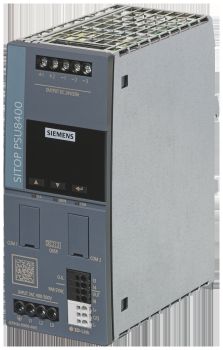
Siemens 6EP3436-8SB00-4AY0 power supply 3ph DC 24V
| Lieske Part No. | 156983 |
|---|---|
| Mfg Part No | 6EP34368SB004AY0 |
| EAN-Code | 4025515156291 |
| Manufacturer | Siemens |
| Here only | 456,00 EUR
542,64 EUR incl. VAT
|
Further information for Siemens 6EP3436-8SB00-4AY0 power supply 3ph DC 24V
| General | |
| Input voltage | 3AC 400-500 V |
| Output voltage | 24 V |
| Output current | 20 A |
| Alarm contact | configurable |
| Control contact | for parallel operation |
| Efficiency | high across entire load range |
| No-load losses | minimum |
| Overload capability | high static and dynamic |
| Parallel operation | possible |
| Compatibility | with SITOP modules such as UPS500S, RED1200, SEL1200 |
| IO-Link connection | |
| Display | |
| DC-capable input | |
Applications
The SITOP PSU8400 is suitable for industrial environments with high requirements for operational safety and energy efficiency. It is typically used in enclosures of production systems, material handling technology, packaging machines, or other automated systems where a stable 24-V supply is required for controls, sensors, and actuators. The high static and dynamic overload capacity at the output ensures reliability even under sudden load peaks or fluctuating consumers.
Functions and equipment in detail
The device features a configurable alarm contact for monitoring the operating status. Additionally, a control contact is integrated, enabling even current distribution in parallel operation of multiple power supplies. This function is particularly relevant when multiple PSU8400 modules are operated in parallel to supply higher total currents. The power supply is characterized by high efficiency across the entire load range, minimizing energy consumption and reducing heat generation in the enclosure. The minimal no-load power loss also contributes to energy efficiency.
Technology explained simply
The wide input range allows operation at various network frequencies and voltage ranges, including DC input, increasing global usability. The DC capability of the input also permits operation from DC networks, which is advantageous in certain industrial applications. The IO-Link interface is an industrial communication technology that enables data exchange between the power supply and the control system. This allows proactive maintenance, as status information such as temperature, load, or error messages can be directly integrated into the control software.
Compatibility and accessories
The SITOP PSU8400 can be combined with various modules from the SITOP portfolio to increase the availability of the 24-V supply. These include DC UPS modules such as the SITOP UPS500S, redundancy modules such as the SITOP RED1200, or selectivity modules such as the SITOP SEL1200. These modules enable redundant or uninterruptible power supply, which is important for critical applications. Combining with selectivity modules allows targeted disconnection of loads in case of failure, limiting damage.
Mounting and installation
The power supply is designed for mounting in standard enclosures and is typically installed in DIN rail mounting. The compact width allows efficient space utilization in the enclosure. Connections are made via terminals designed for wiring according to the rated current. Installation requires compliance with electrical safety regulations and correct wiring according to technical documentation.
Advantages in operation
The combination of high efficiency, integrated diagnostic function via IO-Link, and the ability to optimize parallel operation makes the SITOP PSU8400 a powerful solution for demanding industrial applications. The minimal heat generation reduces enclosure load and reduces the need for additional cooling. The ability to integrate diagnostic information directly into control software supports predictive maintenance and increases plant uptime.

This is an offer of:
79279 Vörstetten
https://industry-electronics.com
Tel. 07666/88499-0
Fax. 07666/88499-111
Diesen Artikel finden Sie unter:
industry-electronics.com/artikel/156983

Lieske Elektronik e.K.
Reutener Str. 1079279 Vörstetten
https://industry-electronics.com
Tel. 07666/88499-0
Fax. 07666/88499-111
Diesen Artikel finden Sie unter:
industry-electronics.com/artikel/156983