
Siemens 6AV2124-0QC24-0AX0 HMI TP1500 Comfort Pro
Industrial Material > Automation > PLC Systems
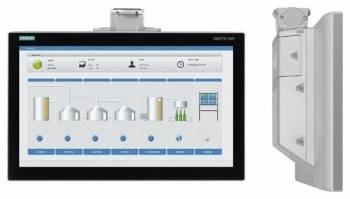
Siemens 6AV2124-0QC24-0AX0 HMI TP1500 Comfort Pro
| Lieske Part No. | 1903441 |
|---|---|
| Mfg Part No | 6AV21240QC240AX0 |
| EAN-Code | 4047623408796 |
| Manufacturer | Siemens |
| Here only | 5.583,68 EUR
6.644,58 EUR incl. VAT
|
Further information for Siemens 6AV2124-0QC24-0AX0 HMI TP1500 Comfort Pro
| General | |
| Product type | SIMATIC HMI Panel |
| Manufacturer | Siemens |
| Display size | 15 inch |
| Display type | Widescreen-TFT |
| Colour palette | 16 million |
| Operation | Touch |
| Interfaces | PROFINET, MPI/PROFIBUS-DP |
| Design memory | 24 MB |
| Operating system | Windows Embedded Compact 2013 |
| Design software | WinCC Comfort V14 SP1 with HSP |
| Degree of protection | IP65 |
| Mounting method | for mounting arm, flange top |
| Expandability | not expandable |
Applications
The TP1500 Comfort Pro is designed for use in industrial environments, particularly in manufacturing and processing industries, where a robust and reliable user interface is required. It is suitable for plants requiring powerful visualisation, such as in the packaging industry, metalworking, or automotive manufacturing. The high protection rating IP65 (equivalent to NEMA4) protects the device against dust, splashing water, and light spray, making it suitable for outdoor use or in humid production environments.
Functions and Equipment in Detail
The panel offers a PROFINET interface, enabling fast and reliable communication with PLC systems and other field devices. Additionally, an MPI/PROFIBUS-DP interface is integrated, supporting connection to older or existing automation systems. The project memory is 24 MB, sufficient for more complex visualisation projects. The operating system environment is based on Windows Embedded Compact 2013 (WEC 2013), optimised for industrial applications. Projecting is done starting from WinCC Comfort V14 SP1 with HSP (Hardware Support Package), facilitating integration into existing Siemens automation environments.
Technology Explained Simply
The integrated PROFINET interface enables Ethernet-based communication with high bandwidth and low latency, which is important for time-critical applications. The MPI/PROFIBUS-DP interface serves as a legacy interface to maintain compatibility with older PLC systems. The touch operation is based on capacitive technology, responding to touch with a finger or suitable stylus. The IP65 protection rating ensures the device is protected against dust and water jets, ensuring high reliability in demanding environments.
Compatibility and Accessories
The device is intended for use with arm mounting systems, with the flange positioned at the top. It is not expandable, meaning no additional modules or memory expansions can be retrofitted. Compatible accessories include service packages, RS422/RS232 converters, angle adapters for RS485, interfaces for IPC227D, base adapters, touch styli, SD memory cards, USB keyboards, protective films, and USB connection cables. These components support integration and operation of the panel in various application scenarios.
Mounting and Installation
Mounting is performed via special adapters directly onto the machine, on a stand base, or on an arm mounting system. The intended mounting method with the flange at the top allows flexible positioning of the panel to optimise usability for the operator. Installation requires connecting the interfaces to the control or network system, with the PROFINET and MPI/PROFIBUS-DP interfaces connected directly to the corresponding cables.
Advantages in Operation
The TP1500 Comfort Pro offers high operational reliability due to its robust construction and high protection rating. The clear and vivid colour display supports quick perception of process states. Integration into Siemens control systems via WinCC Comfort and support for PROFINET and PROFIBUS-DP enables seamless communication within existing automation structures. Simple operation via touch technology reduces training time for operators.

This is an offer of:
79279 Vörstetten
https://industry-electronics.com
Tel. 07666/88499-0
Fax. 07666/88499-111
Diesen Artikel finden Sie unter:
industry-electronics.com/artikel/1903441

Lieske Elektronik e.K.
Reutener Str. 1079279 Vörstetten
https://industry-electronics.com
Tel. 07666/88499-0
Fax. 07666/88499-111
Diesen Artikel finden Sie unter:
industry-electronics.com/artikel/1903441