
Siemens 5SY43257 Circuit Breaker 3p 25A
Installation > Modular devices / equipment installation > Circuit breaker
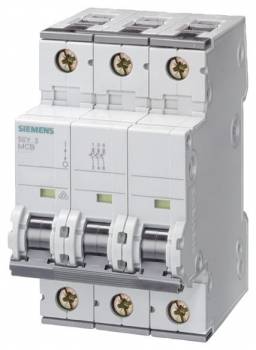
Siemens 5SY43257 Circuit Breaker 3p 25A
| Lieske Part No. | 216421 |
|---|---|
| Mfg Part No | 5SY43257 |
| EAN-Code | 4001869181974 |
| Manufacturer | Siemens |
| Here only | 145,80 EUR
173,50 EUR incl. VAT
|
Further information for Siemens 5SY43257 Circuit Breaker 3p 25A
| General | |
| Degree of protection | Miniature circuit breaker (MCB) |
| Number of poles | 3 way |
| Nominal current | 25 A |
| Switching power | 10 kA |
| Operating voltage | 400 V |
| Characteristic curve | C |
| Construction size | T=70 mm |
| Accessory compatibility | 5SY series |
Applications
The switch is designed for use in low-voltage installations, particularly in distributions requiring safe protection of lines and consumers. It is suitable for applications requiring high switching capacity and reliability, such as in residential and commercial buildings, as well as industrial environments with medium to high electrical loads. The 3-pole design makes it especially suitable for 3-phase networks, where simultaneous disconnection of all phases is required.
Functions and Equipment in Detail
The circuit breaker features a double-chamber terminal that allows any combination of conductors and busbars. This simplifies wiring and offers flexibility during installation. The rear-mounted busbar enables easy and quick power input, reducing installation time. Tool-free installation and removal are achieved via a double slide, simplifying installation and maintenance in operation. The switches are available in various pole configurations, with the 5SY series also including 1-, 2-, 4-pole, as well as 1+N- and 3+N-pole versions.
Technology Explained Simply
The protection function of the device is based on thermal and magnetic tripping mechanisms. In case of overload, a bimetal strip heats up and triggers the switch to trip once a certain temperature is reached. In the event of a short circuit, a high current activates a magnetic tripping mechanism, which also disconnects the switch. The C characteristic defines the tripping delay: it trips at approximately 5-10 times the rated current within seconds to minutes, depending on the load. The switching capacity of 10 kA means the switch can safely disconnect short circuits with currents up to 10,000 A without damage. The operating voltage is 400 V, which corresponds to the standard voltage in 3-phase networks.
Compatibility and Accessories
The complete accessory range is uniformly compatible with all circuit breakers in the 5SY series. This includes, for example, pin busbars in various configurations (e.g., 10 mm² or 16 mm², 3-phase, shock-protected), handle locking devices, auxiliary switches, fault signal switches, remote actuators, and RCD blocks. These components can be combined according to requirements to extend the switch’s functionality, such as integrating residual current protection or remote control.
Installation and Mounting
Mounting is tool-free via a double slide, which is inserted into the corresponding mounting opening in the enclosure. Wiring is done through the double-chamber terminal, suitable for both conductors and busbars. The rear busbar allows direct power input, simplifying wiring. The size T=70 mm corresponds to the standard for modular installation devices and fits in typical distribution boxes.
Operational Advantages
The switch offers high reliability and safety for protecting electrical installations. Tool-free mounting and removal reduce installation time and simplify maintenance work. The flexible wiring options provided by the double-chamber terminal and rear busbar increase flexibility in planning and implementing distributions. The uniform accessory compatibility of the 5SY series enables standardized equipment of enclosures, simplifying planning and maintenance.

This is an offer of:
79279 Vörstetten
https://industry-electronics.com
Tel. 07666/88499-0
Fax. 07666/88499-111
Diesen Artikel finden Sie unter:
industry-electronics.com/artikel/216421

Lieske Elektronik e.K.
Reutener Str. 1079279 Vörstetten
https://industry-electronics.com
Tel. 07666/88499-0
Fax. 07666/88499-111
Diesen Artikel finden Sie unter:
industry-electronics.com/artikel/216421