
Siemens 5SY43207 Circuit Breaker 3p C 20A
Installation > Modular devices / equipment installation > Circuit breaker
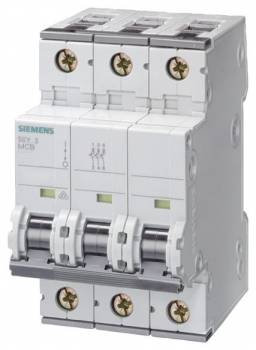
Siemens 5SY43207 Circuit Breaker 3p C 20A
| Lieske Part No. | 137248 |
|---|---|
| Mfg Part No | 5SY43207 |
| EAN-Code | 4001869181967 |
| Manufacturer | Siemens |
| Here only | 134,10 EUR
159,58 EUR incl. VAT
|
Further information for Siemens 5SY43207 Circuit Breaker 3p C 20A
| General | |
| Degree of protection | Miniature circuit breaker (MCB) |
| Switching curve | C |
| Nominal current | 20 A |
| Switching power | 10 kA |
| Nominal voltage | 400 V |
| Number of poles | 3 way |
| Overall width | 70 mm |
| Product series | 5SY4 |
| Manufacturer | Siemens |
Applications
The switch is designed for use in electrical distributions where reliable protection of circuits and consumers is required. It is particularly suitable for installations where high switching capacity and secure disconnection during overload or short-circuit are necessary. The 3-pole configuration makes it appropriate for three-phase AC systems, for example in residential and commercial buildings, where multiple consumers are supplied via a common distribution.
Functions and Equipment in Detail
The circuit breaker 5SY4320-7 features a double-chamber terminal, enabling flexible connections between conductors and busbars. This simplifies installation and allows for any combination of connection types. The rear-mounted busbar facilitates easy wiring of the supply, making installation in the enclosure more efficient. Mounting and dismounting are tool-free via a double slider, which speeds up installation in operation and simplifies maintenance.
Technology Explained Simply
The tripping curve C means that the switch trips within seconds at a current of approximately 5 to 10 times the rated current (i.e., 100 to 200 A at a rated current of 20 A). This is suitable for applications with moderate inrush currents, such as those occurring with electric heaters, pumps, or lighting. The switching capacity of 10 kA ensures that the switch can safely disconnect even under high short-circuit currents without damage. The rated voltage of 400 V corresponds to the standard for three-phase AC systems in Europe.
Compatibility and Accessories
Accessories for the SENTRON series 5SY are standardized and can be combined with all devices in this product line. These include, for example, pin busbars in various configurations (e.g., 3-phase, 10 mm² or 16 mm², with or without end caps), remote actuators, under-voltage release units, load current release units, false signal switches, and locking devices. These components allow application-specific adaptation of protection functions and operability. The locking device with strap (e.g., 5ST3803) can be used to mark the switch in its operational position.
Mounting and Installation
Mounting is carried out in modular installation frames, with the overall width of 70 mm enabling placement in standard enclosures. The tool-free mounting via the double slider reduces installation time and minimizes the risk of incorrect operation. The rear busbar simplifies wiring of the supply, enabling quick and secure electrical connections. The double-chamber terminal allows connections with various conductor cross-sections and busbars, increasing flexibility during installation.
Operational Advantages
The switch offers high operational reliability due to its robust construction and standardized accessory compatibility. The tool-free mounting and simple wiring reduce installation time and error susceptibility. The tripping curve C ensures a balanced response to overloads, avoiding unnecessary disconnections. The switching capacity of 10 kA guarantees safe disconnection even under high short-circuit currents, enhancing the safety of the installation. The standardized accessory range allows flexible expansion of functions, for example by using remote actuators or signaling units.

This is an offer of:
79279 Vörstetten
https://industry-electronics.com
Tel. 07666/88499-0
Fax. 07666/88499-111
Diesen Artikel finden Sie unter:
industry-electronics.com/artikel/137248

Lieske Elektronik e.K.
Reutener Str. 1079279 Vörstetten
https://industry-electronics.com
Tel. 07666/88499-0
Fax. 07666/88499-111
Diesen Artikel finden Sie unter:
industry-electronics.com/artikel/137248