
Siemens 5SU13546KK13 RCD 30mA TypeA
Installation > Modular devices / equipment installation > RCD
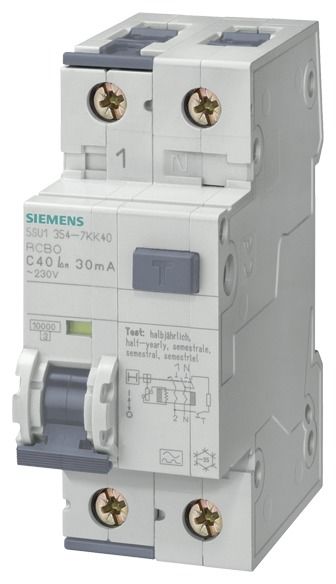
Siemens 5SU13546KK13 RCD 30mA TypeA
| Lieske Part No. | 278133 |
|---|---|
| Mfg Part No | 5SU13546KK13 |
| EAN-Code | 4001869307749 |
| Manufacturer | Siemens |
| Here only | 181,80 EUR
216,34 EUR incl. VAT
|
Further information for Siemens 5SU13546KK13 RCD 30mA TypeA
| General | |
| Degree of protection | Type A |
| Nominal current | 13 A |
| Earth fault trip current | 30 mA |
| Switching power | 10 kA |
| Nominal voltage | 230 V AC |
| Protection function | FI/LS protection (RCBO) |
| Characteristic | B |
| Number of poles | 1P+N |
| Certification | DIN EN 61009-1, DIN EN 61009-2-1 |
| Built-in width | 70 mm |
| Terminal technology | Double chamber terminals |
Residual current circuit breaker with integrated line protection (RCBO) offers a compact solution for combined protection in residential and commercial installations. The double-chamber terminals allow easy connection of conductors with different cross-sections, speeding up installation and enhancing connection reliability. The devices are VDE-tested and certified according to DIN EN 61009-1 and DIN EN 61009-2-1, confirming compliance with European safety standards for residual current circuit breakers. Certification to these standards ensures reliable operation under various operating conditions.
Technology explained clearly – The switch operates on the principle of an RCBO (Residual Current Circuit Breaker with Overcurrent Protection), combining residual current and line protection in a single device. Upon detection of a fault current of at least 30 mA, or in case of overload or short circuit, the circuit is automatically interrupted. The B characteristic responds to increasing currents exceeding the nominal current and trips when the current exceeds a value typical for the B characteristic. The switching capacity of 10 kA means the device can safely trip even under high short-circuit currents without damage.
Compatibility and accessories – The device is part of the SENTRON system and can be expanded with various accessories. These include, for example, remote actuators such as the 5ST3073-0MC, auxiliary switches such as the 5ST3010, undervoltage release units such as the 5ST3040, and pin busbars such as the 5ST3736 or 5ST3638. These components enable flexible expansion of functions, such as remote control, signal output, or connection to other switching devices via pin busbars. The use of pin busbars simplifies wiring and ensures a clean, structured installation.
Mounting and installation – The FI/LS switch is mounted on a standard installation enclosure using a DIN rail. The mounting width is 70 mm, matching the standard for single devices. The double-chamber terminals facilitate connecting conductors of different cross-sections, reducing installation time. Installation must comply with applicable regulations and standards, particularly DIN VDE 0100 and DIN EN 61009.
Advantages in operation – The combination of residual current and line protection in a single device reduces space requirements in the enclosure and simplifies planning and maintenance. VDE certification according to DIN EN 61009-1 and -2-1 ensures high safety. The B characteristic enables selective tripping, increasing the availability of power supply. The integrated data matrix code function allows quick access to technical data via the Siemens Industry Online Support App, simplifying maintenance and documentation. The use of pin busbars and compatible accessories enables flexible functional expansion without additional mounting effort.
The device is designed for use in electrical systems requiring protection against electric shock and overloads. It is particularly suitable for apartments, office buildings, commercial enterprises, and other installations where high safety and reliability are required. The combination of residual current and line protection in a single device provides an efficient and compact solution for protecting electrical installations.

This is an offer of:
79279 Vörstetten
https://industry-electronics.com
Tel. 07666/88499-0
Fax. 07666/88499-111
Diesen Artikel finden Sie unter:
industry-electronics.com/artikel/278133

Lieske Elektronik e.K.
Reutener Str. 1079279 Vörstetten
https://industry-electronics.com
Tel. 07666/88499-0
Fax. 07666/88499-111
Diesen Artikel finden Sie unter:
industry-electronics.com/artikel/278133