
Siemens 5SU1354-1KK16 FI/LS switch 1P+N 30 mA
Installation > Modular devices / equipment installation > RCD
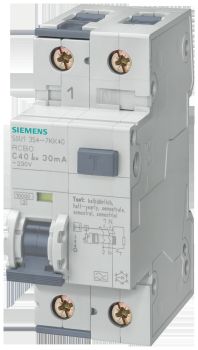
Siemens 5SU1354-1KK16 FI/LS switch 1P+N 30 mA
| Lieske Part No. | 128925 |
|---|---|
| Mfg Part No | 5SU13541KK16 |
| EAN-Code | 4001869307664 |
| Manufacturer | Siemens |
| Here only | 180,90 EUR
215,27 EUR incl. VAT
|
Further information for Siemens 5SU1354-1KK16 FI/LS switch 1P+N 30 mA
| General | |
| Nominal current | 16 A |
| Operating voltage | 230 V AC |
| Earth fault type | AC |
| Rated tripping sensitivity | 30 mA |
| Release characteristic | C |
| Switching power | 10 kA |
| Number of poles | 1P+N |
| Test button | |
Applications
The residual current circuit breaker 5SU1354-1KK16 is intended for use in electrical distributions within low-voltage technology. It is typically installed in apartments, office buildings, commercial enterprises, or small production facilities where personal protection is required. The combination of residual current and line protection functions enables a compact solution that protects against both overloads and dangerous earth leakage currents. The protection class IP20 excludes use in outdoor environments or damp rooms, as there is no protection against splashing water or dust.
Functions and Equipment in Detail
The switch is designed as a 1P+N model, meaning it protects one phase conductor and one neutral conductor. The rated tripping sensitivity of 30 mA ensures that the switch trips even at low earth leakage currents that may be dangerous to humans. The type C tripping characteristic allows for a tolerant response to short-term current surges that occur during the startup of motors or electronic devices, without unnecessary tripping. The maximum switching capacity is 10 kA, indicating the switch’s ability to safely interrupt a short-circuit current up to this magnitude. The integrated test button enables regular functional testing of the switch to ensure the reliability of the protective function.
Technology Explained Simply
The RCD/MCB switch combines two protective functions in one device: residual current protection (RCD) and line protection (MCB). Residual current protection detects when current flows from the electrical installation to earth, for example, due to insulation faults or contact with a metallic enclosure. When the threshold of 30 mA is reached, the circuit is interrupted. Line protection safeguards against overloads and short circuits by tripping when current values exceed the rated current of 16 A. The type C tripping characteristic ensures that the switch does not unnecessarily trip during short-term current surges that are not harmful, but only during sustained overloads. The protection class IP20 means the switch is protected against contact with fingers or similar objects, but not against dust or water.
Compatibility and Accessories
The switch is compatible with various accessories that extend its functionality. These include auxiliary switches such as the 5ST3014-2 or 5ST3015, which provide additional switching functions for controls or signals. Fault signal switches such as the 5ST3022-2 or 5ST3021-2 enable visual or audible indication of a tripping event. Load current release units such as the 5ST3031 or 5ST3030 can be used for remote control of the switch. Undervoltage release units such as the 5ST3043 or 5ST3045 ensure the switch automatically trips during undervoltage conditions. Rotary drives such as the 5ST3060 enable mechanical remote control.
Installation and Mounting
The switch is designed for modular installation in standard distribution boards. Mounting is done in a 1-module size, enabling compact placement within distribution boards. Connections are made via screw terminals designed for connecting electrical conductors. Installation must comply with applicable electrical regulations, particularly VDE 0100 and DIN VDE 0664. The test button must be operated regularly to check the switch’s functionality. Installation should be carried out by a qualified electrician to ensure the safety of the installation.
Advantages in Operation
Using the Siemens 5SU1354-1KK16 provides reliable protection for persons and equipment. The combination of residual current and line protection in a single device reduces space requirements in the distribution board and simplifies planning and installation. The type C tripping characteristic ensures an appropriate response to load surges, increasing the availability of the electrical installation. The integrated test button enables simple and regular functional checks, simplifying maintenance. Compatibility with various accessories expands application possibilities and allows customized adaptation to specific requirements.

This is an offer of:
79279 Vörstetten
https://industry-electronics.com
Tel. 07666/88499-0
Fax. 07666/88499-111
Diesen Artikel finden Sie unter:
industry-electronics.com/artikel/128925

Lieske Elektronik e.K.
Reutener Str. 1079279 Vörstetten
https://industry-electronics.com
Tel. 07666/88499-0
Fax. 07666/88499-111
Diesen Artikel finden Sie unter:
industry-electronics.com/artikel/128925