
Siemens 5SL61106 Circuit Breaker 1p B 10A
Installation > Modular devices / equipment installation > Circuit breaker
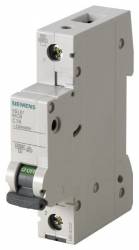
Siemens 5SL61106 Circuit Breaker 1p B 10A
| Lieske Part No. | 622005 |
|---|---|
| Mfg Part No | 5SL61106 |
| EAN-Code | 4001869388281 |
| Manufacturer | Siemens |
| Here only | 13,68 EUR
16,28 EUR incl. VAT
|
Further information for Siemens 5SL61106 Circuit Breaker 1p B 10A
| General | |
| Degree of protection | B |
| Nominal current | 10 A |
| Operating voltage | 230/400 V |
| Switching power | 6 kA |
| Number of poles | 1 way |
| Device series | SENTRON |
| Mounting method | tool-free |
| Connection type | Rear busbar |
| Accessory compatibility | Auxiliary power switch, handle lock, pin busbars, spacers |
Applications
The switch is intended for standard applications in electrical installations, particularly in single-family homes, multi-family buildings, and small commercial and office buildings. It protects electrical wiring and connected loads against thermal overload and short-circuit currents. The single-pole configuration is suitable for single-phase circuits, for example for lighting, socket outlets, or small consumer installations. Use in 1+N or 3+N pole configurations is also possible, with the exact configuration varying according to application and circuit diagram.
Functions and Equipment in Detail
The circuit breaker allows tool-free mounting and removal, simplifying installation and maintenance in modular enclosures. The rear-mounted busbar facilitates wiring of the supply and ensures a structured and secure connection. The switches are available in various pole configurations, with the single-pole version applying to the configuration described here. The device is part of a comprehensive product system that can be extended with various accessories, such as auxiliary switches or handle locks, to realize additional functions such as signal output or mechanical protection.
Technology Explained Simply
Protection type B means that the switch disconnects at a certain current level (here 10 A) during overload after a defined time, with the disconnection time depending on the magnitude of the overload current. In case of short-circuit currents significantly exceeding the nominal current, immediate disconnection occurs. The switching capacity of 6 kA describes the maximum current the switch can safely interrupt without damage to the device or the installation. The operating voltage of 230/400 V covers common voltages in low-voltage installations, with 230 V applying to single-phase and 400 V to three-phase systems.
Compatibility and Accessories
The switch is compatible with various accessories that extend its functionality. These include, for example, auxiliary switches (e.g. 5ST3010), which enable signal output based on switch position, or handle locks (e.g. 5ST3806), which prevent unintended operation. Pin busbars (e.g. 5ST3614, 5ST3740, 5ST3731) in various configurations (single-phase, three-phase, different cross-sections) can be used to connect multiple switches. The busbars are available in various lengths and cross-sections (e.g. 10 mm², 16 mm²) and allow flexible adaptation to the specific installation. Spacers (e.g. 5TG8240) serve to provide optical and mechanical separation of devices in modular enclosures.
Mounting and Installation
Mounting is tool-free in modular enclosures, with the device installed in standard installation enclosures or boxes. The rear busbar enables easy and secure connection of the supply. Installation must comply with applicable electrical regulations, particularly VDE 0100 and DIN VDE 0664. Wiring is done via designated connection points, with polarity and current direction to be observed. The switches are intended for use in enclosed enclosures, with ambient conditions (temperature, humidity) complying with normative requirements.
Advantages in Operation
The switch provides reliable protection against overload and short circuit, ensuring the safety of the electrical installation and connected devices. Tool-free mounting reduces installation time and minimizes error susceptibility. The use of accessories allows individual adaptation to specific requirements, such as monitoring switch position or mechanical protection. Compatibility with various busbars and accessories ensures flexibility in planning and execution of electrical installations.

This is an offer of:
79279 Vörstetten
https://industry-electronics.com
Tel. 07666/88499-0
Fax. 07666/88499-111
Diesen Artikel finden Sie unter:
industry-electronics.com/artikel/622005

Lieske Elektronik e.K.
Reutener Str. 1079279 Vörstetten
https://industry-electronics.com
Tel. 07666/88499-0
Fax. 07666/88499-111
Diesen Artikel finden Sie unter:
industry-electronics.com/artikel/622005