
Siemens 5SH317 Fuse Holder Screw DIII 35A
Installation > Securing material > D-Fuses and Accessories
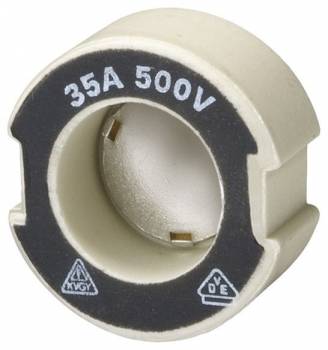
Siemens 5SH317 Fuse Holder Screw DIII 35A
| Lieske Part No. | 320349 |
|---|---|
| Mfg Part No | 5SH317 |
| EAN-Code | 4001869023922 |
| Manufacturer | Siemens |
| Here only | 2,42 EUR
2,88 EUR incl. VAT
|
Further information for Siemens 5SH317 Fuse Holder Screw DIII 35A
| General | |
| Manufacturer | Siemens |
| Fusing system | DIAZED |
| Utilization category | DIII |
| Nominal current | 35 A |
| Norm | IEC 60269-3 |
| Accessory compatibility | DIAZED fuse inserts, DIAZED fuse holders |
DIAZED fuse system
The DIAZED system from Siemens is a proven fuse system developed since 1906 and used worldwide in electrical installation. It is designed for use in distributors and switchgear and provides protection for people, equipment and installations. The locking screw 5SH317 is part of this system and is used for the secure fixation of fuse inserts in the socket. The design conforms to standard IEC 60269-3, enabling international use in many countries.
Applications
The locking screw is used in industrial electrical engineering as well as in household installations. It is intended for use in distributors and switchgear, where a secure and reliable connection between fuse insert and socket is required. The system is user-friendly and approved for use in private households, provided that installation complies with applicable regulations. The locking screw is compatible with fuse inserts rated at 35 A in the DIII system.
Functions and equipment in detail
The D-locking screw 5SH317 is specifically designed for use with DIAZED and NEOZED fuse inserts. It ensures a firm and secure connection between the fuse insert and the socket, preventing accidental loosening or loss of contact. The screw is part of a coordinated portfolio that includes various socket and fuse types, enabling flexible and standardized installation. The locking screw is suitable for use in single-pole and three-pole sockets, available in various versions.
Technology explained simply
The locking screw is a mechanical component that secures the electrical connection between the fuse insert and the socket. It is screwed into the socket and holds the fuse insert in position, ensuring a reliable electrical contact. The locking screw is made of robust material suitable for the requirements of electrical installation. The design conforms to IEC 60269-3, enabling international standardization and compatibility with other components of the DIAZED system.
Compatibility and accessories
The locking screw 5SH317 is compatible with various fuse inserts and sockets of the DIAZED system. Compatible accessories include, for example, the DIAZED fuse socket 5SF1260, 5SF4230, 5SF1205, and 5SF5268. Fuse inserts such as 5SB4111 or 5SD8035 are also compatible with this locking screw. The locking screw is used in combination with sockets executed in classic screw technology to ensure secure installation.
Installation and mounting
The mounting of the locking screw is done by inserting it into the designated socket and then screwing it in. The screw must be tightened securely but not excessively to ensure a reliable connection without damaging the component. Installation usually takes place during the mounting of a fuse insert into a socket, where the locking screw ensures mechanical stability. The locking screw is intended for use in distributors and switchgear, with installation complying with applicable regulations.
Advantages in operation
The locking screw 5SH317 provides a reliable and secure connection between fuse insert and socket, increasing operational safety. The use of a standardized component from the DIAZED system ensures compatibility and interchangeability. The locking screw is robust and suitable for use in industrial and household installations. Standardization according to IEC 60269-3 enables international use and simplifies planning and installation in various projects.

This is an offer of:
79279 Vörstetten
https://industry-electronics.com
Tel. 07666/88499-0
Fax. 07666/88499-111
Diesen Artikel finden Sie unter:
industry-electronics.com/artikel/320349

Lieske Elektronik e.K.
Reutener Str. 1079279 Vörstetten
https://industry-electronics.com
Tel. 07666/88499-0
Fax. 07666/88499-111
Diesen Artikel finden Sie unter:
industry-electronics.com/artikel/320349