
Siemens 4AM6542-8ED40-0FA0 transformer 1Upri=600-230V
Industrial Material > Automation > Power supplies, transformers and power supplies
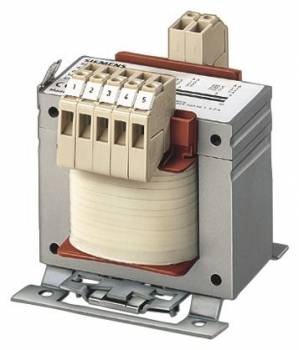
Siemens 4AM6542-8ED40-0FA0 transformer 1Upri=600-230V
| Lieske Part No. | 655270 |
|---|---|
| Mfg Part No | 4AM65428ED400FA0 |
| EAN-Code | 4001869905273 |
| Manufacturer | Siemens |
| Here only | 1.414,27 EUR
1.682,98 EUR incl. VAT
|
Further information for Siemens 4AM6542-8ED40-0FA0 transformer 1Upri=600-230V
| General | |
| Phases | 1 |
| Nominal power | 2,5 kVA |
| Short-time rating (S6) | 13,3 kVA |
| Primary voltage | 600-575-550-525-500-480-460-440-415-400-240-230 V |
| Secondary voltage | 2x115 V |
| Secondary current | 10,9-21,8 A |
| Frequency | 50...60 Hz |
| Switching group | II0 |
| Shielding value | 0 |
| Ambient temperature | 40 °C |
| Insulation class | B |
| Degree of protection | IP00 |
| Connection type | screw/flat pin connection |
| Mounting method | Screws |
| Compliance with standards | EN 61558-2-1, -2-2, -2-4 |
| Approval | UL/CSA-Recognized |
Applications
The transformer is intended for use in industrial control and regulation systems, particularly in installations requiring galvanic isolation between primary and secondary sides. It is commonly used in machine building, manufacturing plants, and automation technology, where the safety of equipment and operators is paramount. The isolation of circuits reduces the risk of electric shock and enables the supply of control devices, relays, contactors, and other electronic components with a safe, galvanically isolated voltage.
Functions and Equipment in Detail
The transformer features a primary voltage setting available in multiple steps from 230 V to 600 V, allowing flexible adaptation to various supply voltages. The secondary voltage is constantly 2x115 V, typical for supplying control and auxiliary circuits. The rated power of 2.5 kVA is achieved under continuous operation (S1 operating mode), while the short-time power of 13.3 kVA (S6 operating mode) is intended for time-limited load peaks. The current on the secondary side varies depending on voltage setting between 10.9 A and 21.8 A.
Technology Explained Simply
Galvanic isolation between primary and secondary sides is achieved through insulation of the windings, preventing direct electrical contact between circuits. This protects personnel and equipment from dangerous touch voltages. The winding group II0 and shielding factor 0 indicate a specific winding configuration optimized for intended applications. Insulation class B and ambient temperature of 40 °C (TA) ensure reliable operation under industrial conditions. Protection class IP00 means the transformer is not protected against mechanical impacts or moisture and must therefore only be installed in enclosed switch cabinets or enclosures.
Compatibility and Accessories
The transformer is compliant with electrical installations according to standards EN 61558-2-1, -2-2, and -2-4. It is UL/CSA-Recognized, confirming its suitability for use in installations according to safety requirements in the USA and Canada. Connections are made via screw and flat pin terminals, enabling flexible and secure connections with cables and conductors. Mounting is done using screws, allowing installation in standard enclosures or switchgear.
Mounting and Installation
Mounting is done via screw fastening in a closed enclosure or switchgear. Due to protection class IP00, the transformer is not suitable for outdoor use or in damp environments. It must be installed in a protected, dry room to ensure functionality and service life. The connection terminals allow for secure and mechanically stable connections with conductors.
Advantages in Operation
The combination of control, isolation, and safety transformer functions in a single device reduces the number of required components and simplifies circuit diagram planning. The high short-time power enables supply of loads requiring short-term higher currents, such as during motor or relay start-up phases. Compliance with international standards and UL/CSA approval increases acceptance in international projects.

This is an offer of:
79279 Vörstetten
https://industry-electronics.com
Tel. 07666/88499-0
Fax. 07666/88499-111
Diesen Artikel finden Sie unter:
industry-electronics.com/artikel/655270

Lieske Elektronik e.K.
Reutener Str. 1079279 Vörstetten
https://industry-electronics.com
Tel. 07666/88499-0
Fax. 07666/88499-111
Diesen Artikel finden Sie unter:
industry-electronics.com/artikel/655270