
Siemens 3UG4825-2CA40 monitoring relay digital earth fault monitoring
Industrial Material > Industrial relays and contactors > Switching units / measuring, control relay
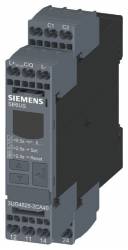
Siemens 3UG4825-2CA40 monitoring relay digital earth fault monitoring
| Lieske Part No. | 686787 |
|---|---|
| Mfg Part No | 3UG48252CA40 |
| EAN-Code | 4011209912540 |
| Manufacturer | Siemens |
| Here only | 468,66 EUR
557,71 EUR incl. VAT
|
Further information for Siemens 3UG4825-2CA40 monitoring relay digital earth fault monitoring
| General | |
| Operating voltage | 24 V DC |
| Adjustable range of warning threshold | 0,03 A |
| Adjustable range of trip value | 40 A |
| Start-up delay | 0 s |
| Release delay | 999,9 s |
| Switch-off hysteresis | 50 % |
| Warning hysteresis | 5 % |
| Number of changeover contacts | 2 |
| Connection system | Spring tension |
| Fault memory | Switchable |
| Indication | actual value, fault type |
| Self-monitoring | permanent |
| Accessory compatibility | Differenzstromwandler 3UL23 |
Applications
This device is suitable for monitoring electrical installations in industrial environments, particularly in areas where high safety and reliability of power supply are required. It is used to detect hazardous fault currents early and, if necessary, trigger a shutdown or warning to prevent damage to machines or personnel. Applications include production plants, conveyor systems, or systems with increased moisture or dust risk.
Functions and Equipment in Detail
The relay features digital parameterization controlled via a menu. The adjustable ranges for warning threshold and trip value are between 0.03 A and 40 A, with both values adjustable independently. The start-up and trip delay can be set between 0 and 999.9 seconds, allowing flexible adaptation to various system conditions. The trip hysteresis is up to 50%, while the warning hysteresis is fixed at 5%. These functions ensure precise and reliable response to fault currents without unnecessary false trips.
Technology Explained Simply
The device operates with spring-loaded technology, ensuring a secure and vibration-resistant connection. The display continuously shows the actual value or the type of fault, enabling quick diagnosis. High measurement accuracy and continuous self-monitoring ensure the device independently checks its own functionality. An optional fault memory allows storage of fault information, which is helpful for maintenance and diagnosis. Removable terminals facilitate device replacement without requiring re-wiring.
Compatibility and Accessories
Current transformers are available in various widths, such as 35 mm, 55 mm, 80 mm, 105 mm, 140 mm, and 210 mm, and support fault current ranges from 30 mA to 40 A. Additional accessories include tamper-proof covers (e.g., 3RP1902), adapters for screw mounting (3RP1903), as well as device identification plates and insert clips, which are uniformly compatible with all relays in the SIRIUS series.
Mounting and Installation
Mounting is done in standard enclosures. The device has a width of 22.5 mm and is equipped with two changeover contacts. Connection options include both screw connection and spring-loaded connection, with the latter enabling quick, maintenance-free, and vibration-resistant connections. Installation is facilitated by menu-guided parameterization and actual value display for rapid commissioning.
Advantages in Operation
Digital adjustability and clear fault indication ensure high operational safety. Self-monitoring and fault memory support maintenance and diagnostics. The combination of high flexibility and space-saving, due to the possibility of mounting the residual current transformer inside or outside the enclosure, makes the device suitable for various application scenarios. Global usability, enabled by wide voltage supply and international certifications, extends the application range beyond national borders.
The device is marked as discontinued; the preferred successor is model 3UG5825-1AA40, which is also available with IO-Link and offers similar functions.

This is an offer of:
79279 Vörstetten
https://industry-electronics.com
Tel. 07666/88499-0
Fax. 07666/88499-111
Diesen Artikel finden Sie unter:
industry-electronics.com/artikel/686787

Lieske Elektronik e.K.
Reutener Str. 1079279 Vörstetten
https://industry-electronics.com
Tel. 07666/88499-0
Fax. 07666/88499-111
Diesen Artikel finden Sie unter:
industry-electronics.com/artikel/686787