
Siemens 3SK21121AA10 safety relay 3-pole
Industrial Material > Industrial relays and contactors > Safety relay
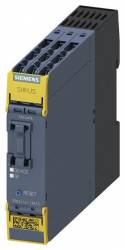
Siemens 3SK21121AA10 safety relay 3-pole
| Lieske Part No. | 900749 |
|---|---|
| Mfg Part No | 3SK21121AA10 |
| EAN-Code | 4047621004914 |
| Manufacturer | Siemens |
| Here only | 661,50 EUR
787,19 EUR incl. VAT
|
Further information for Siemens 3SK21121AA10 safety relay 3-pole
| General | |
| Mounting width | 22,5 mm |
| Operating voltage | 24 V DC |
| Number of safety inputs | 10 |
| Number of fault-safe semiconductor outputs | 2 |
| Number of semiconductor outputs | 1 |
| Degree of protection | IP20 |
| Safety approval | SIL 3 (IEC 62061) |
| Performance level | e (ISO 13849-1) |
| Connection type | Screw connection |
| Parameterization | via SIRIUS Safety ES |
| Compatibility | with 3SK1, 3RQ1, 3RM1 |
Applications
This safety control device is used in systems that must meet high safety requirements, such as in the machine building industry, for monitoring safety doors, or for muting functions in packaging and assembly systems. Compliance with standards SIL 3 (IEC 62061) and Performance Level e (ISO 13849-1) makes it suitable for critical applications where high availability and reliability are required. The integrated logic building blocks simplify the implementation of safety functions without additional programming effort.
Functions and Equipment in Detail
The device features powerful semiconductor outputs designed for controlling loads in safety functions. The outputs can be connected via device connectors to output extensions from the 3SK1 series, coupling relays from the 3RQ1 series, or fault-safe motor starters from the 3RM1 series. This allows for flexible expansion of the number of outputs and seamless integration into existing safety architectures. Wiring is done via screw terminals, with a spring-cage connection (Push-In) also available.
Technology Explained Simply
The safety functions of the device are based on redundant signal paths and fault-safe semiconductor outputs that reliably switch off in the event of a fault. Configuration via SIRIUS Safety ES allows precise setup of the logic, enabling various safety functions to be processed in parallel. The software also supports error diagnosis, making maintenance and servicing more efficient. The protection rating IP20 is suitable for use in enclosed switchgear, with the devices mounted in standard switchboards.
Compatibility and Accessories
The safety control device is compatible with various accessories, including output extensions from the 3SK1 series, coupling relays from the 3RQ1 series, and fault-safe motor starters from the 3RM1 series. These components can be connected via device connectors, avoiding additional wiring. Additional accessories include mounting clips for wall mounting, coding pins for identification, and sealing caps, which facilitate handling and maintenance. Integration into existing SIRIUS systems is straightforward.
Mounting and Installation
Mounting is done in standard switchboards using screw or spring-cage terminals. The width of 22.5 mm allows for compact placement in confined switchgear. The use of device connectors for connecting extensions and motor starters reduces wiring effort. Installation requires no special tools, as the connections are standardized.
Advantages in Operation
The combination of compact design, high safety performance, and flexible expandability makes the device a reliable solution for complex safety applications. Software support via SIRIUS Safety ES reduces commissioning effort and enables quick error diagnosis. Integration into existing SIRIUS systems requires no additional effort, enabling efficient maintenance and expansion of the system. Compliance with SIL 3 and Performance Level e standards ensures reliability in critical applications.

This is an offer of:
79279 Vörstetten
https://industry-electronics.com
Tel. 07666/88499-0
Fax. 07666/88499-111
Diesen Artikel finden Sie unter:
industry-electronics.com/artikel/900749

Lieske Elektronik e.K.
Reutener Str. 1079279 Vörstetten
https://industry-electronics.com
Tel. 07666/88499-0
Fax. 07666/88499-111
Diesen Artikel finden Sie unter:
industry-electronics.com/artikel/900749