
Siemens 3RW5217-3TC04 soft starter 200-480V 38A
Industrial Material > Automation > Frequency converter, soft starter
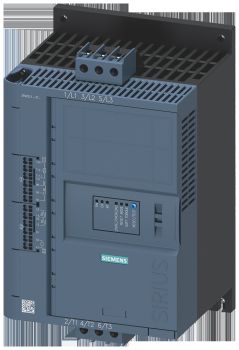
Siemens 3RW5217-3TC04 soft starter 200-480V 38A
| Lieske Part No. | 128586 |
|---|---|
| Mfg Part No | 3RW52173TC04 |
| EAN-Code | 4047621036670 |
| Manufacturer | Siemens |
| Here only | 1.264,20 EUR
1.504,40 EUR incl. VAT
|
Further information for Siemens 3RW5217-3TC04 soft starter 200-480V 38A
| General | |
| Operating voltage | 200-480 V |
| Control supply voltage | AC/DC 24 V |
| Nominal current | 38 A |
| Connection type | Spring clamp terminals |
| Communication modules | PROFINET, PROFIBUS, Modbus TCP |
| Approvals | IEC, UL/CSA |
| Thermistor input | |
| Soft torque | |
| Remote reset | |
Applications
The soft starter is designed for simple applications where gentle motor control is required to relieve the power grid and minimize mechanical stress. It is particularly suitable for drives with high starting currents, where direct starting with high current peaks should be avoided. The 3-phase control makes it especially suitable for high motor powers and root-3 switching. The integrated Soft-Torque function ensures particularly gentle motor acceleration, thereby extending the service life of drive components.
Functions and equipment in detail
The soft starter features intelligent monitoring functions that protect the soft starter from overheating and the motor from overload. The current during start-up can be limited to an adjustable maximum value to relieve the network. An integrated remote reset enables remote troubleshooting, reducing maintenance time. The control supply voltage is AC/DC 24 V, allowing flexible integration into existing control systems. The connection type is spring-cage terminals, ensuring fast and secure wiring. An integrated thermistor input allows motor monitoring via thermistors and automatic shutdown in case of overload.
Technology explained simply
The soft starter operates with stepless voltage control, gently accelerating the motor instead of starting it directly at full voltage. This reduces mechanical stress on drive components and avoids sudden current peaks that could burden the power grid. The integrated bypass switches the motor directly to the line voltage after start-up, so the soft starter is no longer in the current circuit and thus saves energy. The 3-phase control ensures uniform and stable control of all three phases, which is particularly important for large motors.
Compatibility and accessories
The soft starter is compatible with optional plug-in communication modules enabling connection via PROFINET, PROFIBUS, and Modbus TCP. For operation, various HMI modules are available, which can be installed in the device or in the enclosure door. Additional accessories such as fan covers, hinged lids, identification plates, and power switches are available, facilitating integration into existing enclosures. The devices are globally approved, for example according to IEC and UL/CSA, ensuring international usability.
Mounting and installation
Mounting is done in standard enclosures. The spring-cage terminals allow fast and secure wiring without additional tools. The devices are designed for networks in the voltage range of 200 to 480 V and can be flexibly used in combination with other SIRIUS modules and accessories. Installation must follow the technical instructions in the manufacturer’s manual, which are required for correct operation.
Advantages in operation
Operation of the soft starter is maintenance-free, as no mechanical switches are involved in the current circuit. The integrated protection functions increase operational safety and extend the motor’s service life. The space and wiring savings compared to star-delta starters and frequency converters reduce installation effort. The remote reset function enables quick fault resolution without physical access to the device, increasing operational uptime.

This is an offer of:
79279 Vörstetten
https://industry-electronics.com
Tel. 07666/88499-0
Fax. 07666/88499-111
Diesen Artikel finden Sie unter:
industry-electronics.com/artikel/128586

Lieske Elektronik e.K.
Reutener Str. 1079279 Vörstetten
https://industry-electronics.com
Tel. 07666/88499-0
Fax. 07666/88499-111
Diesen Artikel finden Sie unter:
industry-electronics.com/artikel/128586