
Siemens 3RH19212JE11 auxiliary switch 1S+1Ö encapsulated
Industrial Material > Control devices / Pilot devices > Motor protection switch
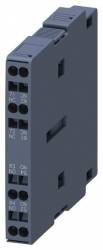
Siemens 3RH19212JE11 auxiliary switch 1S+1Ö encapsulated
| Lieske Part No. | 124385 |
|---|---|
| Mfg Part No | 3RH19212JE11 |
| EAN-Code | 4011209557444 |
| Manufacturer | Siemens |
| Here only | 50,96 EUR
60,64 EUR incl. VAT
|
Further information for Siemens 3RH19212JE11 auxiliary switch 1S+1Ö encapsulated
| General | |
| Degree of protection | Encapsulated |
| Number of normally open contacts (NO) | 1 |
| Number of normally closed contacts (NC) | 1 |
| Connection system | Spring clamp connection |
| Mounting method | Sideways |
| Compatibility | For contactors 3RT1 sizes S0-S12 |
| Function | Positive-guided contact elements |
| Norm | DIN EN50012 |
Applications
The auxiliary switch is used in industrial plants where additional signals are required for control, monitoring, or feedback. It is particularly suitable for applications in automation technology, where signal processing occurs via auxiliary contacts, for example, to indicate the switching state, to control additional components, or to integrate into safety circuits. The side mounting allows flexible placement on existing contactors without loading the front side.
Functions and Equipment in Detail
The auxiliary switch 3RH1921-2JE11 features one close contact and one open contact, both switching without delay. These contacts are designed as forced-guided contact elements, meaning they are mechanically coupled to the main contact of the contactor and exactly replicate its switching operation. The contacts are encapsulated, providing high mechanical stability and protection against external influences. The electrical connection is made via spring-cage terminal, enabling quick and secure mounting without additional tools.
Technology Explained Simply
The function of the auxiliary switch is based on mechanical coupling with the main contact of the power contactor. When the main contact switches, the auxiliary switch is activated via a mechanical connection. The close contact opens when the main contact closes, and the open contact closes when the main contact opens. This function allows the state of the contactor to be mirrored in a separate control circuit. The spring-cage connection ensures a secure and durable electrical connection without requiring screw connections to be tightened. The encapsulation protects the contacts from dust, moisture, and mechanical stress, increasing service life.
Compatibility and Accessories
The auxiliary switch is specifically designed for power contactors of the 3RT1 series and can be mounted on sizes from S0 to S12. It is available as a side-mounted auxiliary switch, allowing it to be installed parallel to the front side of the contactor. The 3RH19/3RH29 series offers various variants, including front- and side-mountable models with different contact configurations. The auxiliary switches can be used as mirror contacts with 3RT power contactors or as forced-guided contact elements in 3RH auxiliary contactors.
Mounting and Installation
Mounting is tool-free on contactors of the 3RT1 series. The side fixation is achieved via a mechanical interlock, ensuring a secure and stable connection. The electrical connection is made via the spring-cage terminal, eliminating the need for additional tools or screw connections. Installation is therefore quick and simple, without requiring special mounting equipment.
Operational Advantages
Using the auxiliary switch enables expansion of control functions without additional components. The tool-free mounting reduces installation time and minimizes error sources. The mechanical coupling with the main contact ensures high reliability and precise signal transmission. The spring-cage connection provides a secure electrical connection that remains stable even during frequent switching operations. The encapsulation increases service life and operational safety, especially in industrial environments with increased contamination risks.

This is an offer of:
79279 Vörstetten
https://industry-electronics.com
Tel. 07666/88499-0
Fax. 07666/88499-111
Diesen Artikel finden Sie unter:
industry-electronics.com/artikel/124385

Lieske Elektronik e.K.
Reutener Str. 1079279 Vörstetten
https://industry-electronics.com
Tel. 07666/88499-0
Fax. 07666/88499-111
Diesen Artikel finden Sie unter:
industry-electronics.com/artikel/124385