
Siemens 3RF2320-2CA02 semiconductor contactor 20A 24-230V/24VDC
Industrial Material > Industrial relays and contactors > Contactors
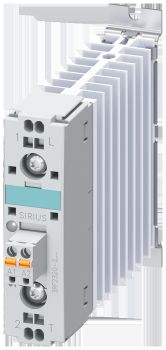
Siemens 3RF2320-2CA02 semiconductor contactor 20A 24-230V/24VDC
| Lieske Part No. | 127572 |
|---|---|
| Mfg Part No | 3RF23202CA02 |
| EAN-Code | 4011209572683 |
| Manufacturer | Siemens |
| Here only | 111,60 EUR
132,80 EUR incl. VAT
|
Further information for Siemens 3RF2320-2CA02 semiconductor contactor 20A 24-230V/24VDC
| General | |
| Switching class | AC51 |
| Rated current | 20 A |
| Operation temperature | 40 °C |
| Actuation voltage | 24-230 V |
| Connection type | Screw, spring-cage, or ring terminal connection |
| Approvals | IEC, UL/CSA |
| Type of device | Semiconductor contactor |
| Number of phases | 1 phase |
| Product series | SIRIUS |
Applications
This semiconductor contactor is intended for use in industrial control and automation systems, particularly in applications requiring disturbance-free and quiet switching functions. Typical applications include controlling heating and cooling elements, valves, pumps, or other electrical consumers in production and packaging lines. The devices are globally approved and comply with international standards such as IEC and UL/CSA, ensuring safe and standard-compliant integration into existing systems.
Functions and Equipment in Detail
The device has a rated current of 20 A and is designed for an operating temperature up to 40 °C. It can be operated with a control voltage in the range of 24 to 230 V AC or 24 V DC. The switching function is performed using semiconductor technology, thereby avoiding mechanical contacts and associated wear. The devices are classified in switching class AC51, indicating use with inductive loads. Mounting is done on a DIN rail, with the compact design minimizing space requirements.
Technology Explained Simply
Semiconductor technology enables wear-free switching, as no mechanical contacts are involved. This eliminates maintenance work due to contact wear. The devices operate silently, making them suitable for environments with high noise emission requirements. The integrated cooling ensures the device remains thermally stable even under continuous load. Control is performed via an electrical voltage, which can be connected using screw, spring-cage, or ring terminal connections, allowing flexible wiring.
Compatibility and Accessories
The semiconductor contactor is part of the SIRIUS system building kit and can be extended with standardized function modules from the 3RF29 series. These modules can be easily clicked on and extend functionality, for example by adding protection functions or signaling units. Additional accessories include control plugs and terminal covers, which facilitate installation and maintenance. Compatible devices from the series include, for example, model 3RF2320-1CA02 for a different voltage range or model 3RF2320-2CA04 with another voltage range.
Mounting and Installation
Mounting is done on a DIN rail inside the enclosure. The integrated cooling allows direct installation without additional cooling measures. Connection options include screw, spring-cage, and ring terminal connections, enabling flexible wiring to existing cables. The devices are designed for use in enclosed enclosures and require no special environmental conditions beyond the specified operating temperature of 40 °C.
Operational Advantages
The wear-free switching function results in a long service life and reduces maintenance requirements. The silent operation enables use in sensitive environments. The integrated cooling and compact design optimize space requirements in the enclosure. Global approval according to IEC and UL/CSA ensures safe and standard-compliant integration into various application scenarios. The expandability via function modules allows flexible adaptation to specific requirements without a complete system overhaul.

This is an offer of:
79279 Vörstetten
https://industry-electronics.com
Tel. 07666/88499-0
Fax. 07666/88499-111
Diesen Artikel finden Sie unter:
industry-electronics.com/artikel/127572

Lieske Elektronik e.K.
Reutener Str. 1079279 Vörstetten
https://industry-electronics.com
Tel. 07666/88499-0
Fax. 07666/88499-111
Diesen Artikel finden Sie unter:
industry-electronics.com/artikel/127572