
Siemens 3RB3123-4SE0 motor protection switch 3-12A
Industrial Material > Control devices / Pilot devices > Motor protection switch
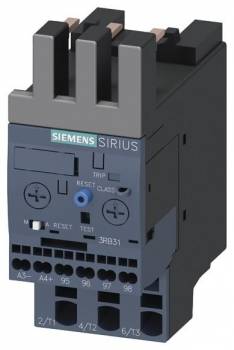
Siemens 3RB3123-4SE0 motor protection switch 3-12A
| Lieske Part No. | 718974 |
|---|---|
| Mfg Part No | 3RB31234SE0 |
| EAN-Code | 4011209749672 |
| Manufacturer | Siemens |
| Here only | 236,20 EUR
281,08 EUR incl. VAT
|
Further information for Siemens 3RB3123-4SE0 motor protection switch 3-12A
| General | |
| Adjustment range | 3-12 A |
| Release class | 5-30 |
| Construction size | S0 |
| Type of electrical connection of main circuit | spring clamp |
| Connection type auxiliary circuit | spring clamp |
| Reset function | Manual-automatic RESET |
| Earth fault detection | Internal |
| Remote reset | Integrated |
| Approvals | IEC, UL/CSA |
| ATEX suitability | |
Applications
This overload relay is designed for use in industrial control and switching systems, particularly in installations with electric motors. It is suitable for applications requiring high reliability and precise protection functions, such as in manufacturing, process engineering, or building automation. Global certification according to IEC and UL/CSA, as well as suitability for hazardous explosive areas (ATEX), extends its application range in international and specialized use cases.
Functions and Equipment in Detail
The device offers internal earth fault detection, which can detect and signal a defined earth fault in the motor or wiring network. This supports early fault detection and prevents damage caused by unintended earth fault conditions. An integrated remote reset allows resetting of the relay via an auxiliary circuit, simplifying maintenance and operation. The manual-automatic reset function enables both manual and automatic resetting after tripping. Connections in the main and auxiliary circuits are made via spring-cage terminals, ensuring quick, maintenance-free, and vibration-resistant connections.
Technology Explained Simply
The electronic control of the overload relay enables a current-dependent protection function that adapts to the actual load situation. The trip characteristic is designed to account for the thermal stress on the motor, achieving optimal protection under various start-up and operating conditions. The low power loss reduces heat generation within the device itself, extending its service life and reducing thermal load in the enclosure. The 3RB31 version offers extended functions such as remote reset and earth fault detection, which are necessary for demanding applications.
Compatibility and Accessories
The overload relay is designed for contactor-mounted use and fits into size S0. It is compatible with accessories such as the single mounting carrier 3RU2926-3AC01, enabling individual mounting, and the tamper-proof cover 3RB3984-0, ensuring secure and tamper-resistant installation. Accessories are available for all sizes from S00 to S3, allowing flexible integration into existing systems. Combining it with other SIRIUS components ensures a modular and scalable system architecture.
Mounting and Installation
Mounting is done directly in the contactor, with spring-cage terminals for main and auxiliary circuits ensuring a secure and vibration-resistant connection. Installation requires no special tools, as the spring-cage terminals can be operated without tools. Individual mounting is possible using the appropriate carrier, allowing the device to be mounted in open enclosures or in combination with other components.
Operational Advantages
The combination of electronic control, low power loss, and extended functions such as remote reset and earth fault detection leads to increased operational safety and reduced maintenance requirements. Global certification and suitability for explosive hazardous areas expand application possibilities. The modular design of the SIRIUS system enables flexible expansion and adaptation to future requirements.

This is an offer of:
79279 Vörstetten
https://industry-electronics.com
Tel. 07666/88499-0
Fax. 07666/88499-111
Diesen Artikel finden Sie unter:
industry-electronics.com/artikel/718974

Lieske Elektronik e.K.
Reutener Str. 1079279 Vörstetten
https://industry-electronics.com
Tel. 07666/88499-0
Fax. 07666/88499-111
Diesen Artikel finden Sie unter:
industry-electronics.com/artikel/718974