
Siemens 3NP5260-0EA26 fuse load isolator 3-pole
Industrial Material > Control devices / Pilot devices > Cam switch / power switch
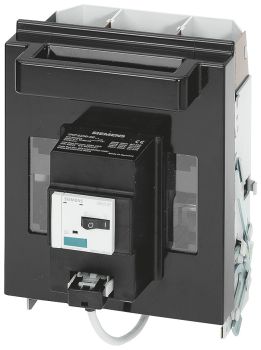
Siemens 3NP5260-0EA26 fuse load isolator 3-pole
| Lieske Part No. | 1276853 |
|---|---|
| Mfg Part No | 3NP52600EA26 |
| EAN-Code | 4011209151390 |
| Manufacturer | Siemens |
| Here only | 1.506,71 EUR
1.792,98 EUR incl. VAT
|
Further information for Siemens 3NP5260-0EA26 fuse load isolator 3-pole
| General | |
| Number of poles | 3 |
| Nominal current | 250 A |
| Fuse type | NH1 |
| Fuse monitoring | via 3RV |
| Auxiliary switch on load isolator | 1S+1Ö |
| Auxiliary switch on fuse monitoring | 2S |
| Degree of protection | IP40 |
| Connection system | Screw connection |
| Switching type | fast make |
| Mounting method | assembly and mounting on mounting plate |
| Compatibility | Siemens busbar system 8US, DIN rail, floor mounting |
| Accessory compatibility | NH1 fuse inserts, handle insert 3NY1421, terminal clamp 3NY1907, plug 3NY1910 |
Applications
The fuse switch disconnector 3NP5260-0EA26 is intended for use in industrial applications, such as machine construction, manufacturing systems, power supply systems, and infrastructure projects. It enables the safe disconnection of circuits and protects personnel and equipment through integrated fuse monitoring. The 3NP switch series is suitable for various mounting variants, including floor mounting, DIN rail, and the Siemens busbar system 8US.
Functions and equipment in detail
The switch features a standard integrated encircling and shock protection, which prevents the user from touching live parts during installation of busbar systems, even with rear access. Large viewing windows allow easy inspection of installed fuses. The electronic fuse monitoring, implemented via a 3RV module, monitors the fuse condition and can trigger a response in case of failure or defect. Additionally, network monitoring is integrated. The switch is equipped with auxiliary switches: the switch disconnector has 1 NO and 1 NC contact, while the fuse monitoring unit has 2 NO contacts integrated. The switching points of the auxiliary switches can be flexibly adjusted, either simultaneously or in advance.
Technology explained clearly
The fuse switch disconnector combines the functions of a switch disconnector with protection provided by NH1 fuses. Quick insertion enables efficient and safe operation. The screw connection technology ensures a stable and reliable connection. Fuse monitoring via the 3RV module ensures that operation continues only if the fuse is intact. The integrated network monitoring checks the supply voltage and can react to deviations. The protection rating IP40 protects against contact with moving parts and against solid objects, but not against water.
Compatibility and accessories
The switch is compatible with various NH1 fuse inserts, including types such as 3NA3136, 3NA3140, 3NA3142, 3NA6136, 3NA6140, 3NA6142, 3NA7136, 3NA7142, as well as 3ND2136 and 3ND2140. These are available in various rated currents (e.g. 160 A, 200 A, 224 A) and with live or insulated handle inserts. Additionally, handle inserts such as 3NY1421 can be used for switches 3NP5260. Terminal clamps such as 3NY1907 are suitable for round conductors with cross-sections from 35 to 130 mm². Plugs such as 3NY1910 with 1 m connection cable are also compatible.
Mounting and installation
The switch is designed for installation on mounting plates and can also be mounted on DIN rail or in a floor mounting system. It is suitable for use in the Siemens busbar system 8US. Mounting is done via screw connection, with cable exits configurable at the top or bottom. Quick insertion simplifies operation. The option to lock and seal provides additional security against unauthorized access.
Advantages in operation
The switch offers improved personnel and equipment protection through integrated encircling and shock protection as well as electronic fuse monitoring. The modular design and comprehensive accessories enable high flexibility in adapting to different requirements. The flexible adjustment of auxiliary switch timing supports integration into more complex control systems. The clear view of the fuses through the large viewing windows facilitates maintenance and inspection.

This is an offer of:
79279 Vörstetten
https://industry-electronics.com
Tel. 07666/88499-0
Fax. 07666/88499-111
Diesen Artikel finden Sie unter:
industry-electronics.com/artikel/1276853

Lieske Elektronik e.K.
Reutener Str. 1079279 Vörstetten
https://industry-electronics.com
Tel. 07666/88499-0
Fax. 07666/88499-111
Diesen Artikel finden Sie unter:
industry-electronics.com/artikel/1276853