
Ses-Sterling 06360421000 CE-MT PG7
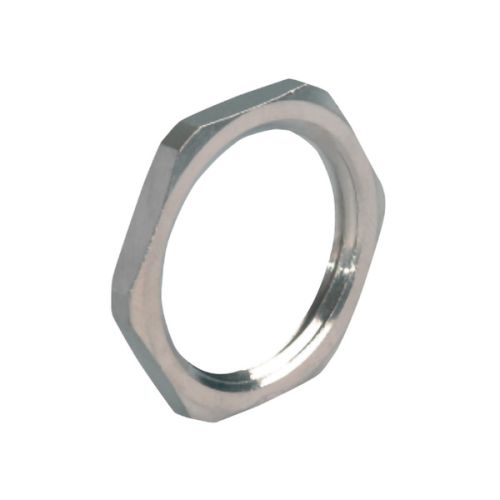
Ses-Sterling 06360421000 CE-MT PG7
| Lieske Part No. | 808030 |
|---|---|
| Mfg Part No | 06360421000 |
| EAN-Code | 3597471294665 |
| Manufacturer | Ses-Sterling |
| Here only | 29,44 EUR
35,03 EUR incl. VAT
|
Further information for Ses-Sterling 06360421000 CE-MT PG7
| General | |
| Colour | Minimum quantity |
Applications
The CE-MT PG7 lock nut is used in electrical installations, machine building, and automation technology, where cables must be routed through enclosure walls. It is particularly suitable for applications requiring high mechanical load capacity and secure fastening. The lock nut is used in conjunction with cable glands that also comply with the PG7 standard to ensure a precise and tight connection. It is mounted on the inside of the enclosure to support the gland from the outside.
Functions and Features in Detail
The lock nut is made from a metallic material designed for high strength and durability. It features an internal threaded hole precisely matched to the thread of the cable gland. The shape is cylindrical with a flat outer surface that fits against the inner side of the enclosure. The lock nut is tightened using a screwdriver or suitable tool to secure the cable gland from the inside. The packaging contains 100 pieces, making it suitable for large projects or series assembly.
Technology Explained Simply
The CE-MT PG7 lock nut is a mechanical component that functions as a backing. When a cable gland is screwed in from the outside into an enclosure, the lock nut on the inside ensures the gland is not damaged by the screwing force and allows for even distribution of force. This prevents gland failure and ensures a tight and stable connection. The designation PG7 refers to the standard for cable glands, defining a specific inner diameter and matching thread form. The lock nut is therefore specifically designed for this standard.
Compatibility and Accessories
The CE-MT PG7 lock nut is specifically developed for use with cable glands of type PG7. It is compatible with all cable glands that meet the PG7 standard, regardless of the manufacturer. Use with other connection diameters is not intended and may result in inadequate fastening or damage.
Installation and Mounting
Mounting typically occurs after inserting the cable gland into the enclosure. The lock nut is placed from the inside onto the inner side of the enclosure and tightened using a screwdriver or suitable tool. Care should be taken to tighten the lock nut firmly but not excessively to avoid damaging the enclosure or the gland. Installation generally requires no additional tools beyond a screwdriver or appropriate wrench.
Individual specifications such as the weight of 1.9 g per piece or the packaging unit of 100 pieces are technical details relevant for planning and procurement. The colour is specified as minimum quantity, indicating that the lock nut is supplied in a standard colour suitable for most applications. The packaging weight of 0.19 kg refers to the total package containing 100 pieces.
Operational Advantages
Using the CE-MT PG7 lock nut ensures a secure and tight fixation of cable glands, increasing the overall reliability of the installation. The mechanical stability prevents the gland from loosening under load, which is particularly important in moving or vibration-prone environments. Standardization according to PG7 enables universal use with various cable glands, simplifying planning and procurement. Supply in packs of 100 pieces is especially advantageous for series assembly and large projects, enabling efficient procurement and storage.

This is an offer of:
79279 Vörstetten
https://industry-electronics.com
Tel. 07666/88499-0
Fax. 07666/88499-111
Diesen Artikel finden Sie unter:
industry-electronics.com/artikel/808030

Lieske Elektronik e.K.
Reutener Str. 1079279 Vörstetten
https://industry-electronics.com
Tel. 07666/88499-0
Fax. 07666/88499-111
Diesen Artikel finden Sie unter:
industry-electronics.com/artikel/808030