
Ses-Sterling 03600304013 V-22 GY
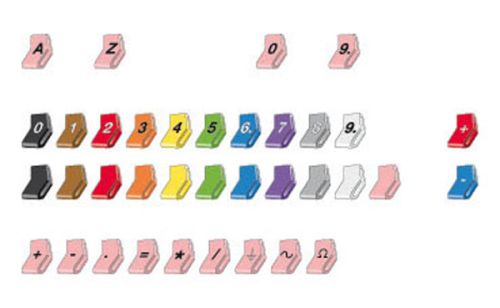
Ses-Sterling 03600304013 V-22 GY
| Lieske Part No. | 796915 |
|---|---|
| Mfg Part No | 03600304013 |
| EAN-Code | 3597470041864 |
| Manufacturer | Ses-Sterling |
| Here only | 15,69 EUR
18,67 EUR incl. VAT
|
Further information for Ses-Sterling 03600304013 V-22 GY
| General | |
| Colour | Grey |
Identification rings are an essential component in structured cabling, as they help prevent errors during installation or maintenance. The PLIO-V-MARKERS type V-22 are designed for cables with an outer diameter of 1.3 to 2 mm, making them particularly suitable for cables with a cross-section of 0.5 mm². These dimensions cover a typical application range in electrical installations, especially for control lines, signal or data cables. The rings are unprinted, allowing them to be individually labelled, for example with a pen, labelling device or laser marking, depending on project requirements.
Soft PVC as material offers good flexibility and elasticity, enabling the rings to be easily slid onto the cable without damaging it. At the same time, the material ensures sufficient durability and resistance to mechanical stresses that may occur during daily operation. The strip form of the pre-cut rings simplifies handling, as they can be directly removed from the packaging and slid onto the cable without requiring additional tools or cutting operations.
Cable identification is particularly important in complex systems to avoid errors during commissioning, maintenance or repair. The PLIO-V-MARKERS type V-22 support this task by providing clear, visual differentiation of wires. The grey colour is neutral and can be easily combined with other colours to mark different functions or systems. The use of identification rings is a proven method in electrical and IT technology to increase clarity and safety of installations.
The packaging unit of 1000 pieces is designed for professional users who work in larger quantities, for example during installations in buildings, factories or data centres. The weight specification of 0.087 g per piece results in a total packaging weight of 0.087 kg, indicating the low mass of individual rings and highlighting their easy handling.
Compatibility is provided for cables with an outer diameter of 1.3 to 2 mm and a cross-section of 0.5 mm². These specifications cover a wide range of standard cables used in electrical and IT technology. The rings are not suitable for cables with larger or smaller diameters, as they are not stretchable and therefore cannot be adapted to other dimensions. The use requires no additional tools, as the rings are pre-cut and can be directly slid onto the cable.
Installation is carried out by simply sliding the rings onto the cable. No special preparation or tools are required. The rings fit securely onto the cable and will not come loose on their own, as long as the cable is within the specified diameter range. Labelling is done after installation by manual writing or using a labelling device, depending on requirements. The use is therefore quick, efficient and cost-effective, especially in larger installations.
Operational advantages include easy handling, high availability in large quantities and clear visual identification. The rings enable quick identification of cables, speeding up maintenance and fault repair. The use of soft PVC ensures long service life and mechanical robustness. The grey colour provides a neutral, yet distinct marking that integrates well into technical environments. The packaging unit of 1000 pieces is suitable for professional users who work in larger quantities and require continuous supply.
The PLIO-V-MARKERS type V-22 identification rings are thus a reliable and practical tool for structured cabling in electrical and IT technology. They support efficiency and safety during installation and maintenance of cable systems through clear, visual identification.

This is an offer of:
79279 Vörstetten
https://industry-electronics.com
Tel. 07666/88499-0
Fax. 07666/88499-111
Diesen Artikel finden Sie unter:
industry-electronics.com/artikel/796915

Lieske Elektronik e.K.
Reutener Str. 1079279 Vörstetten
https://industry-electronics.com
Tel. 07666/88499-0
Fax. 07666/88499-111
Diesen Artikel finden Sie unter:
industry-electronics.com/artikel/796915