
Ses-Sterling 035200170041 Helavia Twin HT-1bis 1 YE
Ses-Sterling 035200170041 Helavia Twin HT-1bis 1 YE
| Lieske Part No. | 795428 |
|---|---|
| Mfg Part No | 035200170041 |
| EAN-Code | 3597470262733 |
| Manufacturer | Ses-Sterling |
| Here only | 5,34 EUR
6,35 EUR incl. VAT
|
Further information for Ses-Sterling 035200170041 Helavia Twin HT-1bis 1 YE
| General | |
| Colour | Yellow |
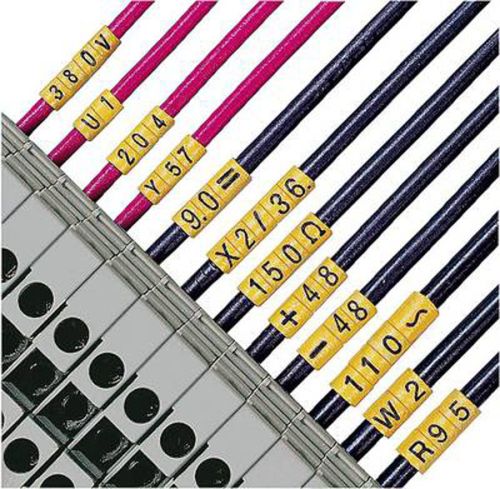
Identification rings made of rubber are a standard in cable wiring to prevent errors during installation or maintenance. The colour yellow and the black print 1 provide high contrast, ensuring clear readability even under low lighting conditions or in complex wiring situations. The rings are intended for indoor use, with the material selection aimed at good resistance to mechanical stress and minor chemical influences. The thick-walled design ensures that the rings do not easily deform and retain their shape even after repeated installation and removal.
Cable identification is a crucial component of structured cabling, particularly in IT infrastructures, building automation systems, and industrial installations. The rings enable quick identification of cables, significantly simplifying maintenance, fault finding, and system expansion. The use of identification rings with unique markings such as the digit 1 helps avoid confusion, especially in systems with numerous parallel lines.
The rings are available in a small pack of 100 pieces, making them suitable for small to medium-sized projects or for use in workshops and installation environments. The packaging is designed to allow safe transport and storage of the rings without damage. The weight of a single ring is 0.048 g, facilitating easy handling and installation, without the rings hanging loose or shifting on the cables during use.
The rubber material base offers good elasticity, allowing the rings to be stretched elastically over the cable without damaging it. The thick-walled construction ensures that the rings remain securely in place even on cables at the upper end of the diameter range (up to 3.5 mm) and do not slip off. The use of rubber as a material is widespread in cable identification, as it provides sufficient flexibility and durability without damaging the cables.
The rings are not designed for outdoor use or in damp environments, as no specific protection ratings such as IP67 or similar are specified. The material description applies exclusively to use in dry indoor environments.
The Helavia Twin HT-1bis 1 identification rings are a reliable tool for structured cabling. The combination of yellow colour, black digit 1 print, and thick-walled rubber construction ensures clear, durable, and easily readable identification. The rings are easy to install, securely fit on the cable, and support efficiency during installation and maintenance of cable systems. The pack of 100 pieces provides a practical quantity for frequent applications in electrical and IT trades.
Cable outer diameter of 2.5 to 3.5 mm is the specified application range, with ring width from 3.8 to 5.5 mm and print size of 2.6 mm ensuring visual recognisability and mechanical fit. The rings are not suitable for cables outside this diameter range, as they either cannot be slipped over the cable or will not remain securely in place.
The use of identification rings in the colour yellow with black digit 1 is particularly beneficial in systems where clear visual differentiation between various cable groups is required. The thick-walled design ensures long service life and minimises the risk of wear or abrasion of the print. The rings are not designed for use in environments with high temperatures, chemical exposure, or moisture, as no corresponding protection specifications are provided.

This is an offer of:
79279 Vörstetten
https://industry-electronics.com
Tel. 07666/88499-0
Fax. 07666/88499-111
Diesen Artikel finden Sie unter:
industry-electronics.com/artikel/795428

Lieske Elektronik e.K.
Reutener Str. 1079279 Vörstetten
https://industry-electronics.com
Tel. 07666/88499-0
Fax. 07666/88499-111
Diesen Artikel finden Sie unter:
industry-electronics.com/artikel/795428