
Ses-Sterling 03520005004ALTB Helavia Twin HT-4 oscillator
Ses-Sterling 03520005004ALTB Helavia Twin HT-4 oscillator
| Lieske Part No. | 794370 |
|---|---|
| Mfg Part No | 03520005004ALTB |
| EAN-Code | 3597470263990 |
| Manufacturer | Ses-Sterling |
| Here only | 30,96 EUR
36,84 EUR incl. VAT
|
Further information for Ses-Sterling 03520005004ALTB Helavia Twin HT-4 oscillator
| General | |
| Colour | Yellow |
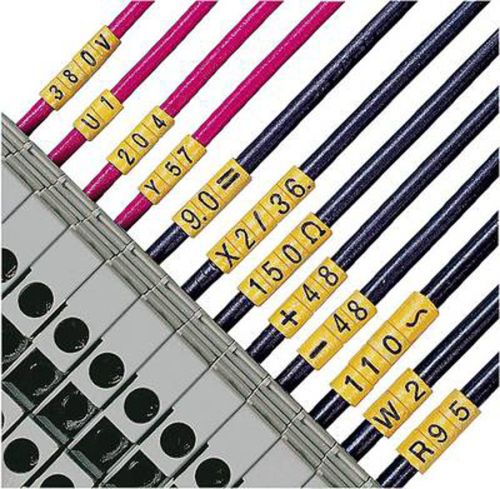
Identification rings made of rubber are suitable for durable and flexible marking, as they can be easily placed around cables while ensuring stable fixation. The rubber material composition provides a certain elasticity and resistance to mechanical stress, making them suitable for use in industrial environments. The colour Yellow serves as a visual identifier, enabling clear assignment when combined with other colours or markings. In practice, the colour is often used within colour-coding systems to indicate specific line functions, voltage levels, or system affiliations.
The packaging unit of 500 pieces is suitable for medium to large projects, while the industrial pack of 1000 pieces is intended for larger installations or series assembly. The packaging is designed to store the rings cleanly and without damage. The specification of weight per piece at 0.21 g allows for easy estimation of transport and storage costs, as well as precise planning of material quantities for projects. The total packaging weight of 0.105 kg for 500 pieces results in an average mass of 0.21 g per ring, which matches the individual weight specification.
The identification rings are intended for use in electrical installation, automation technology, and industrial manufacturing. They are particularly suitable for marking cables in enclosures, controls, drive systems, and other technical installations where clear and durable identification is required. The use of rubber as material provides flexibility, allowing the rings to be secured on cables with varying diameters without tearing or damage.
The colour Yellow is a standardised identifier used in many industries for specific functions or systems. In electrical engineering, Yellow may be used for protective conductors, specific control lines, or as a warning colour. The exact meaning of the colour depends on the internal guidelines of the respective company or the standardisation applicable to the project. The use of uniform colours simplifies maintenance and fault diagnosis, as technical personnel can quickly identify which system or purpose a cable belongs to.

This is an offer of:
79279 Vörstetten
https://industry-electronics.com
Tel. 07666/88499-0
Fax. 07666/88499-111
Diesen Artikel finden Sie unter:
industry-electronics.com/artikel/794370

Lieske Elektronik e.K.
Reutener Str. 1079279 Vörstetten
https://industry-electronics.com
Tel. 07666/88499-0
Fax. 07666/88499-111
Diesen Artikel finden Sie unter:
industry-electronics.com/artikel/794370