
Schneider Electric TM241CE40U PLC controller 40E/A serial transistor negative logic
Industrial Material > Automation > PLC Systems
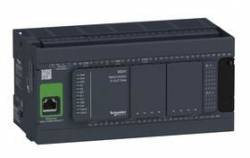
Schneider Electric TM241CE40U PLC controller 40E/A serial transistor negative logic
| Lieske Part No. | 934817 |
|---|---|
| Mfg Part No | TM241CE40U |
| EAN-Code | 3606480611162 |
| Manufacturer | Schneider Electric |
| Here only | 457,21 EUR
544,08 EUR incl. VAT
|
Further information for Schneider Electric TM241CE40U PLC controller 40E/A serial transistor negative logic
| Complementary | |
| Discrete I/O number | 40 |
| Maximum number of I/O expansion module | 7 (local I/O-Architecture); 14 (remote I/O-Architecture) |
| Supply voltage limits | 20.4…28.8 V |
| Inrush current | 50 A |
| Power consumption in W | 32.6…40.4 W (with max number of I/O expansion module) |
| Discrete input logic | Sink or source |
| Discrete input voltage | 24 V |
| Discrete input voltage type | DC |
| Voltage state 1 guaranteed | >= 15 V for input |
| Discrete input current | 10.7 mA for fast input; 7 mA for input |
| Input impedance | 4.7 kOhm for input; 2.81 kOhm for fast input |
| Configurable filtering time | 1 s for fast input; 12 ms for fast input; 0 ms for input; 1 ms for input; 4 ms for input; 12 ms for input |
| Discrete output logic | Negative logic (sink) |
| Output voltage limits | 30 V DC |
| Maximum current per output common | 2 A |
| Maximum output frequency | 20 kHz for fast output (PWM mode); 100 kHz for fast output (PLS mode); 1 kHz for output |
| Accuracy | +/- 0.1 % at 0.02…0.1 kHz for fast output; +/- 1 % at 0.1…1 kHz for fast output |
| Maximum leakage current | 5 µA for output |
| Protection type | Short-circuit protection; Short-circuit and overload protection with automatic reset; Reverse polarity protection for fast output |
| Reset time | 10 ms automatic reset output; 12 s automatic reset fast output |
| Memory capacity | 64 MB for system memory RAM |
| Data backed up | 128 MB built-in flash memory for backup of user programs |
| Battery type | BR2032 lithium non-rechargeable, battery life: 4 year(s) |
| Backup time | 2 years at 25 °C |
| Execution time for 1 KInstruction | 0.3 ms for event and periodic task; 0.7 ms for other instruction |
| Application structure | 8 external event tasks; 3 cyclic master tasks + 1 freewheeling task; 4 cyclic master tasks; 8 event tasks |
| Realtime clock | With |
| Positioning functions | PTO function 4 channel(s) (positioning frequency: 100 kHz); PTO function 4 channel(s) for transistor output (positioning frequency: 1 kHz) |
| Counting input number | 4 fast input (HSC mode) at 200 kHz; 16 standard input at 1 kHz |
| Control signal type | A/B at 100 kHz for fast input (HSC mode); Pulse/direction at 200 kHz for fast input (HSC mode); Single phase at 200 kHz for fast input (HSC mode) |
| Integrated connection type | Non isolated serial link serial 1 with RJ45 connector and RS232/RS485 interface ; Non isolated serial link serial 2 with removable screw terminal block connector and RS485 interface ; USB port with mini B USB 2.0 connector; Ethernet with RJ45 connector |
| Supply | (serial 1)serial link supply: 5 V |
| Transmission rate | 1.2...115.2 kbit/s (115.2 kbit/s by default) for bus length of 15 m for RS485; 1.2...115.2 kbit/s (115.2 kbit/s by default) for bus length of 3 m for RS232; 480 Mbit/s for bus length of 3 m for USB; 10/100 Mbit/s for Ethernet |
| Communication port protocol | Non isolated serial link: Modbus master/slave |
| Port Ethernet | 10BASE-T/100BASE-TX - 1 port(s) copper cable |
| Local signalling | 1 LED (green) for PWR; 1 LED (green) for RUN; 1 LED (red) for module error (ERR); 1 LED (red) for I/O error (I/O); 1 LED (green) for SD card access (SD); 1 LED (red) for BAT; 1 LED (green) for SL1; 1 LED (green) for SL2; 1 LED (red) for bus fault on TM4 (TM4); 1 LED per channel (green) for I/O state; 1 LED (green) for Ethernet port activity |
| Electrical connection | removable screw terminal blockfor inputs and outputs (pitch 5.08 mm); removable screw terminal blockfor connecting the 24 V DC power supply (pitch 5.08 mm) |
| Maximum cable distance between devices | Unshielded cable: |
| Insulation | Between supply and internal logic at 500 V AC; Non-insulated between supply and ground; Between input and internal logic at 500 V AC; Non-insulated between inputs; Between fast input and internal logic at 500 V AC; Between output and internal logic at 500 V AC; Non-insulated between outputs; Between fast output and internal logic at 500 V AC; Between output groups at 500 V AC |
| Marking | CE |
| Surge withstand | 1 kV power lines (DC) common mode conforming to IEC 61000-4-5; 1 kV shielded cable common mode conforming to IEC 61000-4-5; 0.5 kV power lines (DC) differential mode conforming to IEC 61000-4-5; 1 kV relay output differential mode conforming to IEC 61000-4-5; 1 kV input common mode conforming to IEC 61000-4-5; 1 kV transistor output common mode conforming to IEC 61000-4-5 |
| Web services | Web server |
| Maximum number of connections | 8 Modbus server; 8 SoMachine protocol; 10 web server; 4 FTP server; 16 Ethernet/IP target; 8 Modbus client |
| Number of server device(s) | 64 Modbus TCP: ; 16 EtherNet/IP: |
| Cycle time | 10 ms 16 EtherNet/IP; 64 ms 64 Modbus TCP |
| Mounting support | Top hat type TH35-15 rail conforming to IEC 60715; Top hat type TH35-7.5 rail conforming to IEC 60715; plate or panel with fixing kit |
| Height | 90 mm |
| Depth | 95 mm |
| Width | 190 mm |
| Net weight | 0.62 kg |
| Contractual warranty | |
| Warranty (in months) | 18 |
| Environment | |
| Standards | ANSI/ISA 12-12-01; CSA C22.2 No 142; CSA C22.2 No 213; IEC 61131-2:2007; Marine specification (LR, ABS, DNV, GL); UL 508 |
| Product certifications | RCM; cULus; CE; UKCA; DNV-GL; ABS; LR |
| Resistance to electrostatic discharge | 8 kV in air conforming to IEC 61000-4-2; 4 kV on contact conforming to IEC 61000-4-2 |
| Resistance to electromagnetic fields | 10 V/m 80 MHz...1 GHz conforming to IEC 61000-4-3; 3 V/m 1.4 GHz...2 GHz conforming to IEC 61000-4-3; 1 V/m 2 GHz...3 GHz conforming to IEC 61000-4-3 |
| Resistance to fast transients | 2 kV (power lines) conforming to IEC 61000-4-4; 1 kV (Ethernet line) conforming to IEC 61000-4-4; 1 kV (serial link) conforming to IEC 61000-4-4; 1 kV (input) conforming to IEC 61000-4-4; 1 kV (transistor output) conforming to IEC 61000-4-4 |
| Resistance to conducted disturbances | 10 V 0.15...80 MHz conforming to IEC 61000-4-6; 3 V 0.1...80 MHz conforming to Marine specification (LR, ABS, DNV, GL); 10 V spot frequency (2, 3, 4, 6.2, 8.2, 12.6, 16.5, 18.8, 22, 25 MHz) conforming to Marine specification (LR, ABS, DNV, GL) |
| Immunity to microbreaks | 10 ms |
| Ambient air temperature for operation | -10…50 °C (vertical installation); -10…55 °C (horizontal installation) |
| Ambient air temperature for storage | -25…70 °C |
| Relative humidity | 10…95 %, without condensation (in operation); 10…95 %, without condensation (in storage) |
| IP degree of protection | IP20 with protective cover in place |
| Pollution degree | 2 |
| Operating altitude | 0...2000 m |
| Storage altitude | 0…3000 m |
| Vibration resistance | 3.5 mm at 5…8.4 Hz on symmetrical rail; 3 gn at 8.4…150 Hz on symmetrical rail; 3.5 mm at 5…8.4 Hz on panel mounting; 3 gn at 8.4…150 Hz on panel mounting |
| Shock resistance | 15 gn for 11 ms |
| Logistical informations | |
| Country of origin | ID |
| Main | |
| Range of product | Modicon M241 |
| Product or component type | Logic controller |
| [Us] rated supply voltage | 24 V DC |
| Discrete input number | 24, discrete input 8 fast input conforming to IEC 61131-2 Type 1 |
| Discrete output type | Transistor |
| Discrete output number | 16 transistor 4 fast output |
| Discrete output voltage | 24 V DC for transistor output |
| Discrete output current | 0.1 A for fast output (PTO mode) (Q0...Q3); 0.5 A for transistor output (Q0...Q15) |
| Packing Units | |
| Unit Type of Package 1 | PCE |
| Number of Units in Package 1 | 1 |
| Package 1 Height | 11.415 cm |
| Package 1 Width | 13.024 cm |
| Package 1 Length | 22.936 cm |
| Package 1 Weight | 770.0 g |
| Unit Type of Package 2 | S03 |
| Number of Units in Package 2 | 6 |
| Package 2 Height | 30 cm |
| Package 2 Width | 30 cm |
| Package 2 Length | 40 cm |
| Package 2 Weight | 5.49 kg |
| Unit Type of Package 3 | P06 |
| Number of Units in Package 3 | 48 |
| Package 3 Height | 75.0 cm |
| Package 3 Width | 40.0 cm |
| Package 3 Length | 80.0 cm |
| Package 3 Weight | 54 kg |
Applications
The controller is suitable for applications in industrial automation, particularly in machine building, material handling, packaging technology, and other areas where a compact, powerful, and networked control system is required. The integrated functions such as positioning, counting, and fast I/O enable precise control of drives, motors, and mechanical movements. Support for EtherNet/IP, Modbus TCP, and OPC UA makes it a central component in networked production environments.
Functions and Equipment in Detail
The device features an integrated real-time clock and a positioning function with PTO (Pulse Train Output) for up to 4 channels. The positioning frequency is 100 kHz for fast outputs and 1 kHz for standard outputs. Additionally, 4 fast counting inputs (HSC mode) with a frequency of 200 kHz are available. The controller supports various control signal types such as A/B, pulse/direction, and single-phase. The integrated control enables coordination of up to 4 axes. The digital outputs are equipped with short-circuit and overload protection, as well as reverse polarity protection for fast outputs, enhancing operational safety.
Technology Explained Simply
The controller operates with an execution time of 0.3 ms for event and periodic tasks and 0.7 ms for other instructions. The integrated RAM memory is 64 MB, with 54 MB available for operation, and the Flash memory provides 128 MB for secure storage of user programs. Storage is handled via an integrated Flash memory, ensuring data retention for 2 years at 25 °C. The controller is equipped with a USB-mini-B port and an SD card slot to facilitate programming and data transfer. A Run/Stop switch allows direct control of the operating state.
Compatibility and Accessories
The controller is expandable with up to two plug-in modules, with local I/O expansions supporting up to 7 modules and decentralized (remote) expansions supporting up to 14 modules. Compatible accessories include plug-in modules such as TMC4TI2 (2 temperature inputs), TMC4AI2 (2 analog current inputs), TMC4AQ2 (2 analog outputs), as well as the mounting kit TMAM2 for DIN rail mounting. Communication is via an Ethernet interface (RJ45) supporting EtherNet/IP, Modbus TCP, OPC UA Server, SNMP, DNS Client, Webserver, and SQL Client. Additionally, an RS485/RS232 interface (RJ45) and an RS485 interface (screw terminal strip) are available, supporting Modbus ASCII/RTU Master/Slave and ASCII string transmission.
Mounting and Installation
Mounting is done on a 35 mm DIN rail or directly on a control panel. Connections are made via removable screw terminal strips. The operating ambient temperature ranges from -10 °C to +55 °C. The controller is intended for use in non-hazardous areas. Programming and configuration are performed using the EcoStruxure Machine Expert software, which is based on CODESYS V3 and supports programming languages including Structured Text (ST), Function Block Diagram (FBD/CFC), Instruction List (AWL), Ladder Diagram (KOP), and Sequential Function Chart (SFC). Certification includes CE, cULus Listing Mark, CSA, EAC, LR, ABS, DNV-GL, ODVA, and Achilles.
Operational Advantages
The combination of fast I/O, integrated positioning, extensive network support, and expandable architecture makes the Modicon M241 a flexible solution for modern automation tasks. The high execution speed and robust hardware construction ensure reliable performance in industrial environments. The integrated protection function with automatic reset (10 ms for standard outputs, 12 s for fast outputs) minimizes downtime. Support for SD card and USB port simplifies programming and maintenance. Certifications according to international standards ensure compliance with safety and quality requirements.

This is an offer of:
79279 Vörstetten
https://industry-electronics.com
Tel. 07666/88499-0
Fax. 07666/88499-111
Diesen Artikel finden Sie unter:
industry-electronics.com/artikel/934817

Lieske Elektronik e.K.
Reutener Str. 1079279 Vörstetten
https://industry-electronics.com
Tel. 07666/88499-0
Fax. 07666/88499-111
Diesen Artikel finden Sie unter:
industry-electronics.com/artikel/934817