
Schneider Electric LXM62DD15C21000 drive 15A 2XIE
Industrial Material > Enclosures / Chassis > Switchboard-Systems
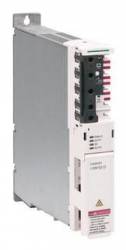
Schneider Electric LXM62DD15C21000 drive 15A 2XIE
| Lieske Part No. | 612532 |
|---|---|
| Mfg Part No | LXM62DD15C21000 |
| EAN-Code | 3606485317724 |
| Manufacturer | Schneider Electric |
| Here only | 1.620,35 EUR
1.928,22 EUR incl. VAT
|
Further information for Schneider Electric LXM62DD15C21000 drive 15A 2XIE
| Complementary | |
| Network number of phases | Three phase |
| [Us] rated supply voltage | 400 V (- 10...10 %) for three phase; 230 V (- 10...10 %) for three phase; 230 V (- 10...10 %) for single phase |
| Supply frequency | 50/60 Hz - 5...5 % |
| Continuous output current | 5 A at 4 kHz |
| Output current 3s peak | 15 A at 4 kHz |
| Continuous power | 2.4 kW |
| Nominal power | 2.4 kW |
| Switching frequency | 8 kHz |
| Overvoltage category | III |
| Electrical connection | Terminal, clamping capacity: 0.2...15 mm², 24 AWG...16 AWG (CN4); Terminal, clamping capacity: 0.5...16 mm², 20 AWG...6 AWG (CN5); Terminal, clamping capacity: 0.75...16 mm², 18 AWG...6 AWG (CN6); Terminal, clamping capacity: 0.2...6 mm², 24 AWG...10 AWG (CN7) |
| Tightening torque | CN1: 2.5 N.m |
| Number of inputs | 2 digital; 2 touch probe |
| Discrete input voltage | 24 V DC for - 20...25 % |
| Number of outputs | 2 digital |
| Discrete output voltage | 24 V DC |
| Safety function | STO (safe torque off) |
| Communication interface | SERCOS III, integrated |
| Depth | 270 mm |
| Height | 310 mm |
| Width | 44.5 mm |
| Net weight | 3 kg |
| Contractual warranty | |
| Warranty (in months) | 18 |
| Environment | |
| Standards | CSA C22.2 No 14; IEC 61800-5-1; ISO 13849-1; ISO 13849-2; UL 508C; IEC 61508; IEC 62061; IEC 61800-5-2; IEC 61800-3 |
| Product certifications | CSA; TÜV; CE; EAC; UL |
| IP degree of protection | IP20 conforming to IEC 60529 |
| Vibration resistance | 10 m/s² conforming to IEC 60721-3-3 |
| Shock resistance | 100 m/s² conforming to IEC 60721-3-3 |
| Pollution degree | 2 conforming to IEC 61800-5-2 |
| Environmental characteristic | 3K3 conforming to IEC 60721-3-3 |
| Relative humidity | 5…85 % |
| Ambient air temperature for operation | 5…55 °C |
| Logistical informations | |
| Country of origin | FR |
| Main | |
| Range of product | PacDrive 3 |
| Device short name | LXM 62 |
| Product or component type | Single drive |
| Component name | LXM62 |
| Packing Units | |
| Unit Type of Package 1 | PCE |
| Number of Units in Package 1 | 1 |
| Package 1 Height | 11.000 cm |
| Package 1 Width | 34.000 cm |
| Package 1 Length | 44.000 cm |
| Package 1 Weight | 3.856 kg |
| Unit Type of Package 2 | S06 |
| Number of Units in Package 2 | 10 |
| Package 2 Height | 75.000 cm |
| Package 2 Width | 60.000 cm |
| Package 2 Length | 80.000 cm |
| Package 2 Weight | 51.560 kg |
Applications include controlling servo motors in industrial automation systems, particularly in applications requiring high precision and reliability. The drive is designed for use in enclosures, with dimensions of 44.5 mm (width) × 310 mm (height) × 270 mm (depth) and a product weight of 3 kg to be considered. Mounting is carried out in standardized enclosures, complying with standards such as CSA C22.2 No. 14, IEC 61800-5-1, ISO 13849-1, UL 508C, and others. Certifications CE, TÜV, CSA, EAC, and UL confirm compliance with international safety and quality requirements.
Functions and equipment in detail include the integrated safety function STO (Safe Torque Off), which allows the torque to be safely switched off to bring the machine into a safe state. The standard version also includes adaptive torque limitation, mechanical overload protection, released brake control, and sensorless speed control with BMP motors. These functions increase operational safety and reduce maintenance requirements. Communication is via an integrated SERCOS III interface, enabling fast and reliable data transmission in industrial networks.
Technology explained simply shows that the drive has multiple electrical connections: Terminals CN4 to CN7 support different cross-sections (0.2–16 mm², AWG 24–AWG 6), with CN1 requiring a tightening torque of 2.5 Nm. The digital inputs (2 pieces) and outputs (2 pieces) operate at a voltage of 24 V DC (±20–25 %). Power supply is via a 3-phase supply, with a 1-phase supply at 230 V also possible. The overvoltage category III protects against transient voltage surges. The switching frequency of 8 kHz ensures precise motor control.
Compatibility and accessories include use with SH3 servo motors, with connection possible via OMC (One-Motor-Cable) or via two cables with SinCos encoder. Compatible motors are listed in the product range, for example models such as SH31002P0BA4000 or SH30703P02A2000, which feature different torques, brake characteristics, and shaft properties. Corresponding connection accessories are included in the delivery scope according to the manufacturer, simplifying installation.
Mounting and installation is carried out in enclosures under the specified environmental conditions. Mounting follows the given dimensions and the protection rating IP20. Electrical connections are made via terminals, with terminal capacities and required tightening torque (2.5 Nm for CN1) to be considered. Communication via SERCOS III requires appropriate network configuration in the industrial environment.
Operational advantages lie in high operational safety due to integrated protection functions such as STO and mechanical overload protection. Sensorless speed control reduces the number of required sensors and lowers maintenance costs. Flexible connection to multi-axis systems via bus communication enables a scalable and modular automation solution. Reliability is ensured by certifications and compliance with international standards.

This is an offer of:
79279 Vörstetten
https://industry-electronics.com
Tel. 07666/88499-0
Fax. 07666/88499-111
Diesen Artikel finden Sie unter:
industry-electronics.com/artikel/612532

Lieske Elektronik e.K.
Reutener Str. 1079279 Vörstetten
https://industry-electronics.com
Tel. 07666/88499-0
Fax. 07666/88499-111
Diesen Artikel finden Sie unter:
industry-electronics.com/artikel/612532