
Schneider Electric LXM28AUA5M3X servo drive 50 kW
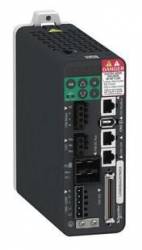
Schneider Electric LXM28AUA5M3X servo drive 50 kW
| Lieske Part No. | 868629 |
|---|---|
| Mfg Part No | LXM28AUA5M3X |
| EAN-Code | 3606480711756 |
| Manufacturer | Schneider Electric |
| Here only | 646,67 EUR
769,54 EUR incl. VAT
|
Further information for Schneider Electric LXM28AUA5M3X servo drive 50 kW
| Complementary | |
| Network number of phases | Single phase; Three phase |
| [Us] rated supply voltage | 200...240 V (- 10...15 %) for three phase; 200...240 V (- 20...15 %) for single phase |
| Supply voltage limits | 200…255 V three phase; 170…255 V single phase |
| Supply frequency | 50/60 Hz - 5...5 % |
| Network frequency | 47.5...63 Hz |
| EMC filter | Without EMC filter |
| Continuous output current | 0.64 A at 16 kHz |
| Output current 3s peak | 2 A at 220 V |
| Continuous power | 50 W at 220 V |
| Nominal power | 0.05 kW at 220 V 16 kHz |
| Switching frequency | 16 kHz |
| Overvoltage category | III |
| Maximum leakage current | 1.3 mA |
| Electrical isolation | Between power and control |
| Type of cable | Shielded motor cable (temperature: 0…55 °C) copper |
| Electrical connection | Spring terminal, clamping capacity: 0.82...1 mm², 18 AWG (L1-L2); Spring terminal, clamping capacity: 0.82...1 mm², 18 AWG (R, S, T); Spring terminal, clamping capacity: 0.82...1 mm², 18 AWG (U, V, W, PE); Spring terminal, clamping capacity: 0.82...1 mm², 18 AWG (PA/+, PBe) |
| Discrete input number | 8 programmable (CN1); 1 pulse train input (PTI) (CN1); 2 fast capture (CN1); 1 safety function STO (CN9) |
| Discrete input voltage | 24 V DC for logic |
| Discrete input logic | Positive or negative (CN1) |
| Discrete output number | 5 logic output (CN1) at 12...24 V DC; 1 pulse train output (PTO) (CN1) |
| Discrete output voltage | 12...24 V DC |
| Discrete output logic | Positive or negative (CN1) |
| Analogue input number | 2 |
| Absolute accuracy error | 0.1 % |
| Analogue input type | V_REF voltage analog input: - 10...10 V, impedance: 10 kOhm, resolution: 14 bits; T_REF voltage analog input |
| Control signal type | Servo motor encoder feedback CN2 |
| Protection type | Against reverse polarity: inputs signal; Against short-circuits: outputs signal; Overcurrent: motor; Overvoltage: motor; Undervoltage: motor; Overheating: motor; Overload: motor; Overspeed: motor |
| Safety function | STO (safe torque off), integrated |
| Safety level | SIL 2 conforming to IEC 61800-5-2: 2007; SIL 2 conforming to IEC 61508-1: 2010; PL d/category 3 conforming to ISO 13849-1: 2008; SIL 2 conforming to ISO 13849-1: 2009/AC; SIL 2 conforming to IEC 60204-1: 2006; SIL 2 conforming to IEC 60204-1: 2009/A1; SIL 2 conforming to IEC 60204-1: 2010/AC; SIL 2 conforming to IEC 62061: 2012 |
| Communication interface | CANopen, integrated; CANmotion, integrated |
| Connector type | RJ45 (CN4) for CANopen, CANmotion |
| Method of access | Slave |
| Transmission rate | 250 kbit/s for bus length of 100…250 m for CANopen, CANmotion; 500 kbit/s for bus length of 4…100 m for CANopen, CANmotion; 1 Mbit/s for bus length of 4 m for CANopen, CANmotion |
| Number of addresses | 1…127 for CANopen, CANmotion |
| Physical interface | RS485 for Modbus Serial line slave |
| Status LED | 1 LED (red) charge; 1 LED (green) RUN; 1 LED (red) error |
| Signalling function | Servo status and fault codes five 7-segment display units |
| Marking | CE; CULus |
| Type of cooling | Natural convection |
| Operating position | Vertical |
| Product compatibility | Servo motor BCH2 (40 mm, 1 motor stacks) at 50 W |
| Width | 55 mm |
| Height | 150 mm |
| Depth | 146 mm |
| Net weight | 1 kg |
| Supply voltage description | Single phase 220 V AC 50...60 Hz; Three phase 220 V AC 50...60 Hz |
| Drive voltage drop coefficient | 1 |
| Field weakening | False |
| Continuous output current 2 | 0.64 A |
| Switching frequency 2 | 16 kHz |
| Continuous output current 3 | 0.64 A |
| Switching frequency 3 | 16 kHz |
| Communication iinterface | Pulse train output; CANopen DS402; CANmotion; Pulse train input |
| Emc filter compatibility | Type 020; Type 022 |
| Contractual warranty | |
| Warranty (in months) | 18 |
| Environment | |
| Electromagnetic compatibility | Conducted emission - test level: level 3 category C3 conforming to IEC 61800-3 |
| Standards | IEC 61800-5-1 |
| Product certifications | CE; cULus |
| IP degree of protection | IP20 |
| Vibration resistance | 3M4 amplitude = 3 mm (f = 9…200 Hz) conforming to IEC 60721-3-3 |
| Shock resistance | 10 gn, type I conforming to IEC 60721-3-3 |
| Relative humidity | 5…95 % without condensation |
| Ambient air temperature for operation | 0…55 °C |
| Ambient air temperature for storage | -25…65 °C |
| Operating altitude | 1000...2000 m 1 % per 100 m |
| Logistical informations | |
| Country of origin | CN |
| Main | |
| Range of product | Lexium 28 |
| Device short name | LXM28A |
| Product or component type | Motion servo drive |
| Format of the drive | Compact housing |
| Line current | 0.8 A 262.8 % at 220 V, single phase; 0.8 A 227 % at 220 V, three phase |
| Packing Units | |
| Unit Type of Package 1 | PCE |
| Number of Units in Package 1 | 1 |
| Package 1 Height | 7.5 cm |
| Package 1 Width | 23 cm |
| Package 1 Length | 23.7 cm |
| Package 1 Weight | 1.26 kg |
| Unit Type of Package 2 | S03 |
| Number of Units in Package 2 | 5 |
| Package 2 Height | 30 cm |
| Package 2 Width | 30 cm |
| Package 2 Length | 40 cm |
| Package 2 Weight | 7.043 kg |
| Unit Type of Package 3 | PAL |
| Number of Units in Package 3 | 40 |
| Package 3 Height | 60 cm |
| Package 3 Width | 60 cm |
| Package 3 Length | 80 cm |
| Package 3 Weight | 55.12 kg |

This is an offer of:
79279 Vörstetten
https://industry-electronics.com
Tel. 07666/88499-0
Fax. 07666/88499-111
Diesen Artikel finden Sie unter:
industry-electronics.com/artikel/868629

Lieske Elektronik e.K.
Reutener Str. 1079279 Vörstetten
https://industry-electronics.com
Tel. 07666/88499-0
Fax. 07666/88499-111
Diesen Artikel finden Sie unter:
industry-electronics.com/artikel/868629