
Samsung MZ1L23T8HBLA-00A07 SSD 3.84TB M.2 NVMe 22110
Computer-Components > Hard Drives > SSD M.2
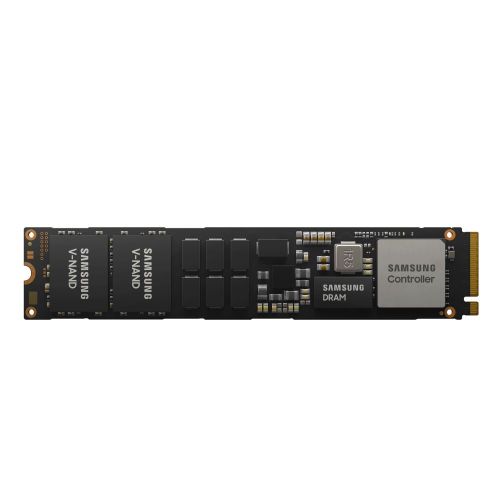
Samsung MZ1L23T8HBLA-00A07 SSD 3.84TB M.2 NVMe 22110
| Lieske Part No. | 2518735 |
|---|---|
| Mfg Part No | MZ1L23T8HBLA-00A07 |
| EAN-Code | |
| Manufacturer | Samsung |
| Here only | 2.602,60 EUR
3.097,09 EUR incl. VAT
|
Further information for Samsung MZ1L23T8HBLA-00A07 SSD 3.84TB M.2 NVMe 22110
| General | |
| Capacity | 3,84 TB |
| Interface | PCIe 4.0 x4 |
| Form factor | M.2 |
| Reading speed | 5500 MB/s |
| Write speed | 2000 MB/s |
| 4K IOPS read operations | 800000 IOPS |
| 4K IOPS write operations | 85000 IOPS |
| TBW | 7008 TB |
| Workload | 1 DWPD |
| Encoding | Hardware-based AES-XTS 256-bit |
| Power-loss protection | Enhanced |
Applications
The SSD is particularly suitable for professional IT environments where high access speed and stable performance over extended periods are required. Due to the 1 DWPD (Drive Writes Per Day) workload rate, it is suitable for continuous use in server and storage solutions. The integrated Enhanced Power-Loss Data Protection ensures that no data loss occurs in the event of a sudden power failure, which is important for critical applications.
Features and Specifications in Detail
The SSD achieves sequential read speeds of up to 5,500 MB/s and sequential write speeds of up to 2,000 MB/s. For random access (4K IOPS), the values are 800,000 IOPS for read operations and 85,000 IOPS for write operations. These values enable fast processing of many small files and support applications with high I/O demands. The integrated hardware-based AES-XTS 256-bit encryption provides high protection for sensitive data without significantly impacting the SSD's performance.
Technology Explained Simply
The use of the PCIe Gen4 x4 interface enables high bandwidth, which is necessary for the fast data rates. NVMe technology optimizes communication between storage and processor, reducing latency and increasing efficiency. The Enhanced Power-Loss Data Protection protects data via an internal buffer that completes the last write operations in the event of a power failure. The AES-XTS 256-bit encryption is performed in hardware, providing high security without creating additional software overhead.
Compatibility and Accessories
The SSD is designed in the M.2 form factor and requires a corresponding M.2 slot on the motherboard. Compatibility is ensured if the system supports PCIe Gen4 x4 and NVMe.
Installation and Mounting
Installation is performed by inserting the SSD into a free M.2 slot on the motherboard. The connection is made via the integrated PCIe interface, so no additional cables or adapters are required. The SSD is recognized by the system as soon as power is supplied.
Operational Advantages
The SSD offers high performance combined with reliability, making it suitable for continuous use in servers and workstations. The 5-year manufacturer's warranty with a TBW rate of 7,008 TBW (Terabytes Written) underscores the longevity of the device. The integrated encryption and power-loss protection function increase security and stability during operation.

This is an offer of:
79279 Vörstetten
https://industry-electronics.com
Tel. 07666/88499-0
Fax. 07666/88499-111
Diesen Artikel finden Sie unter:
industry-electronics.com/artikel/2518735

Lieske Elektronik e.K.
Reutener Str. 1079279 Vörstetten
https://industry-electronics.com
Tel. 07666/88499-0
Fax. 07666/88499-111
Diesen Artikel finden Sie unter:
industry-electronics.com/artikel/2518735