
Rittal 9677910 connection block 1600 A for laminated copper busbars 80x20
Industrial Material > Enclosures / Chassis > Power distribution components
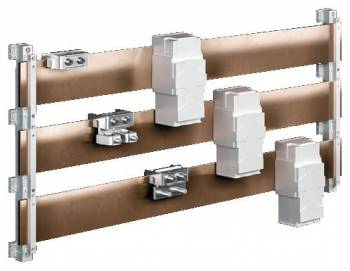
Rittal 9677910 connection block 1600 A for laminated copper busbars 80x20
| Lieske Part No. | 1585442 |
|---|---|
| Mfg Part No | 9677910 |
| EAN-Code | 4028177705302 |
| Manufacturer | Rittal |
| Here only | 79,63 EUR
94,76 EUR incl. VAT
|
Further information for Rittal 9677910 connection block 1600 A for laminated copper busbars 80x20
| General | |
| Material | Sheet steel, zinc-plated, E-Cu, tinned |
| Terminal block height | 20 mm |
| Terminal block width | 80 mm |
| Cable exit | Above/under |
| Rated current max. | 1.600 A |
| Width | 98 mm |
| Suitable for busbars | Height: 10 mm |
| Copper content (kg/piece) | 0,689 |
| PCF/VE (Cradle-to-Gate) | 3.7 kg CO2 eq (Cat B) |
| Note on PCF class | Category B: PCF value (Cradle-to-Gate) approximately calculated based on product weight and self-declared |
Applications
This connection block is used in industrial electrical installations where reliable power distribution is required. It is particularly suitable for systems with high current loads, such as in manufacturing, power supply, or large-scale plant installations. The use of laminated copper busbars enables efficient power transmission with low resistance. The zinc-coated steel sheet and tinned E-Cu contact surface ensure high corrosion resistance and secure electrical conductivity.
Functions and Features in Detail
The block is designed to securely connect wires or laminated copper busbars. The clamping surface with dimensions 80 mm (width) × 20 mm (height) provides sufficient space for securing large cross-sections. The tinned E-Cu contact surface ensures optimal electrical conductivity and minimizes contact resistance. The wire exits at the top and bottom allow flexible integration into existing enclosure constructions. The zinc-coated steel sheet protects the block from environmental influences and extends its service life.
Technology Explained Simply
The connection block is made of zinc-coated steel sheet and features a tinned E-Cu contact surface, ensuring high electrical conductivity. The zinc coating protects the material from corrosion, especially in humid or industrial environments. The clamping surface is dimensioned to ensure a stable connection even under high current loads. The rated current of 1,600 A means the block is designed for applications involving high electrical power transmission. The nominal voltage of 690 V covers the range for industrial installations operating at high voltage.
Compatibility and Accessories
The connection block is specifically designed for busbars with a height of 10 mm. It is therefore compatible with standard busbars in industrial enclosures. As accessory, a shock protection cover for connection block 9677910 is available, providing additional safety during installation and maintenance. This cover prevents unintended contact with live parts and increases operational safety.
Installation and Mounting
Mounting is done by securing to a busbar with 10 mm height. The wire exits at the top and bottom allow flexible positioning within the enclosure. The clamping surface is loaded with the wires or busbars to be connected and tightened securely. The zinc-coated steel sheet ensures long service life, even under industrial conditions. Installation does not require special tools, although using an appropriate screwdriver or pliers is recommended to ensure a secure clamping connection.
Operational Advantages
The connection block offers a high current-carrying capacity of 1,600 A, making it suitable for demanding industrial applications. The tinned E-Cu contact surface ensures low contact resistance and minimizes heat losses. The zinc-coated steel sheet increases corrosion resistance and extends service life. The flexible mounting via wire exits at the top and bottom allows easy integration into existing enclosure configurations. The compatibility with 10 mm busbars makes it a universally applicable component in power distribution.

This is an offer of:
79279 Vörstetten
https://industry-electronics.com
Tel. 07666/88499-0
Fax. 07666/88499-111
Diesen Artikel finden Sie unter:
industry-electronics.com/artikel/1585442

Lieske Elektronik e.K.
Reutener Str. 1079279 Vörstetten
https://industry-electronics.com
Tel. 07666/88499-0
Fax. 07666/88499-111
Diesen Artikel finden Sie unter:
industry-electronics.com/artikel/1585442