
Rittal 9677810 current transformer 150/5A
Industrial Material > Enclosures / Chassis > Power distribution components
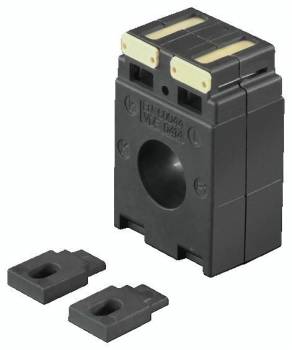
Rittal 9677810 current transformer 150/5A
| Lieske Part No. | 1128218 |
|---|---|
| Mfg Part No | 9677810 |
| EAN-Code | 4028177705234 |
| Manufacturer | Rittal |
| Here only | 35,65 EUR
42,42 EUR incl. VAT
|
Further information for Rittal 9677810 current transformer 150/5A
| General | |
| Material | Polyamide |
| For size | 00 |
| Suitable for part no. | 9677000, 9677010, 9677015, 9677025, 9677060, 9677065, 9677070, 9677075, 9677080, 9677085 |
| Rated power | 2,5 VA |
| Electrical connection type | Screw terminals |
| Insulation class | E |
| Primary current | 150 A |
| Accuracy class | 1 |
| Test basis | IEC 60 044-1, EN 60715, DIN VDE 0414, DIN 42 600-2 |
| Connection of ring conductors | 2,5 ‐ 4 mm² |
| Rated frequency | 50 ‐ 50 ‐ Hz |
Applications
The current transformer is intended for use in power distribution systems, particularly in switchgear equipped with NH fuse switch disconnectors or NH switch disconnectors. It is used in installations with a primary current of 150 A, where the secondary current is standardized at 5 A. The rated frequency is 50 Hz, making it suitable for standard mains voltages in Europe and other regions with a 50 Hz grid frequency. The application is in industrial environments where precise current measurement is required for load monitoring, energy consumption control, or protection functions.
Functions and Equipment in Detail
The current transformer SV 9677810 features an accuracy class 1, ensuring high measurement accuracy in current transmission. The rated power is 2.5 VA, which describes the maximum power the transformer can deliver to the connected measuring or protective device. The electrical connection is made via screw terminals, enabling a secure and mechanically stable connection for round conductors with a cross-section of 2.5 to 4 mm². The housing is made of polyamide, a robust plastic suitable for its electrical insulation properties and resistance to mechanical stress.
Technology Explained Simply
A current transformer converts the primary current flowing in a conductor into a smaller, measurable secondary current. In this model, a primary current of 150 A is transformed into a secondary current of 5 A. This enables connection to measuring devices such as meters or relays that cannot operate directly with high currents. The insulation class E refers to the thermal endurance of the insulating material, meaning the transformer is designed for operating temperatures up to 120 °C. The test basis includes international standards such as IEC 60 044-1, EN 60715, DIN VDE 0414, and DIN 42 600-2, which guarantee the safety and reliability of the product.
Compatibility and Accessories
The current transformer is specifically designed for size 00 and is compatible with article numbers 9677000, 9677010, 9677015, 9677025, 9677060, 9677065, 9677070, 9677075, 9677080, and 9677085. These article numbers refer to various models of NH fuse switch disconnectors and NH switch disconnectors used in the same size system. The mechanical integration into these components is achieved via a fixed center spacing of 185 mm, ensuring uniform installation in distributions.
Mounting and Installation
Mounting is done directly into the designated assembly components of size 00. The screw terminals allow for easy and secure connection of round conductors. It is important to ensure that the conductor cross-sections are within the range of 2.5 to 4 mm² to guarantee a correct and safe connection.
Advantages in Operation
The current transformer provides reliable and precise current measurement with accuracy class 1, which is important for industrial applications. The compact design enables efficient space utilization in enclosures without changing the installation depth. The use of polyamide as housing material ensures high mechanical stability and electrical insulation. Compliance with international standards such as IEC 60 044-1 and EN 60715 ensures safety and compatibility with other electrical components in the system.

This is an offer of:
79279 Vörstetten
https://industry-electronics.com
Tel. 07666/88499-0
Fax. 07666/88499-111
Diesen Artikel finden Sie unter:
industry-electronics.com/artikel/1128218

Lieske Elektronik e.K.
Reutener Str. 1079279 Vörstetten
https://industry-electronics.com
Tel. 07666/88499-0
Fax. 07666/88499-111
Diesen Artikel finden Sie unter:
industry-electronics.com/artikel/1128218