
Rittal 9345734 CB device adapter 4-pole
Industrial Material > Enclosures / Chassis > Power distribution components
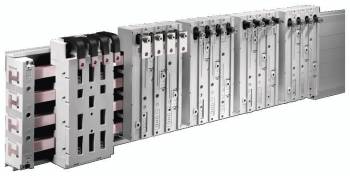
Rittal 9345734 CB device adapter 4-pole
| Lieske Part No. | 1132621 |
|---|---|
| Mfg Part No | 9345734 |
| EAN-Code | 4028177684546 |
| Manufacturer | Rittal |
| Here only | 175,38 EUR
208,70 EUR incl. VAT
|
Further information for Rittal 9345734 CB device adapter 4-pole
| General | |
| Material | Polyamide, flammability rating according to UL 94-V0 |
| Colour | RAL 7035 |
| Scope of delivery | Copper roll, connection screws |
| Rated current max. | 500 A |
| Rated operating voltage | 690 V, 4~ |
| Note | Cable exit: switch output or as outgoing cable from switching device, the specified technical data may vary for UL applications |
| Cable exit | Below |
| For rail systems with centre spacing | 60 mm |
| Number of poles | 4-pole |
| Width | 185 mm |
| Height | 300 mm |
| Suitable for busbars | Height: 5, 10 mm |
| Suitable for manufacturer (type) | Siemens |
| Copper content (kg/piece) | 2,103 |
Applications
The CB-device adapter is used in industrial enclosures where secure and reliable power distribution is required. It is particularly suitable for installations in the manufacturing industry, power supply, machine building, and other areas where high electrical loads and a stable connection between switching device and busbar are necessary. Use in busbar systems with a center spacing of 60 mm enables standardized mounting in common enclosure constructions.
Features and Equipment in Detail
The adapter is made of polyamide and meets the requirements for flammability behavior according to UL 94-V0, indicating high flame resistance and low smoke development under heat stress. The color is RAL 7035, a gray standard tone that integrates well visually in industrial environments. The copper roller included in the delivery ensures a conductive and mechanically stable connection to the busbar. Additionally, connection screws are included, enabling the adapter to be fastened to the busbar. The fit is for busbars with a height of 5 mm and 10 mm, covering a wide range of standard profiles.
Technology Explained Simply
The adapter functions as a mechanical and electrical transition between the switching device and the busbar. The copper roller ensures low contact impedance and minimizes heat losses at high currents. The 4-pole design enables connection of all phases and the neutral conductor in a four-wire system. The rated voltage of 690 V is typical for industrial applications, especially in high-power installations. Mounting is done using the provided connection screws, ensuring a secure connection to the busbar.
Compatibility and Accessories
The adapter is specifically developed for switching devices from the manufacturer Siemens, particularly for the VL400 system. It is designed for busbar systems with a center spacing of 60 mm, enabling universal use in standard enclosure construction. The fit for busbars with a height of 5 mm and 10 mm expands the range of applications.
Mounting and Installation
Mounting is done by fastening the connection screws to the busbar. The copper roller is placed between the switching device and the busbar, establishing an electrically conductive connection. Positioning is done with cable exit at the bottom, enabling wiring from below. The dimensions of 185 mm width and 300 mm height are designed for installation in standard enclosures. Mounting requires no additional tools other than a screwdriver or suitable wrench.
Advantages in Operation
Using the Rittal SV 9345734 ensures reliable and maintenance-friendly power distribution. The use of polyamide with UL 94-V0 certification increases safety under thermal stress. The copper roller ensures a stable electrical connection that remains effective even under high loads over extended periods. Standardization of dimensions and center spacing simplifies integration into existing systems. The adapter is designed for use in industrial environments where high mechanical and electrical loads occur.

This is an offer of:
79279 Vörstetten
https://industry-electronics.com
Tel. 07666/88499-0
Fax. 07666/88499-111
Diesen Artikel finden Sie unter:
industry-electronics.com/artikel/1132621

Lieske Elektronik e.K.
Reutener Str. 1079279 Vörstetten
https://industry-electronics.com
Tel. 07666/88499-0
Fax. 07666/88499-111
Diesen Artikel finden Sie unter:
industry-electronics.com/artikel/1132621