
Rittal 8660090 base panel ventilated for 600 mm
Industrial Material > Enclosures / Chassis > System Accessories
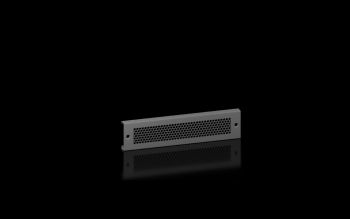
Rittal 8660090 base panel ventilated for 600 mm
| Lieske Part No. | 1062790 |
|---|---|
| Mfg Part No | 8660090 |
| EAN-Code | 4028177982949 |
| Manufacturer | Rittal |
| Here only | 73,72 EUR
87,73 EUR incl. VAT
|
Further information for Rittal 8660090 base panel ventilated for 600 mm
| General | |
| Model | ventilated |
| Material | steel sheet |
| Colour | RAL 9005 |
| Scope of delivery | Including mounting hardware |
| Height | 100 mm |
| Suitable for | Housing type: VX, VX IT, VX SE, TX CableNet, TS, TS IT, TP, PC, IW, CX, width/depth: 600 mm |
| Type rating according to UL 50E | Type 1, Type 12 |
| Weight/PU | 1,42 kg |
| PCF/VE (Cradle-to-Gate) | 17,01 |
Applications
The plinth trim panel is used in industrial environments where targeted ventilation of the enclosure plinth is required. It is especially suitable for installations where heat dissipation occurs via the lower section of the enclosure to ensure even temperature distribution. For plinth heights of 200 mm, either one or two panels can be used optionally to optimize ventilation options. The panel is designed for indoor use and complies with UL 50E type ratings, namely Type 1 and Type 12, which indicates protection against dust and splashing water, as well as protection against contact with live parts.
Functions and Equipment in Detail
The panel is made of sheet metal, ensuring high mechanical stability and durability. The RAL 9005 finish ensures a uniform visual appearance in the enclosure environment. The delivery includes mounting materials for secure attachment to the plinth. Ventilation is achieved through integrated openings that ensure continuous air circulation. The panel is packaged in units of 2 pieces, with a weight per package of 1.42 kg.
Technology Explained Simply
The ventilation function of the plinth trim panel supports cooling of electronic components in the enclosure by enabling continuous air supply through the plinth area. This is particularly important in densely populated enclosures, where heat dissipation via the upper section alone is insufficient. The ventilated panel design thus serves as a supplementary measure in the thermal management strategy of the enclosure. The choice of sheet metal provides sufficient strength to withstand mechanical loads during operation.
Compatibility and Accessories
The panel is compatible with a wide range of enclosure types, particularly models VX, VX IT, VX SE, TX CableNet, TS, TS IT, TP, PC, IW, and CX, provided they have a width and depth of 600 mm. Additional accessories are available, such as VX plinth expansion angles, mounting brackets for VX systems, optional panel mounting hardware, or VX system chassis. The optional panel mounting hardware allows side mounting to the plinth corner pieces, offering additional flexibility during installation. The cable strain relief rail with angle profile is also available as a suitable accessory to optimize cable routing in the plinth area.
Mounting and Installation
Mounting is done using the included mounting materials. The panel is attached to the enclosure plinth, with the ventilation openings oriented downward or sideways, depending on the arrangement within the enclosure. For a plinth height of 200 mm, the panel can be used singly or in pairs to adjust ventilation performance. Installation is simple and does not require special tools, as the fastening components are standardized.
Operational Advantages
Ventilation via the plinth area improves the thermal performance of the enclosure by enabling additional air supply. This reduces thermal stress on electronic components and can extend component lifespan. The use of sheet metal ensures a robust and durable construction that operates reliably even under industrial conditions. Compatibility with various enclosure types increases flexibility in planning and installing enclosure systems.

This is an offer of:
79279 Vörstetten
https://industry-electronics.com
Tel. 07666/88499-0
Fax. 07666/88499-111
Diesen Artikel finden Sie unter:
industry-electronics.com/artikel/1062790

Lieske Elektronik e.K.
Reutener Str. 1079279 Vörstetten
https://industry-electronics.com
Tel. 07666/88499-0
Fax. 07666/88499-111
Diesen Artikel finden Sie unter:
industry-electronics.com/artikel/1062790