
Rittal 7979314 PDU switched 32A 230V 16xSchuko
19 Inch-Technology > Accessories/Equipment > Energy Management
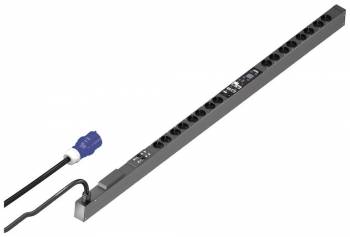
Rittal 7979314 PDU switched 32A 230V 16xSchuko
| Lieske Part No. | 110106 |
|---|---|
| Mfg Part No | 7979314 |
| EAN-Code | 4028177947894 |
| Manufacturer | Rittal |
| Here only | 1.223,49 EUR
1.455,95 EUR incl. VAT
|
Further information for Rittal 7979314 PDU switched 32A 230V 16xSchuko
| General | |
| Model | PDU, switched |
| Material | Aluminium profile, black anodised, mounting slots: plastic |
| Scope of delivery | Including mounting hardware |
| Width | 44 mm |
| Depth | 70 mm |
| Length | 1.495 mm |
| Number of sockets and type | 16 x Schuko (Type F, CEE 7/3) |
| Socket outlets | 16 x Schuko |
| Rated operating voltage | 230 V (AC) |
| Rated current (max.) | 32 A |
| Nominal power | 7,4 kW |
| Power supplies | Phases per input: 1~ |
| Connection cable length | 3 m |
| Electrical connection type | CEE |
| Interfaces | USB 2.0 port (USB-A) for mass configuration, firmware update & data logging, CAN-Bus interface (RJ45) for max. 16 environment sensors, serial interface RS232 (RJ12) for LTE unit, scripting, CLI, use of own certificates/TLS 1.2, email sending on alarm (SMTP), user management including rights management, LDAP(S)/Radius/Active Directory integration, Syslog server integration (max. 2 servers), fully redundant Ethernet interface 10/100/1000 Mbit/s |
| Number of RJ45 ports for sensor units max | 2 |
| Policies | EMC Directive 2014/30/EU, Low Voltage Directive 2014/35/EU |
| Standards | EN 62368-1, EN 61000-3, EN 61000-4, EN 61000-6, EN 62053-21 |
| Protocols | Web server (HTTP, HTTPS, SSL) SSH, Telnet, NTP, TCP/IP v4 & v6, DHCP, DNS, SNMP v1, v2c & v3, Modbus/TCP, OPC-UA, MIB for integration into 3rd party DCIM software, FTP/SFTP (update/file transfer) |
| Operating temperature range | 5 °C...50 °C |
| Humidity (non-condensing) | 10...95 % |
| Storage temperature range | -20 °C...70 °C |
| Suitable for | Housing type: VX IT cabinet frame: ≥ 1,800 mm, housing type: VX IT 19"-profile rails: ≥ 1,800 mm |
Applications
The PDU is designed for use in professional IT infrastructures, particularly in server and network racks, where precise power distribution and monitoring are required. It is suitable for racks with a minimum length of 1,800 mm, both with VX IT-enclosure frames and 48,3 cm ( 19 inch ) profile rails. The integrated energy measurement enables accurate recording of voltage, current, frequency, active power, active energy, apparent power, apparent energy, power factor (cosPhi), and phase angle. Additionally, neutral conductor current is measured to detect unbalanced loads. Measurement accuracy is ±1 % (kWh) according to the standard EN 62053-21.
Functions and Equipment in Detail
The PDU features a fully redundant Ethernet interface (10/100/1000 Mbit/s) for communication with network and monitoring systems. The integrated real-time clock is backed up by a replaceable battery (maximum 10-year lifespan) to retain time and status information even during power failure. Switching is performed via bistable relays, which offer low power consumption and high switching capacity, even with inrush currents up to 300 A. Outputs can be switched individually or in groups, with programmable switching behavior (e.g., time control, logical conditions). Upon power restoration, the startup behavior (on, off, last status) can be programmed to avoid overloads. An integrated electromagnetic buzzer provides acoustic alarm signaling for warnings or alarm conditions.
Technology Explained Simply
The PDU is self-powered, meaning it requires no external power supply for its control and monitoring functions. Power supply is redundant across all phases, ensuring fault-tolerant operation. Control is managed by a powerful CPU (ARM Cortex A8), which handles measurement and control functions. The display (128x128 pixels, RGB, TFT) is rotatable (180°) and replaceable within the housing, allowing correct orientation depending on mounting position. Display is via a bright TFT screen with backlight and energy-saving mode. Multicolored LEDs (green, yellow, red) indicate switching status and warning or alarm thresholds per phase. A power LED indicates voltage presence. The PDU includes a digital input (potential-free contact) and an additional alarm output (changeover contact).
Compatibility and Accessories
The PDU can be connected to CMC III CAN-Bus sensors to monitor environmental parameters such as temperature, humidity, or smoke. Up to 16 sensors can be connected. The interface is via an RJ45 connection. Additionally, a serial interface RS232 (RJ12) is available, which can be used for connecting an LTE module, scripting, CLI, using custom certificates (TLS 1.2), or sending emails on alarm (SMTP). The PDU supports protocols such as Web server (HTTP/HTTPS/SSL), SSH, Telnet, NTP, TCP/IP v4 & v6, DHCP, DNS, SNMP v1, v2c & v3, Modbus/TCP, OPC-UA, and MIB for integration into DCIM software. A USB 2.0 port (USB-A) is provided for mass configuration, firmware updates, and data logging. User management includes rights management as well as integration with LDAP(S), Radius, or Active Directory. Connection to Syslog servers (up to 2 servers) is also possible.
Mounting and Installation
Mounting is tool-free in the Zero-U-Space of Rittal VX IT- or TS IT-racks. The device is supplied with mounting hardware for installation on the designated enclosure frame or profile rails. Color coding of phases (L1=pink, L2=black, L3=white) facilitates assignment and installation. The PDU is designed for operating temperatures from 5 °C to 50 °C and humidity from 10 % to 95 % (non-condensing). Storage temperature ranges from -20 °C to 70 °C.
Operational Advantages
The PDU offers high operational reliability through redundant power supply and integrated fault detection. Phase-specific energy measurement enables precise load distribution and monitoring. Individual control of outputs allows flexible use, e.g., sequential switching on after power restoration to avoid network load peaks. The integrated network interface and support for multiple protocols enable easy integration into existing IT and monitoring systems. Battery-backed real-time clock ensures that operating hour counters (total and cyclic, resettable) and configurations are retained even during power failure. The PDU is compliant with IT infrastructure guidelines EMC Directive 2014/30/EU and Low Voltage Directive 2014/35/EU, as well as standards EN 62368-1, EN 61000-3, EN 61000-4, EN 61000-6, EN 62053-21. Batteries are not included in the delivery scope.

This is an offer of:
79279 Vörstetten
https://industry-electronics.com
Tel. 07666/88499-0
Fax. 07666/88499-111
Diesen Artikel finden Sie unter:
industry-electronics.com/artikel/110106

Lieske Elektronik e.K.
Reutener Str. 1079279 Vörstetten
https://industry-electronics.com
Tel. 07666/88499-0
Fax. 07666/88499-111
Diesen Artikel finden Sie unter:
industry-electronics.com/artikel/110106