
Rittal 7979236 PDU Metered 16A/3P CEE 24xC13 6xC19
19 Inch-Technology > Accessories/Equipment > Energy Management
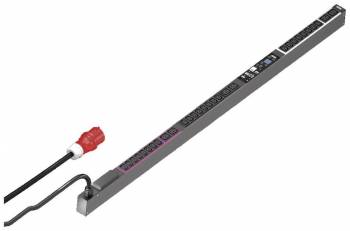
Rittal 7979236 PDU Metered 16A/3P CEE 24xC13 6xC19
| Lieske Part No. | 1056063 |
|---|---|
| Mfg Part No | 7979236 |
| EAN-Code | 4028177947764 |
| Manufacturer | Rittal |
| Here only | 745,78 EUR
887,48 EUR incl. VAT
|
Further information for Rittal 7979236 PDU Metered 16A/3P CEE 24xC13 6xC19
| General | |
| Model | PDU, metered |
| Material | Aluminium profile, black anodised, mounting slots: plastic |
| Scope of delivery | Including mounting hardware |
| Options | Overvoltage protection Type 3 with replaceable diverters during operation, with status monitoring, integrable in PDU housing, differential current measurement (Type B) per input/phase/fuse, monitoring of optional overvoltage protection, CMC III CAN-Bus sensors for environment monitoring connectable, max. 16 sensors, other housing colours available |
| Description of measurement functions | measurement per phase or input, powerful CPU (ARM Cortex A8), digital input (potential-free contact), additional alarm output/relay output (changeover contact) |
| Width | 44 mm |
| Depth | 70 mm |
| Length | 1.495 mm |
| Number of sockets and type | 24 x C13 / 6 x C19 |
| Rated operating voltage | 400 V (AC) |
| Rated current (max.) | 16 A |
| Nominal power | 11 kW |
| Power supplies | Number: 1, phases per input: 3~ |
| Connection cable length | 3 m |
| Electrical connection type | CEE |
| Interfaces | USB 2.0 port (USB-A) for mass configuration, firmware update & data logging, CAN-Bus interface (RJ45) for max. 16 environment sensors, serial interface RS232 (RJ12) for LTE unit, scripting, CLI, use of own certificates/TLS 1.2, email sending on alarm (SMTP), user management including rights management, LDAP(S)/Radius/Active Directory integration, Syslog server integration (max. 2 servers), fully redundant Ethernet interface 10/100/1000 Mbit/s |
| Policies | EMC Directive 2014/30/EU, Low Voltage Directive 2014/35/EU |
| Standards | EN 62368-1, EN 61000-3, EN 61000-4, EN 61000-6, EN 62053-21 |
| Protocols | Web server (HTTP, HTTPS, SSL) SSH, Telnet, NTP, TCP/IP v4 & v6, DHCP, DNS, SNMP v1, v2c & v3, Modbus/TCP, OPC-UA, MIB for integration into 3rd party DCIM software, FTP/SFTP (update/file transfer) |
| Operating temperature range | 5 °C...50 °C |
| Humidity (non-condensing) | 10...95 % |
| Storage temperature range | -20 °C...70 °C |
| Suitable for | Housing type: VX IT cabinet frame: ≥ 1,800 mm, housing type: VX IT 19"-profile rails: ≥ 1,800 mm |
Applications
The PDU is intended for use in VX IT enclosure frames and VX IT 48,3 cm ( 19 inch ) profile rails with a minimum length of 1,800 mm. When mounted vertically, it can be installed tool-free in Zero-U-Space, minimizing rack space requirements. The color-coded phase marking (L1=pink, L2=black, L3=white) simplifies assignment and maintenance. An integrated real-time clock with battery backup (up to 10 years, replaceable) ensures accurate timestamping of measurements and events. The measurement accuracy is ±1 % (kWh) according to standard EN 62053-21, ensuring reliable energy accounting.
Functions and Equipment in Detail
The PDU features a bright TFT display (128x128 pixels, RGB) with backlight and energy-saving mode, showing performance data and basic configuration. The display is rotatable by 180° and replaceable, enabling operation regardless of mounting position. The measurement functions include voltage, current, frequency, active power, active energy, apparent power, apparent energy, power factor (cosPhi), phase angle, and neutral conductor current measurement for unbalanced load detection. For PDUs with integrated fuses, fuse monitoring is provided. An integrated electromagnetic buzzer enables acoustic alarm signaling. The operating hour counters are resettable both globally and cyclically, and adjustable thresholds for voltage, current, and power can be configured for warnings and alarm signals.
Technology Explained Simply
The PDU is driven by a powerful CPU (ARM Cortex A8) that processes measurement data and controls communication via interfaces. The power supply is self-contained — no external power supply is required. The connection cable has a length of 3 m and is equipped with a CEE plug. The interfaces include a USB 2.0 port (USB-A) for mass configuration, firmware updates, and data logging, a CAN-Bus interface (RJ45) for connecting up to 16 environmental sensors (CMC III), a serial RS232 interface (RJ12) for LTE unit, scripting, and CLI, and a fully redundant Ethernet interface (10/100/1000 Mbit/s). The protocols include Web server (HTTP, HTTPS, SSL), SSH, Telnet, NTP, TCP/IP v4 & v6, DHCP, DNS, SNMP v1, v2c & v3, Modbus/TCP, OPC-UA, MIB for integration into DCIM software, and FTP/SFTP for file transfers. User management includes rights management, integration with LDAP(S), Radius, or Active Directory, and connection to Syslog servers (up to 2 servers). In case of alarms, an SMTP email can be sent.
Compatibility and Accessories
The PDU is compatible with CMC III CAN-Bus sensors, which can be used for environmental monitoring (e.g., temperature, humidity). The number of connectable sensors is limited to a maximum of 16. Optionally, a Type 3 surge protection device can be integrated, featuring replaceable discharge devices during operation and status monitoring. Differential current measurement (Type B) is possible per input, phase, and fuse. Monitoring of the optional surge protection device is also integrated. Additional options include connecting a CMC III Online Comfort Handle VX with Master-Key function or a combination lock for CMC III. For installation, PDU mounting adapters TE 8000 and PDU universal locking for C14/C20 plugs are available. Covers for C13 and C19 sockets are also available.
Installation and Mounting
Mounting is tool-free in the VX IT enclosure frame or on the 48,3 cm ( 19 inch ) profile rails, with a minimum length of 1,800 mm required. The delivery includes fastening material needed for installation. The PDU is designed for indoor use, with an operating temperature range of 5 °C to 50 °C and non-condensing humidity of 10 % to 95 %. The storage temperature ranges from -20 °C to 70 °C.
Operational Advantages
The energy-saving design ensures low self-consumption. The fully redundant power supply increases reliability, as the PDU can continue operating even if one phase fails. The integrated network interface enables remote monitoring and control via various protocols. Energy accounting per phase supports efficiency improvements and cost control in data centers. Integration with DCIM software via MIB allows inclusion in existing infrastructure management systems. Adjustable alarm thresholds and acoustic alarm signaling enhance responsiveness to critical conditions. The battery-backed real-time clock ensures continuous timestamping even during power failure.
Standards and Regulations
The PDU complies with the EMC Directive 2014/30/EU and Low Voltage Directive 2014/35/EU. The standards include EN 62368-1, EN 61000-3, EN 61000-4, EN 61000-6, and EN 62053-21. The measurement accuracy according to EN 62053-21 ensures reliability in energy measurement. The protocols and interfaces enable flexible integration into existing IT infrastructures.
Delivery Contents
The delivery includes the PDU and fastening material for mounting in the VX IT enclosure frame or on the 48,3 cm ( 19 inch ) profile rails.
Operating Environment
The PDU is designed for indoor use. The operating temperature is between 5 °C and 50 °C, and the non-condensing humidity is between 10 % and 95 %. The storage temperature is from -20 °C to 70 °C. The PDU is not designed for outdoor use or humid environments, as no IP protection rating is specified.
Interfaces and Protocols
The PDU features a fully redundant Ethernet interface (10/100/1000 Mbit/s), a USB 2.0 port (USB-A), a CAN-Bus interface (RJ45), and a serial RS232 interface (RJ12). The supported protocols include Web server (HTTP, HTTPS, SSL), SSH, Telnet, NTP, TCP/IP v4 & v6, DHCP, DNS, SNMP v1, v2c & v3, Modbus/TCP, OPC-UA, MIB, and FTP/SFTP. User management supports LDAP(S), Radius, Active Directory, and Syslog server connection. The email sending function (SMTP) enables alarm notification for critical events.
Energy Efficiency and Reliability
The energy-saving design ensures low self-consumption. The fully redundant power supply increases reliability, as the PDU can continue operating even if one phase fails. The integrated real-time clock with battery backup (up to 10 years, replaceable) ensures accurate timestamping of measurements. The measurement accuracy of ±1 % (kWh) according to EN 62053-21 ensures reliability in energy measurement. The operating hour counters are resettable both globally and cyclically, facilitating maintenance and analysis.
The PDU is designed for use in IT network and server racks, with tool-free mounting in Zero-U-Space. Integration with DCIM software via MIB enables inclusion in existing infrastructure management systems. The connection cable has a length of 3 m and is equipped with a CEE plug. The interfaces include a USB 2.0 port (USB-A) for mass configuration, firmware updates, and data logging, a CAN-Bus interface (RJ45) for connecting up to 16 environmental sensors (CMC III), a serial RS232 interface (RJ12) for LTE unit, scripting, and CLI, and a fully redundant Ethernet interface (10/100/1000 Mbit/s). The protocols include Web server (HTTP, HTTPS, SSL), SSH, Telnet, NTP, TCP/IP v4 & v6, DHCP, DNS, SNMP v1, v2c & v3, Modbus/TCP, OPC-UA, MIB for integration into DCIM software, and FTP/SFTP for file transfers. User management includes rights management, integration with LDAP(S), Radius, or Active Directory, and connection to Syslog servers (up to 2 servers). In case of alarms, an SMTP email can be sent.
Compatibility and Accessories
The PDU is compatible with CMC III CAN-Bus sensors, which can be used for environmental monitoring (e.g., temperature, humidity). The number of connectable sensors is limited to a maximum of 16. Optionally, a Type 3 surge protection device can be integrated, featuring replaceable discharge devices during operation and status monitoring. Differential current measurement (Type B) is possible per input, phase, and fuse. Monitoring of the optional surge protection device is also integrated. Additional options include connecting a CMC III Online Comfort Handle VX with Master-Key function or a combination lock for CMC III. For installation, PDU mounting adapters TE 8000 and PDU universal locking for C14/C20 plugs are available. Covers for C13 and C19 sockets are also available.
Installation and Mounting
Mounting is tool-free in the VX IT enclosure frame or on the 48,3 cm ( 19 inch ) profile rails, with a minimum length of 1,800 mm required. The delivery includes fastening material needed for installation. The PDU is designed for indoor use, with an operating temperature range of 5 °C to 50 °C and non-condensing humidity of 10 % to 95 %. The storage temperature ranges from -20 °C to 70 °C.
Operational Advantages
The energy-saving design ensures low self-consumption. The fully redundant power supply increases reliability, as the PDU can continue operating even if one phase fails. The integrated network interface enables remote monitoring and control via various protocols. Energy accounting per phase supports efficiency improvements and cost control in data centers. Integration with DCIM software via MIB enables inclusion in existing infrastructure management systems. Adjustable alarm thresholds and acoustic alarm signaling enhance responsiveness to critical conditions. The battery-backed real-time clock ensures continuous timestamping even during power failure.
Standards and Regulations
The PDU complies with the EMC Directive 2014/30/EU and Low Voltage Directive 2014/35/EU. The standards include EN 62368-1, EN 61000-3, EN 61000-4, EN 61000-6, and EN 62053-21. The measurement accuracy according to EN 62053-21 ensures reliability in energy measurement. The protocols and interfaces enable flexible integration into existing IT infrastructures.
Delivery Contents
The delivery includes the PDU and fastening material for mounting in the VX IT enclosure frame or on the 48,3 cm ( 19 inch ) profile rails.
Operating Environment
The PDU is designed for indoor use. The operating temperature is between 5 °C and 50 °C, and the non-condensing humidity is between 10 % and 95 %. The storage temperature is from -20 °C to 70 °C. The PDU is not designed for outdoor use or humid environments, as no IP protection rating is specified.
Interfaces and Protocols
The PDU features a fully redundant Ethernet interface (10/100/1000 Mbit/s), a USB 2.0 port (USB-A), a CAN-Bus interface (RJ45), and a serial RS232 interface (RJ12). The supported protocols include Web server (HTTP, HTTPS, SSL), SSH, Telnet, NTP, TCP/IP v4 & v6, DHCP, DNS, SNMP v1, v2c & v3, Modbus/TCP, OPC-UA, MIB, and FTP/SFTP. User management supports LDAP(S), Radius, Active Directory, and Syslog server connection. The email sending function (SMTP) enables alarm notification for critical events.
Energy Efficiency and Reliability
The energy-saving design ensures low self-consumption. The fully redundant power supply increases reliability, as the PDU can continue operating even if one phase fails. The integrated real-time clock with battery backup (up to 10 years, replaceable) ensures accurate timestamping of measurements. The measurement accuracy of ±1 % (kWh) according to EN 62053-21 ensures reliability in energy measurement. The operating hour counters are resettable both globally and cyclically, facilitating maintenance and analysis.

This is an offer of:
79279 Vörstetten
https://industry-electronics.com
Tel. 07666/88499-0
Fax. 07666/88499-111
Diesen Artikel finden Sie unter:
industry-electronics.com/artikel/1056063

Lieske Elektronik e.K.
Reutener Str. 1079279 Vörstetten
https://industry-electronics.com
Tel. 07666/88499-0
Fax. 07666/88499-111
Diesen Artikel finden Sie unter:
industry-electronics.com/artikel/1056063