
Rittal 3590005 busbar E-Cu 80x10 mm 2400 mm
Industrial Material > Enclosures / Chassis > Power distribution components
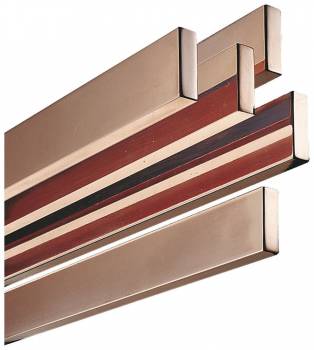
Rittal 3590005 busbar E-Cu 80x10 mm 2400 mm
| Lieske Part No. | 547187 |
|---|---|
| Mfg Part No | 3590005 |
| EAN-Code | 4028177684614 |
| Manufacturer | Rittal |
| Here only | 400,40 EUR
476,48 EUR incl. VAT
|
Further information for Rittal 3590005 busbar E-Cu 80x10 mm 2400 mm
| General | |
| Material | E-Cu F30 |
| Standards | DIN EN 13 601 |
| Cross section | 80 mm x 10 mm |
| Length | 2.400 mm |
| Copper content (kg/piece) | 17,2 |
Applications
The busbar is used in industrial electrical engineering, particularly in enclosures, distribution boxes, and power distribution systems. It serves as a main conductor for distributing electrical power and enables safe and efficient power supply to various consumers or switching devices. Due to its dimensions and material quality, it is especially suitable for applications with high current loads, such as in manufacturing industry, power supply, or large-scale plants.
Functions and Equipment in Detail
The busbar is made of E-Cu F30, a copper material with high electrical conductivity and mechanical strength. The dimensions of 80 mm width and 10 mm thickness ensure sufficient cross-sectional area for transmitting large amounts of current. The length of 2.400 mm allows flexible adaptation to various enclosure sizes. The individual cuttability enables precise fitting to the specific installation, optimizing material usage and installation effort. The busbar is designed for use in enclosures, where it functions as a main conductor.
Technology Explained Simply
The designation E-Cu F30 refers to electrolytic copper with a minimum purity of 99.9 %, known for its high electrical conductivity and mechanical stability. The standard DIN EN 13 601 sets requirements for the construction and testing of electrical conductors in enclosures to ensure safety and reliability. The cross-sectional area of 80 mm x 10 mm corresponds to a total cross-section of 800 mm², enabling high current load capacity. The length of 2.400 mm is standardly available but can be shortened as needed without affecting electrical properties.
Compatibility and Accessories
The busbar is compatible with suitable M12 set nuts, used for securely fastening wires or switching devices to the busbar. Additionally, busbar connectors for E-Cu 40/60/80/100x10 mm, W=40 can be used to connect multiple busbars or create longer conductors. These accessories enable flexible and secure installation in complex enclosure systems.
Installation and Mounting
Mounting is typically done in enclosures or distribution boxes, where the busbar is secured at designated positions using appropriate fastening elements such as set nuts or busbar connectors. The individual cuttability allows precise adaptation to the specific enclosure geometry. During installation, attention should be paid to a clean surface and correct fastening to ensure optimal electrical conductivity and mechanical stability.
Operational Advantages
The use of E-Cu F30 ensures high electrical conductivity and minimizes heat losses. Compliance with DIN EN 13 601 ensures reliability and safety in operation. Individual cuttability reduces material waste and installation effort. The busbar is designed for industrial environments and offers long service life with proper installation and maintenance.

This is an offer of:
79279 Vörstetten
https://industry-electronics.com
Tel. 07666/88499-0
Fax. 07666/88499-111
Diesen Artikel finden Sie unter:
industry-electronics.com/artikel/547187

Lieske Elektronik e.K.
Reutener Str. 1079279 Vörstetten
https://industry-electronics.com
Tel. 07666/88499-0
Fax. 07666/88499-111
Diesen Artikel finden Sie unter:
industry-electronics.com/artikel/547187