
Rittal 3575005 laminated copper busbar 5x40 mm L=200
Industrial Material > Enclosures / Chassis > Power distribution components
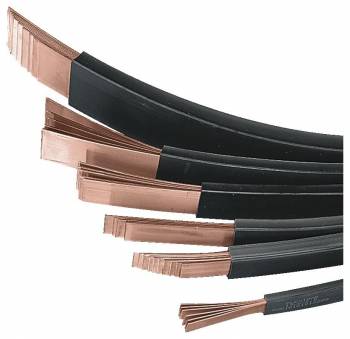
Rittal 3575005 laminated copper busbar 5x40 mm L=200
| Lieske Part No. | 1013784 |
|---|---|
| Mfg Part No | 3575005 |
| EAN-Code | 4028177666818 |
| Manufacturer | Rittal |
| Here only | 127,89 EUR
152,19 EUR incl. VAT
|
Further information for Rittal 3575005 laminated copper busbar 5x40 mm L=200
| General | |
| Material | Cu-contacts: high-purity electrolytic copper F20, insulation: high-resistance vinyl compound, elongation 370 %, temperature: -30 °C...+105 °C, flammability according to UL-94 V0, dielectric strength: 20 kV/mm |
| Length | 2.000 mm |
| Rated current for temperature rise 50 K | 780 A |
| Rated current for temperature rise 30 K | 590 A |
| Rated current for temperature rise 70 K | 930 A |
| Note | Construction = number of fins x fin width x fin thickness, individually cuttable, the resulting conductor temperature of the finned flat copper busbar is the sum of ambient temperature and temperature rise. Example: 3565.005 loaded with 180 A, i.e. the temperature rises by 30 K. At an ambient temperature of 35 °C, the resulting conductor temperature is therefore 35 °C + 30 K = 65 °C. |
| Laminated flat copper execution | Number of fins: 5, fin width: 40 mm, fin thickness: 1 mm |
| Copper content (kg/piece) | 3,58 |
Applications
The laminated copper busbar is suitable for use in industrial enclosures where high current load capacity and thermal stability are required. It is commonly used as a main conductor or distribution conductor in power supply systems, machine controls, and distribution systems. The individual cut-to-length capability allows flexible adaptation to different enclosure sizes and arrangements. The busbar is designed for indoor installations, with its temperature resistance and flame-retardant insulation ensuring continued electrical functionality even under increased thermal stress.
Functions and Equipment in Detail
The busbar offers high electrical conductivity due to the use of high-purity electrolytic copper F20. The laminated structure with five lamellae increases the surface area and improves heat dissipation, resulting in lower temperature rise under load. The vinyl compound insulation ensures high mechanical strength and chemical resistance. The busbar is designed for a maximum operating temperature of +105 °C, with the insulation remaining functional at low temperatures down to -30 °C. The dielectric strength of 20 kV/mm ensures high electrical insulation and prevents breakdown under voltage.
Technology Explained Simply
The rated currents of the busbar depend on the permissible temperature rise. At a temperature rise of 50 K, the rated current is 780 A; at 30 K, it is 590 A; and at 70 K, it is 930 A. These values account for the thermal load on the busbar during operation. The resulting conductor temperature is the sum of the ambient temperature and the temperature rise. For example, a load of 180 A results in a temperature rise of 30 K; at an ambient temperature of 35 °C, the conductor temperature thus reaches 65 °C. The busbar is therefore dimensioned for various operating conditions, with the maximum temperature rise limiting the current load capacity.
Compatibility and Accessories
The busbar is compatible with universal holders for laminated copper busbars, particularly those designed for 20x5 mm and 40x5 mm dimensions. These holders enable secure mounting in enclosures and ensure stable fixation of the busbar. The use of appropriate holders is necessary to ensure mechanical stability and secure electrical connection. The busbar itself is not supplied with holders or other mounting accessories and serves as a pure conductor component.
Installation and Mounting
Installation is performed by securing the busbar to suitable holders installed in the enclosure. The busbar is individually cut to length, allowing it to be trimmed to the desired size. Cutting should be done mechanically, ensuring that edges are smooth and clean to avoid damaging the insulation. Electrical connections are made via terminals or screw connections matched to the cross-sectional dimensions of the busbar. Installation must comply with applicable electrical standards and safety regulations.
Operational Advantages
The laminated structure of the busbar improves heat dissipation, contributing to longer service life and higher reliability. The high electrical conductivity of copper F20 ensures efficient current transmission with minimal losses. The flame-retardant insulation meeting UL-94 V0 standards enhances operational safety, especially in environments with increased fire risk. Individual cut-to-length capability provides flexibility in planning and installation, reducing material waste and simplifying adaptation to specific requirements. The busbar is designed for high mechanical load capacity, making it suitable for industrial environments.
Copper Content and Material
The copper content per piece is 3.58 kg, highlighting the high material quality and conductivity of the busbar. The electrolytic copper F20 used is known for its purity and electrical properties. The vinyl insulation is designed for long service life and high resistance to mechanical and chemical influences. The busbar is thus a robust and reliable component for use in industrial power distribution systems.

This is an offer of:
79279 Vörstetten
https://industry-electronics.com
Tel. 07666/88499-0
Fax. 07666/88499-111
Diesen Artikel finden Sie unter:
industry-electronics.com/artikel/1013784

Lieske Elektronik e.K.
Reutener Str. 1079279 Vörstetten
https://industry-electronics.com
Tel. 07666/88499-0
Fax. 07666/88499-111
Diesen Artikel finden Sie unter:
industry-electronics.com/artikel/1013784